 Blaine
 Why Color Choice Is a Bigger Decision Than It Looks
Picking a siding color feels like the fun part of a project, but on a home near the water in Blaine, that choice has to survive more than a homeowner three states inland ever has to think about. Salt air off Semiahmoo Bay and the Strait of Georgia works on paint film differently than dry inland air does. Driving rain off the water finds every gap in a coating. And the long gray, damp stretch that Whatcom County gets for months at a time gives algae and moss a real head start on north-facing walls and anything shaded by fir and cedar. A color that looks great on a sample chip can chalk, fade unevenly, or show lap marks within a few years if it's not backed by a finish built for this climate.
This is the core reason we standardized on James Hardie fiber cement with its factory-applied ColorPlus finish rather than offering a menu of siding materials with field-painted color as an afterthought. The color system is part of the product, not something bolted on after installation, and that matters more here than in most parts of the country.
How ColorPlus Technology Actually Works
ColorPlus is not paint sprayed on a job site. It's a multi-coat finish baked onto the fiber cement board at the factory, cured under controlled heat before the boards ever leave the plant. Each board gets a primer coat and multiple color coats, applied and cured in a process designed to bond the finish to the substrate rather than just sit on top of it. That's a meaningfully different process than a painter rolling a single field coat onto siding in variable outdoor temperature and humidity, which is exactly the situation you get with primed fiber cement, LP SmartSide, or bare wood siding that has to be painted after installation.
What This Means in Practice
Because the finish is cured at the factory, color consistency from board to board is tighter than what you typically get from field painting, where temperature, humidity, and even the crew's technique on a given day can create subtle sheen or tone differences panel to panel. On a home with long runs of siding facing the water, that consistency is more noticeable than people expect.
The James Hardie Color Palette
James Hardie's ColorPlus palette runs from deep, saturated tones to soft neutrals, and it's organized so that trim, soffit, and accent colors are designed to work together rather than requiring a homeowner to guess at coordination. Common ColorPlus colors include shades like Arctic White, Cobblestone, Iron Gray, Aged Pewter, Timber Bark, Navajo Beige, Mountain Sage, Boothbay Blue, Evening Blue, Khaki Brown, Countrylane Red, and Rich Espresso, alongside lighter neutrals like Pearl Gray and Light Mist for trim.
Reading Color Under Pacific Northwest Light
Color selection under the flat, diffuse light common to this part of Washington behaves differently than it does under strong direct sun. Colors that look punchy on a sample under a bright showroom light or a sunny afternoon can read flatter and grayer under the overcast conditions that dominate a Whatcom County winter. We always recommend viewing a full-size sample board outdoors, on the actual house, at different times of day, before committing — not just holding up a paint chip.
Dark Colors and Heat
Deep colors like Iron Gray or Rich Espresso are popular right now, and Hardie's fiber cement substrate handles heat absorption better than vinyl siding does — vinyl can visibly warp in dark colors under direct sun, which is one of the real limitations of that material. Fiber cement doesn't have that failure mode, so dark colors are genuinely on the table here in a way they aren't with some other siding materials.
Matching Color to a Blaine-Area Home
A few things come up repeatedly when we're helping homeowners in this area choose a color scheme.
Working With the Landscape
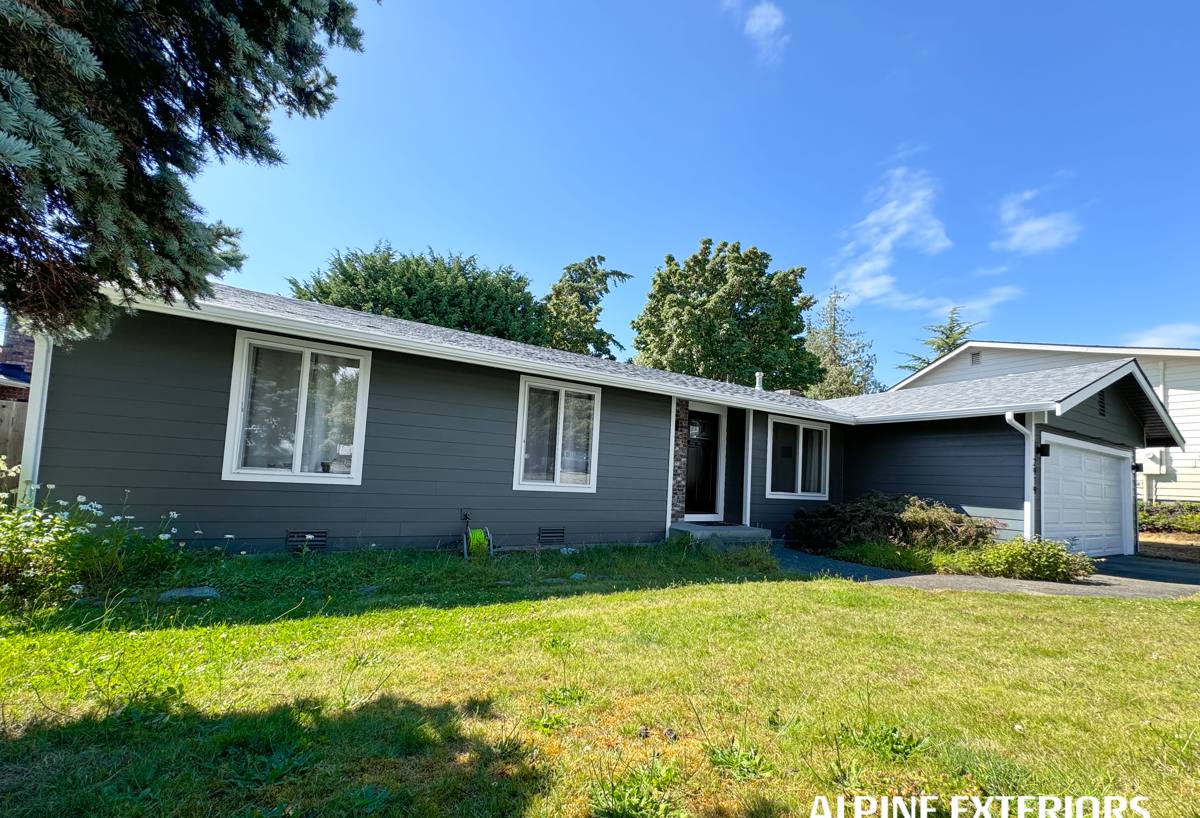
Homes tucked into fir and cedar tree cover tend to look best in colors that don't fight the surrounding green — muted sage, warm grays, and soft neutrals hold up visually and also tend to show less contrast against algae or moss growth on shaded elevations than very light whites do.
Water-Facing and Exposed Elevations
Homes with unobstructed exposure toward the water take the most direct salt-laden wind and rain. On these elevations, color choice matters less for durability than the finish quality does, but darker colors can make chalking or fading more visually obvious over time than a mid-tone would, simply because any change in the finish shows up more against a saturated color.
HOA and Neighborhood Considerations
Some newer developments in and around Blaine have design guidelines around exterior color. We always recommend confirming any HOA color restrictions before finalizing a selection — it's a five-minute check that avoids a costly mistake.
The HZ5 Product Line: Built for This Climate
James Hardie engineers its fiber cement formulation by climate zone, and the HZ5 line is formulated for regions with cold, wet weather cycles — which describes Whatcom County's winters well. The HZ5 formulation is engineered for moisture and freeze-thaw resistance in a way that a one-size-fits-all siding product isn't. This isn't a marketing detail — it's the reason the product performs the way it does over the long term in a climate with a genuine wet season rather than occasional rain.
ColorPlus Finish vs. Field-Applied Paint
The practical differences between a factory-cured finish and a field-painted finish show up most clearly when you compare them side by side.
| Factor | ColorPlus Factory Finish | Field-Applied Paint |
|---|---|---|
| Application environment | Controlled factory conditions, cured with heat | Outdoor job site, weather-dependent |
| Color/sheen consistency | Uniform board to board | Can vary with crew, temperature, humidity |
| Touch-up needs at install | Minimal — factory finish arrives complete | Full field coat required after installation |
| Typical repaint interval | Long-interval touch-up only; not a full repaint cycle | Repaint typically needed within 5-10 years |
| Warranty on the finish | Separate factory finish warranty backing the color | Warranty tied to paint product and applicator, not the siding |
None of this means field-painted siding is a bad product across the board — it means the maintenance rhythm is fundamentally different, and that's something a homeowner should decide with eyes open rather than discover five years in.
Trim, Accent, and Whole-House Strategy
Most of the homes we work on use one of three basic strategies: a single body color with a contrasting trim, a two-tone approach with a different color on gables or accent walls, and a monochrome scheme where trim is a slightly lighter or darker shade of the body color. Whatever the approach, we recommend limiting a home to two or three colors total including trim — more than that tends to look busy rather than intentional, especially on smaller lots common in Blaine's older neighborhoods.
Keeping ColorPlus Siding Looking Right Over Time
ColorPlus is low-maintenance, not no-maintenance. A little routine care goes a long way in a climate that grows moss on anything that stays damp and shaded.
- Rinse siding with a garden hose and soft-bristle brush once or twice a year, more often on shaded, north-facing walls
- Avoid pressure washing directly at the siding at close range — it can drive water behind laps and joints
- Trim back vegetation and tree limbs that keep siding shaded and damp, which is what gives moss and algae the conditions to take hold
- Check and maintain caulking at trim joints and penetrations annually — the finish protects the board, but sealed joints protect the substrate underneath
- Address any chip or scrape down to bare board promptly with a Hardie-approved touch-up product to prevent moisture intrusion at that spot
Why This Is the Only Siding We Install
We don't offer LP SmartSide, vinyl, Cemplank, Allura, or unfinished wood siding as options, and color is a real part of why. A factory-cured finish backed by its own warranty, on a fiber cement substrate engineered for a cold, wet climate zone, gives a homeowner in this part of Whatcom County a siding system where the color is engineered to last rather than something added on afterward and left to weather on its own. We'd rather install one product correctly and stand behind it than offer a wider menu and split our expertise across materials we don't think perform as well here.
If you're weighing colors for a new install or a full re-side in Blaine, we're happy to bring out sample boards and walk your property with you. Reach out for a free, no-pressure estimate — there's a form right below.