 Blaine
 Lynden sits in the Nooksack Valley, a few minutes from the Canadian border and not far from the open water of the Salish Sea. It's a working agricultural community with a strong sense of place, and the homes here take a steady beating from a climate that never really lets up. Salt-tinged air moving in off Puget Sound during storm systems, driving winter rain, and a moss season that can stretch for most of the year all work against exterior siding, trim, and roofing. We're a Blaine-based crew that works throughout Whatcom County, and Lynden is a community we know well because we're out here regularly.
This page is about siding specifically, but we want to be upfront about something: we only install James Hardie fiber cement siding. We don't install vinyl, LP SmartSide, Cemplank, Allura, primed spruce, or cedar. That's not a marketing line — it's a standard we set because of what we've seen these products do, and not do, on homes in this exact climate. Below we'll walk through why, what Hardie actually involves, and how we approach siding alongside the roofing, window, and deck work we also handle.
What Lynden's Climate Actually Does to Siding
Whatcom County's marine climate is mild compared to a lot of the country, but "mild" is misleading when it comes to exterior materials. The combination that matters here is persistent moisture plus organic growth plus salt exposure, and it hits siding in a few specific ways.
Driving Rain and Wind-Driven Moisture
Pacific storm systems don't just drop rain straight down — they push it sideways into wall assemblies, especially on west- and south-facing elevations. Over years, that wind-driven rain finds every weak seam, unsealed joint, and poorly flashed penetration. Materials that swell, wick moisture, or delaminate when wet are working against the climate instead of with it.
A Long Moss and Algae Season
Shaded walls, tree cover, and consistent humidity give moss and algae a long runway to establish themselves on siding surfaces — often longer than in drier parts of the state. Porous or textured materials give moss more to grip onto, and once it's established it holds moisture against the wall surface, which accelerates whatever damage is already happening underneath.
Salt Air and Corrosion
Being close to Puget Sound and the Strait of Georgia means salt-laden air reaches inland communities like Lynden during storm winds, not just waterfront properties. Salt exposure accelerates corrosion on fasteners, flashing, and any metal components in the wall assembly, and it degrades certain finishes faster than manufacturers' standard testing accounts for.
Freeze-Thaw Cycling
Whatcom County doesn't get brutal winters, but it does get repeated freeze-thaw swings, especially in the valley where cold air settles. Any material that absorbs water and then freezes is at risk of cracking, splitting, or losing its bond over repeated cycles — a slow process that often isn't obvious until a wall has been compromised for years.
Why We Standardized on James Hardie
We didn't start out refusing to install other products. We standardized on James Hardie fiber cement after seeing a consistent pattern: siding materials that perform fine in dry, mild climates don't hold up the same way here, and the failures tend to show up years after installation, once they're expensive to fix.
James Hardie fiber cement is made from cement, sand, and cellulose fibers, which makes it non-combustible and dimensionally stable — it doesn't expand and contract with moisture the way wood-based products do, and it isn't susceptible to the same insect and rot issues as cedar. Hardie also engineers specific product lines for different climate zones, including an HZ5 line built for regions with more freeze-thaw exposure, which matters for a valley climate like Lynden's.
The finish matters as much as the substrate. Hardie's ColorPlus technology is a factory-applied, baked-on finish rather than a field-applied paint job, which gives more consistent coverage, better fade resistance, and a longer practical repaint interval than most site-painted materials — an advantage in a climate where UV exposure and moisture both work against paint adhesion.
How Hardie Compares to What We Don't Install
| Material | What it does well | Why it's a harder fit for this climate |
|---|---|---|
| Vinyl siding | Low upfront cost, no repainting | Can warp or crack in temperature swings, seams allow moisture behind the panel, doesn't hold up to impact as well |
| LP SmartSide | Engineered wood, easier to install than fiber cement | Wood-strand core is more moisture-sensitive at cut edges and seams; long-term performance in wet climates depends heavily on installer diligence |
| Cedar | Natural appearance, traditional look | Needs ongoing sealing and maintenance, is more prone to moss, rot, and insect issues in constant moisture |
| Primed spruce / Cemplank / Allura | Lower material cost fiber cement alternatives | Inconsistent factory finish quality and warranty support compared to Hardie's ColorPlus system |
| James Hardie fiber cement | Non-combustible, dimensionally stable, factory-baked finish, climate-specific product lines | Higher material cost, requires correct fastening and joint treatment to perform as designed |
None of the products we don't install are junk — they all have a legitimate place in the market. We just found that for the moisture and salt exposure homes face here, Hardie gives homeowners a longer, lower-maintenance result, and we'd rather stand behind one product we trust completely than offer several we have reservations about.
James Hardie Product Lines and Colors
Hardie makes several distinct siding profiles, and picking the right one is as much about the home's style as the climate:
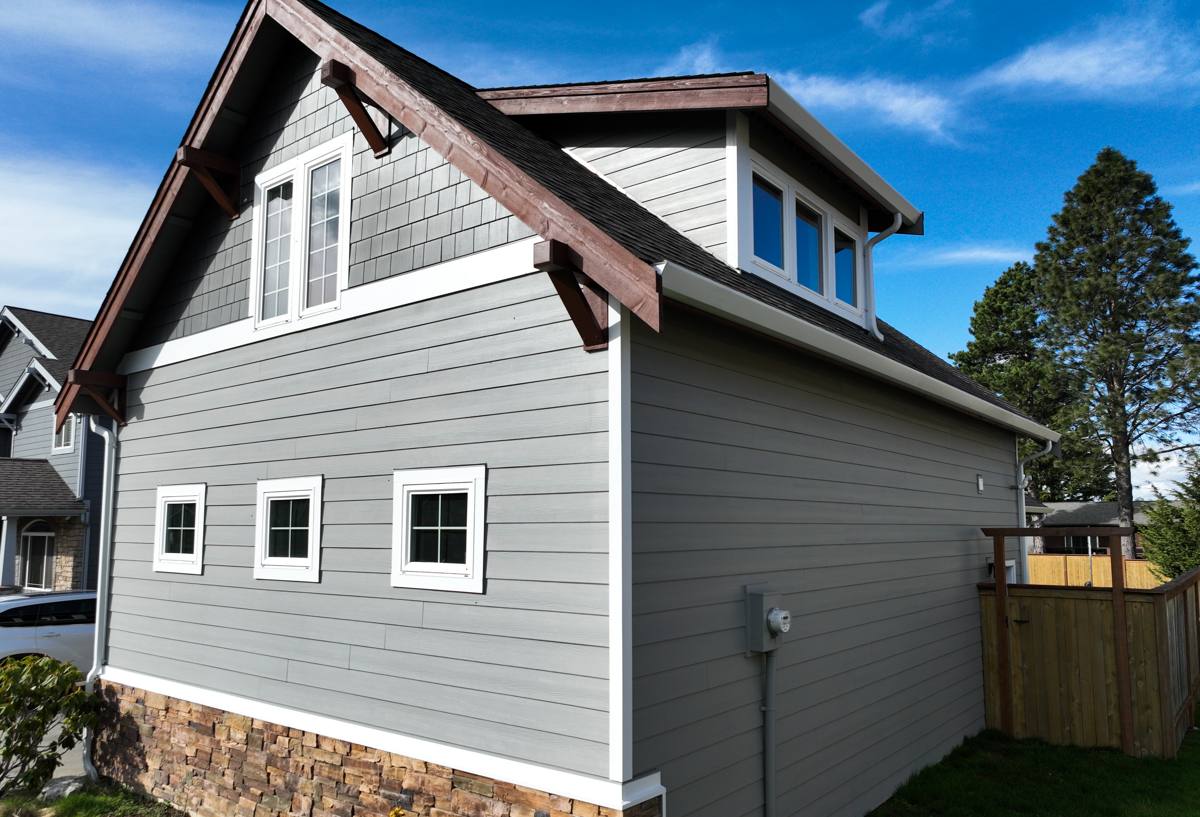
- HardiePlank lap siding — the most common choice, available in several exposure widths and both smooth and cedar-textured finishes
- HardiePanel vertical siding — used for board-and-batten looks or as an accent on gables and entry features
- HardieShingle — a shingle profile for homes going for a more traditional or coastal look without switching to cedar
- HardieTrim — matching trim boards for corners, window and door casing, and fascia, so the whole exterior system is consistent
ColorPlus finishes come in a range of factory colors designed to hold up under UV and moisture exposure, with matching caulk and touch-up paint available so repairs blend in rather than standing out.
What Correct Installation Involves
Fiber cement siding is only as good as the installation behind it. Hardie's warranty coverage and real-world performance both depend on the crew following manufacturer specs, not shortcuts. On every Hardie project we run through the same core requirements:
- Proper water-resistive barrier and flashing at every window, door, and penetration before siding goes up
- Correct fastener type, spacing, and embedment depth per Hardie's published installation guide
- Minimum clearance from grade, roof lines, and decks to keep siding out of standing water and splash-back
- Properly sized and sealed joints, with the right expansion gaps rather than tight-butted seams
- Factory-primed or factory-finished cut edges sealed before installation, not left exposed
- Rainscreen or drainage plane detailing where the wall assembly calls for it, so incidental moisture can drain and dry
Skipping any of these doesn't usually cause an immediate problem — it shows up two, five, or ten years later as moisture intrusion, cracking, or finish failure, and by then it's a much bigger repair than it would have been to do right the first time.
Beyond Siding: Roofing, Windows, and Decks
Siding doesn't work in isolation. On most Lynden projects, siding failure traces back to a roofing or flashing issue overhead, a window that's no longer sealing properly, or a deck ledger that's trapping moisture against the wall. We handle roofing, windows, and decks as well as siding, which lets us look at a home's exterior as one connected system rather than patching one component while an adjacent one keeps causing damage.
This matters most at transitions — where a roof meets a wall, where a deck ledger attaches to siding, where a window is set into a fiber cement wall. Those are the spots where most real-world leaks start, and they're easiest to get right when one crew is responsible for the whole envelope instead of coordinating between separate trades.
Cost Factors for a Lynden Siding Project
| Factor | Why it affects the price |
|---|---|
| Home size and wall complexity | More corners, gables, and dormers mean more cutting, trim, and labor time |
| Current siding removal | Tear-off and disposal of existing material adds cost versus installing over new construction sheathing |
| Underlying wall condition | Rot or moisture damage found once old siding comes off may need repair before new siding goes on |
| Product line and profile | Lap width, shingle profiles, and trim details all carry different material costs |
| Color and finish selection | Standard ColorPlus colors versus premium or custom options can shift material pricing |
| Access and site conditions | Steep lots, limited driveway access, or landscaping close to the home can add labor time |
We give honest, itemized estimates rather than a flat number pulled from square footage alone — every home in Lynden has a slightly different story once we're actually up on a ladder looking at it.
Signs a Lynden Home Might Need New Siding
- Persistent moss or algae staining that comes back within a season of cleaning
- Soft spots, bubbling, or visible warping, especially near the ground or roofline
- Paint that's peeling or failing faster than a normal repaint cycle would suggest
- Visible gaps at seams, corners, or trim where daylight or moisture can get behind the siding
- Rising energy bills that track with drafts or cold spots near exterior walls
None of these guarantee full replacement is needed — sometimes it's a localized repair or a flashing fix. We'll tell you honestly which one it is rather than defaulting to the more expensive answer.
Why a Local Crew Matters
We're based in Blaine and work throughout Whatcom County, which means the crew on your Lynden project has actually installed siding in this exact climate, not just read the manufacturer's spec sheet. That matters for judgment calls — how much clearance to leave at grade on a valley lot with drainage concerns, how to detail flashing on a home that catches more wind-driven rain than average, which trim details actually hold up through a Whatcom County winter. It also means we're not disappearing after the invoice clears; we're a phone call away if something needs a look years down the road.
If you're thinking about siding, roofing, windows, or decks for a home in Lynden, we're happy to come take a look and give you a straightforward, no-pressure estimate — no inflated numbers, no pressure to sign anything on the spot. Fill out the form below and we'll get in touch.