 Blaine
 Why Siding Fails Sooner Near the Blaine Waterfront
Siding in Blaine works harder than siding almost anywhere else in Whatcom County. Homes near Semiahmoo Bay and Drayton Harbor take on salt-laden air that accelerates corrosion of fasteners and finishes. Add in driving rain that comes sideways off the Strait of Georgia during winter storms, and a moss season that can run from October through May in the shade of Douglas firs and cedars, and you have three separate stressors working on your exterior at the same time, year after year.
None of these forces cause sudden failure. They cause slow, cumulative damage that's easy to miss until a repair that would have cost a few hundred dollars turns into a full wall section replacement. This page walks through the warning signs worth checking for a few times a year, what causes them, and what to do once you spot one.
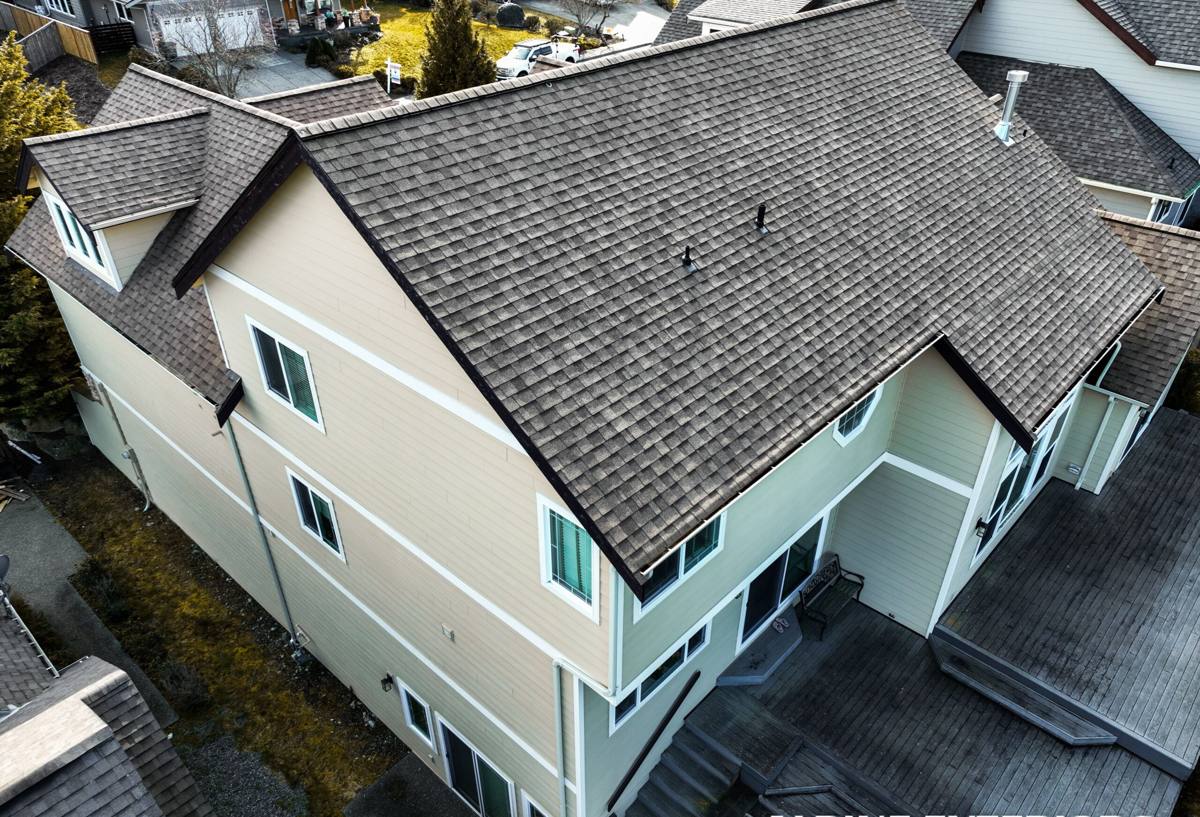
Warning Sign: Bubbling, Peeling, or Cracked Paint
Paint failure is usually the first visible clue that something is wrong underneath, not just a cosmetic issue on its own. When paint bubbles or peels in sheets rather than wearing evenly, it typically means moisture is trapped behind it and pushing outward as it tries to evaporate.
What It Usually Means
On wood-based siding (cedar, primed spruce, or older LP-style products), bubbling paint often means the substrate underneath is already absorbing water. Paint is not a waterproofing layer by itself — it's a finish that needs a stable, dry substrate to bond to. Once moisture gets behind it, the clock is running on the material underneath.
Where to Look First
Check south and west-facing walls first, since they take the brunt of wind-driven rain in this area, along with anywhere paint meets trim, window flashing, or the bottom courses closest to grade or a deck ledger.
Warning Sign: Soft, Spongy, or Crumbling Spots
This is the sign that should get the fastest response. Wood-based siding that has absorbed water for long enough will lose structural integrity — it stops being a rigid board and starts behaving like wet cardboard.
The Screwdriver Test
Press a screwdriver or your thumb firmly against a suspect area, especially near the bottom of a wall, around window sills, or below a roofline that discharges water onto the wall. If the material gives way, flakes, or feels spongy rather than solid, rot has already set in. This is not a paint problem — it's a substrate problem, and it will not stop on its own.
Where Rot Starts First
In Whatcom County's wet-winter climate, rot tends to start at the lowest exposed courses, at inside corners where two walls meet and water sits longer, and at any point where caulking has cracked and let water track behind the siding instead of running off the face. Butt joints between siding boards are also common failure points once the factory or field-applied sealant ages out.
Warning Sign: Visible Gaps, Warping, or Buckling
Wood and wood-composite siding move as they absorb and release moisture. Over enough cycles, that movement can pull boards away from fasteners, open gaps at seams, or cause visible waviness across a wall plane.
A few things to check:
- Boards that no longer sit flush against the wall or against each other
- Nail heads that have backed out or left elongated holes
- Sections that look wavy or "rippled" when viewed at a low angle in daylight
- Gaps at butt joints wide enough to see daylight or insulation behind them
Any of these lets water get behind the siding plane, which is where damage accelerates fastest because that area doesn't dry out between rain events the way the exposed face does.
Warning Sign: Persistent Moss, Algae, and Staining
Some green tinge on north-facing walls or under tree cover is close to unavoidable here — Blaine's tree canopy and marine humidity make moss and algae growth common on almost every exterior surface, including roofs, fences, and decks. The concern isn't the presence of moss; it's moss that keeps coming back heavier every season or that's established itself in a texture or crevice rather than just sitting on the surface.
Moss holds moisture against the siding surface far longer than open air would, which keeps the material wet during exactly the weeks when it would otherwise get a chance to dry out between storms. On porous or textured siding, moss roots can also work into surface irregularities and hold water there permanently. Dark streaking below trim, gutters, or roof valleys is usually just organic staining from runoff, but it's worth wiping a test spot to confirm it's surface-level and not indicating a crack or gap feeding water directly onto the wall.
Warning Sign: Rising Energy Bills or Interior Drafts
Siding that has gapped, warped, or lost its seal at trim and window edges isn't just a moisture problem — it's an air-sealing problem. If heating bills have crept up without an obvious cause, or if a room near an exterior wall feels drafty on windy days, it's worth checking the siding condition on that wall before assuming it's an insulation or window issue. Water intrusion behind siding can also saturate wall insulation, which dramatically reduces its R-value even where the drywall inside still looks fine.
How Long Different Siding Materials Actually Hold Up Here
Not all siding materials handle Blaine's combination of salt air, wind-driven rain, and moss exposure the same way. This is a general comparison based on typical material behavior in a marine, high-moisture climate — actual results depend heavily on installation quality and maintenance.
| Material | Typical Lifespan Here | Moisture Behavior | Maintenance Burden |
|---|---|---|---|
| Cedar (untreated or clear-coated) | 15-25 years | Absorbs water readily; needs consistent sealing/staining to resist rot | High — recoating every 3-5 years |
| Primed spruce / pine bevel | 10-20 years | Softwood substrate; vulnerable at cut ends and fastener points | High — repainting and caulk checks regularly |
| Vinyl siding | 20-30 years | Doesn't absorb water itself, but traps moisture behind it if installed too tight; can crack or fade in UV/salt exposure | Low, but panels aren't repairable individually once faded |
| Wood-composite (e.g., LP-style strand products) | 15-25 years with strict maintenance | Engineered to resist swelling, but edge sealing is critical — failures concentrate at cut edges and joints | Moderate to high — depends on caulk/paint upkeep schedule |
| James Hardie fiber cement | 30-50+ years | Non-combustible, dimensionally stable, doesn't absorb and swell the way wood-based products do | Low — factory ColorPlus finish holds color without repainting cycles |
What To Do When You Spot a Warning Sign
Not every issue means full replacement. A single soft board, a cracked caulk line, or a gapped joint can often be repaired if it's caught before the damage spreads to framing or sheathing. Here's a practical seasonal check homeowners in Blaine can run themselves:
- Walk the full perimeter of the house twice a year — once in fall before the wet season and once in spring
- Press-test any area that looks discolored, bubbled, or stained
- Check inside corners, below windows, and near deck ledgers and hose bibs, since these areas trap water longer
- Look at caulk lines at trim and butt joints for cracking or gaps
- Check for moss or algae that's thickened since the last inspection rather than staying stable
- Note any new interior signs — peeling paint on interior walls, musty smell, or a soft spot on interior trim near an exterior wall — since these can indicate moisture has already worked through
- If more than one warning sign shows up on the same wall section, get it looked at rather than patching the most visible symptom alone
Why We Standardized on James Hardie
Every warning sign covered above — paint failure, soft spots, warping, moss retention — traces back to the same root cause: a material absorbing and holding moisture it wasn't built to handle over decades of Whatcom County weather. That's the specific problem James Hardie fiber cement was engineered to avoid. It's non-combustible, dimensionally stable across wet and dry cycles, and finished with a factory-applied ColorPlus coating that doesn't rely on a homeowner's repainting schedule to stay protected.
We don't install LP SmartSide, vinyl, Cemplank, Allura, primed spruce, or cedar. Each of those products has legitimate uses and reasonable homeowners choose them, but after years of doing this work in a marine climate that punishes wood-based and moisture-sensitive materials, we standardized on Hardie because it's what we're willing to warranty and stand behind long-term. If you're seeing any of the warning signs above on your home, or just want an honest read on how much life is left in your current siding, we're glad to take a look. The estimate is free, there's no pressure, and you'll walk away with a straight answer either way.