 Blaine
 California Creek's Exterior Problem Isn't Hypothetical
If you own a home in California Creek, you already know the climate here doesn't do your siding any favors. You're close enough to the water that salt-laden air is a constant, not an occasional weather event. Rain doesn't just fall straight down for a few weeks in the winter — it comes sideways, off the water, for months at a stretch. And when the rain finally lets up, the moisture doesn't leave. It sits in shaded north- and west-facing walls, under eaves, and behind anything that traps it, and that's exactly where moss and algae get their foothold.
None of this is unique to California Creek specifically, but it's more pronounced here than in a lot of inland Whatcom County neighborhoods, simply because of the proximity to open water and the exposure a lot of these lots have. Siding that would hold up fine forty miles inland gets tested a lot harder out here, and cheaper materials or shortcut installations tend to show their weaknesses sooner rather than later.
What We Actually See on Homes in This Area
- Green-black staining and moss growth on shaded siding, especially north walls and areas under overhangs with limited sun exposure
- Caulking and trim joints that have failed years ahead of schedule due to constant wet-dry cycling
- Paint that's chalking, peeling, or fading unevenly — worse on the water-facing side of the house
- Swelling, delamination, or soft spots on wood-based or engineered wood siding where moisture got behind the surface
- Corroded fasteners and hardware on older siding installations near the coast
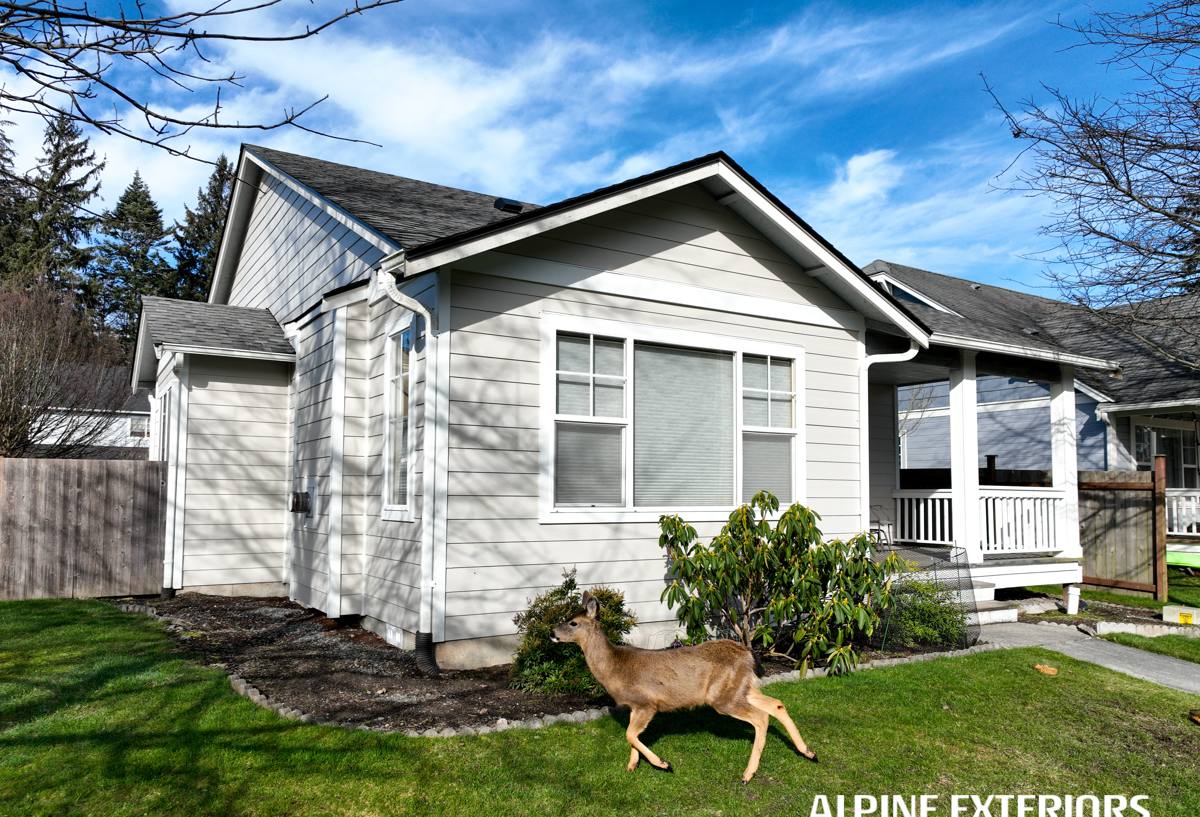
Why We Standardized on James Hardie Fiber Cement
We install James Hardie siding exclusively. Not because it's the only decent product on the market, but because after years of doing exterior work in coastal Whatcom County conditions, it's the material that consistently holds up the way it's supposed to — and the one we're willing to put our name behind.
Fiber cement is engineered from cement, sand, and cellulose fibers. It doesn't absorb water and swell the way wood-based products can, and it isn't a plastic product that becomes brittle in cold weather or can distort in warmer stretches like vinyl can. Hardie's ColorPlus finish is baked on at the factory under controlled conditions, which gives it better fade and chip resistance than field-applied paint, and it's backed by a real, transferable warranty — something that matters if you ever sell the house.
Hardie also builds region-specific product lines through what they call their HZ5 engineering, which accounts for climate zones like ours — freeze-thaw cycles, high moisture exposure, and coastal conditions. It's not a generic siding product retrofitted for the Pacific Northwest; the moisture and climate performance is part of the design.
It's also non-combustible, which is increasingly something homeowners and insurers both care about, even in a wetter climate like ours where wildfire isn't the daily concern it is east of the mountains.
Siding, Roofing, Windows, and Decks — Handled as One Exterior, Not Four Separate Jobs
Siding failures in a place like California Creek rarely happen in isolation. A roof that's shedding water poorly, a window that's not flashed correctly, or a deck ledger board that's trapping moisture against the house can all show up later as a siding problem — staining, rot, or a callback that never should have happened in the first place.
Because we handle siding, roofing, windows, and decks under one crew, we look at the whole envelope of the house, not just the wall cladding. If your siding project uncovers a flashing issue at a window or a roof edge that's letting water track down behind the wall, we can address it as part of the same job instead of sending you to find a second contractor and hoping the two scopes of work line up correctly.
What a Siding Project in California Creek Actually Looks Like
1. On-Site Assessment
We walk the exterior, check for moisture intrusion, evaluate the condition of the existing sheathing and weather barrier, and look at drainage, roof-to-wall transitions, and anywhere water has historically had a hard time getting away from the house.
2. Removal and Sheathing Check
Old siding comes off and we inspect what's underneath. This step matters more here than it would in a drier inland climate — if there's hidden rot or moisture damage in the sheathing, it needs to be addressed before new siding goes up, not covered over.
3. Weather-Resistive Barrier and Flashing
This is where a lot of siding jobs succeed or fail long-term, and it's largely invisible once the project is done. Proper house wrap, correctly lapped and taped seams, and flashing at every window, door, and penetration are what actually keep water out — the siding itself is really the second line of defense.
4. Hardie Installation to Manufacturer Spec
Correct fastener spacing, proper clearance from grade and roof lines, and correctly sealed or ventilated joints depending on the product line. Installation errors are one of the most common reasons any siding product — Hardie included — underperforms, so we install to spec, not to "close enough."
5. Final Walkthrough
We go over the finished work with you, including what maintenance (if any) is realistically needed going forward.
Comparing Siding Options for a Coastal Whatcom County Home
| Material | Moisture Behavior | Maintenance | Typical Lifespan Here |
|---|---|---|---|
| James Hardie Fiber Cement | Does not absorb water or swell; factory finish resists moisture-driven fade | Occasional wash; no repainting needed with ColorPlus | Decades, with a strong transferable warranty |
| Vinyl | Doesn't rot, but can warp, crack, or gap in temperature swings; seams can let water behind panels | Low, but damage often means full panel replacement | Variable; performance drops with age and UV exposure |
| LP SmartSide / Engineered Wood | Wood-based core is vulnerable to swelling and delamination if moisture gets past the surface | Requires diligent caulking and paint upkeep | Shorter in high-moisture coastal exposure without strict maintenance |
| Primed Spruce / Cedar | Natural wood; absorbs moisture, prone to rot and insect issues without constant upkeep | High — regular refinishing and inspection | Shortest of the group in this climate without heavy maintenance investment |
We don't install the last three products listed above. This table isn't meant to knock them across the board — vinyl and engineered wood have legitimate uses and price points elsewhere. But for the moisture and salt exposure homes face in this part of Whatcom County, we've made the call that fiber cement is the product we're willing to stand behind long-term.
Maintenance: What Homeowners Here Should Actually Watch For
- Check shaded and water-facing walls for moss or algae buildup at least once a year
- Inspect caulking around windows, doors, and trim for cracking or gaps, especially after the first hard freeze of the season
- Look for soft spots, staining, or bubbling paint near the bottom courses of siding, where splashback and standing water are most common
- Keep gutters clear so overflow isn't running down the face of the siding
- Trim back vegetation and shrubs that keep siding shaded and damp longer than it needs to be
- Have flashing at rooflines, windows, and deck ledgers checked periodically, since flashing failures often show up as a siding problem before anyone traces it back
Why a Local Crew Makes a Real Difference
A crew that works Blaine and the surrounding Whatcom County coastline regularly knows which walls on a typical California Creek lot take the worst of the weather, how local permitting and inspections tend to go, and what moisture problems actually look like here versus in a drier region. That's not something you get from a crew that's mostly worked inland or in a different climate zone entirely. It also means if something needs a look after the job is done, you're not waiting on a company that has to schedule a special trip out to the coast.
Cost Factors Homeowners Should Know Going In
| Factor | How It Affects the Project |
|---|---|
| House size and complexity | More corners, gables, and trim detail mean more labor and material |
| Existing sheathing condition | Hidden rot or moisture damage found during tear-off adds repair scope |
| Hardie product line selected | Lap siding, panel systems, and shingle-style products vary in material cost |
| Trim and accent work | Detailed trim packages and color-matched accessories add to the bid |
| Access and site conditions | Tight lots, slopes, or limited equipment access can affect labor time |
We don't quote a job sight unseen, and we won't give you a number that isn't grounded in what's actually on your house. A proper estimate starts with a real look at the exterior.
Ready When You Are
If your California Creek home is showing signs of moss, staining, failing caulk, or siding that's just past its useful life, we're glad to take a look and give you an honest read on what's going on — no pressure, no obligation. Fill out the form below to get a free estimate from a crew that actually works this stretch of Whatcom County.