 Blaine
 Dakota Creek Sits Right at the Edge of the Weather
Dakota Creek is one of those Blaine-area spots where you can feel the difference the moment you step outside. The proximity to Semiahmoo Bay and the Strait of Georgia means homes here take on a steady diet of salt-laden air, wind-driven rain, and the kind of persistent gray dampness that Whatcom County is known for most of the year. It's a beautiful place to live, but it is not a gentle place to be a piece of exterior building material.
Siding, trim, roofing, and window assemblies in this neighborhood are working harder than the same products would be thirty or forty miles inland. Salt air accelerates corrosion on fasteners and metal flashing. Driving rain off the water finds every gap, seam, and nail hole that wasn't sealed correctly. And the long, cool, wet stretches from fall through spring create ideal conditions for moss and algae to take hold on anything that stays damp for too long. If you've owned a home in Dakota Creek for more than a few years, you've probably already seen some combination of these show up on your siding, fascia, or roof edges.
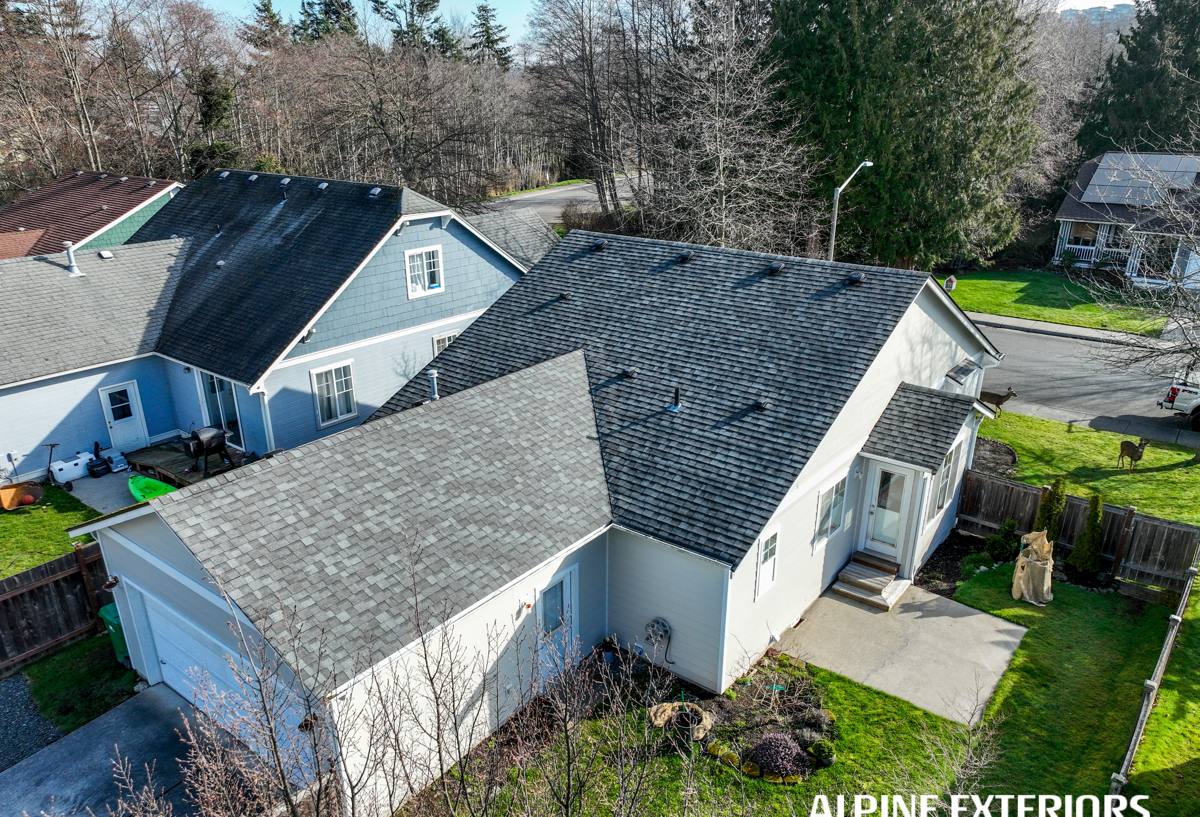
What This Climate Does to the Wrong Siding Material
Not all siding is built to handle marine exposure the same way. This matters more in Dakota Creek than it would in a lot of other places we work.
Wood and Engineered Wood Products
Cedar and engineered wood siding (like LP SmartSide) rely on their factory or field-applied coatings to keep moisture out. In a coastal, high-moisture climate, any breach in that coating — a nail pop, a hairline crack, an unsealed cut edge — gives water a path into the wood substrate. Once moisture gets in, wood-based products can swell, delaminate at the edges, or start to rot from the inside out, often before it's visible from the street. Salt air doesn't cause this directly, but the combination of near-constant humidity and salt residue makes coating failures show up sooner.
Vinyl Siding
Vinyl holds up reasonably well against moisture itself, since it doesn't absorb water, but it has its own weak points in this environment. Wind-driven rain can get behind poorly lapped panels, and vinyl becomes brittle and prone to cracking in temperature swings. It also tends to fade and chalk with long-term UV and salt exposure, and once it's damaged, matching an aged panel color is rarely possible.
Other Fiber Cement Brands
Products like Cemplank or Allura are fiber cement, which is a step in the right direction structurally, but they don't all use the same paint systems, moisture-management engineering, or regional product formulations that James Hardie has developed specifically for climates like this one. The differences show up over time, not on day one.
Why We Install James Hardie Exclusively
We made a decision as a company to install only James Hardie fiber cement siding, and we stand behind that decision on every job, including here in Dakota Creek. A few reasons this matters for a coastal Whatcom County property:
- Non-combustible core: James Hardie siding is fiber cement, not wood or vinyl, so it doesn't feed a fire the way organic or petroleum-based materials can.
- Climate-engineered HZ product lines: Hardie's HZ5 formulation is engineered for regions with more moisture exposure and freeze-thaw cycling, which fits the maritime climate around Blaine better than a one-size-fits-all product.
- ColorPlus factory finish: The color is baked on at the factory under controlled conditions, which holds up better against UV, salt air, and moisture than most field-applied paint jobs, and it comes with its own finish warranty.
- Dimensional stability: Fiber cement doesn't expand and contract with moisture the way wood does, so seams stay tighter and paint lines stay cleaner over the years.
- Strong transferable warranty: A warranty that can transfer to a new owner is a real selling point if you ever list the house, which matters in a desirable area like Dakota Creek.
We're not going to tell you every other product is worthless — vinyl, wood, and other fiber cement brands all have legitimate uses and loyal customers. But we chose to specialize in one system we can install to spec and stand behind, rather than stock five products and hope each one performs. In a climate this demanding, we think that focus matters.
Installation Quality Matters as Much as the Product
Even the best siding material fails early if it's installed wrong, and this is where a lot of coastal siding problems actually start. Correct installation in a place like Dakota Creek includes:
- Proper clearance between siding and grade, decks, and roof lines so water isn't wicking up from below
- Correctly lapped and sealed house wrap or weather-resistive barrier behind the siding
- Rust-resistant, manufacturer-approved fasteners driven to the correct depth — not overdriven, which cracks the board's protective edge
- Properly flashed and caulked window and door penetrations, since these are the most common source of hidden water intrusion
- Correct joint treatment at butt seams and corners so moisture can't track in behind the panel
We see homes where the siding material itself was fine, but shortcuts during installation let water in anyway. That's a preventable problem, and it's the main reason we emphasize workmanship as much as product choice.
Signs Your Current Siding Is Losing the Battle
If you're not sure whether your Dakota Creek home's siding needs attention, a few things are worth checking for:
- Moss or dark streaking that keeps coming back on north-facing or shaded walls even after cleaning
- Soft spots, visible swelling, or delamination at panel edges or seams
- Paint that's peeling, bubbling, or chalking heavily, especially on the sides facing prevailing weather
- Nail heads that have popped or left rust streaks below them
- Gaps opening up at corners or trim where caulking has failed
- A musty smell or visible staining on interior walls that back up to exterior siding
Any one of these on its own isn't necessarily an emergency, but they're worth a real inspection rather than a quick caulk-and-paint patch, especially if the siding is original wood or an older engineered product nearing the end of its service life.
The Whole Exterior Envelope, Not Just Siding
Salt air, driving rain, and moss don't stop at the siding — they affect the roof, windows, and any exterior wood structures like decks at the same time. We handle all four because they work together as a system on a coastal home:
Roofing
Roof edges, flashing, and moss growth in valleys are common failure points in this climate. A roof that's shedding water poorly often ends up dumping extra moisture onto the siding below it.
Windows
Window flashing and seals are one of the most frequent sources of water intrusion behind siding. When we replace siding around older windows, we look closely at whether the window flashing needs to be corrected at the same time.
Decks
Decks attached to the house create a direct path for water and debris to sit against the siding and framing if they're not flashed and ledger-connected correctly, which is a common issue on older Whatcom County homes.
Addressing these together, rather than one at a time in isolation, tends to produce a longer-lasting result than treating siding as a standalone project.
What Affects the Cost of a Siding Project Here
| Factor | Why It Matters in Dakota Creek |
|---|---|
| Home size and wall complexity | More corners, gables, and dormers mean more cutting, flashing, and labor time |
| Current siding removal | Tear-off of failing wood or vinyl adds labor versus a bare-wall install |
| Moisture or rot damage found underneath | Coastal exposure increases the odds of hidden sheathing damage that needs repair before new siding goes on |
| Trim and accent detail | Board-and-batten, shingle-style accents, or trim upgrades add cost but improve durability and curb appeal |
| Access and site conditions | Waterfront-adjacent lots, slopes, or tight setbacks can affect staging and scaffolding needs |
| Paired projects | Combining siding with roofing, window, or deck work can reduce overlapping labor and disruption |
We won't quote a price without seeing the home, but these are the main variables that move the number up or down on most Dakota Creek projects.
Why a Local Crew Matters Out Here
Dakota Creek and the surrounding Blaine area have their own quirks — the specific way weather comes off the water, the local permitting process through Whatcom County, and the reality that a repair crew needs to actually be reachable when a wind event knocks something loose. A contractor who works this area regularly understands the exposure levels block by block and doesn't need to relearn the local conditions on your job. That's a big part of why we keep our crews familiar with this specific stretch of coastline rather than treating every job the same regardless of location.
Here's a short checklist worth using with any contractor you're considering for exterior work in this area:
- Ask what siding product they install and why — and be wary of anyone who installs "whatever the customer picks" with no stated standard
- Confirm they carry current Washington state contractor licensing and insurance
- Ask how they handle flashing and moisture barrier detail, not just the visible finish
- Ask for a written scope that specifies fastener type, house wrap, and trim details
- Ask whether they inspect for hidden moisture damage before closing up the wall
- Ask how warranty claims are handled and whether the warranty is transferable
If you're weighing a siding, roofing, window, or deck project for a Dakota Creek home, we're happy to come take a look and give you a straightforward, no-pressure estimate — no obligation, just an honest read on what your home actually needs.