 Blaine
 Siding Built for Bellingham's Weather, Not Just Its Looks
Bellingham sits close enough to the water and far enough north that its homes take on a specific combination of punishment: salt-laden air moving in off Bellingham Bay and the Strait of Georgia, long stretches of driving rain that come in sideways during fall and winter storms, and a moss and algae season that can run eight or nine months out of the year on shaded, north-facing walls. Any siding installed here has to handle all three at once, year after year, without babysitting from the homeowner.
That combination is harder on siding than people expect. Salt air accelerates corrosion on fasteners and trim. Driving rain finds every gap in flashing and caulking that a calmer climate would never test. And moss doesn't just look bad — it holds moisture against the wall surface long after the rain has stopped, which is exactly the condition that rots wood-based products and delaminates poorly bonded composites. A siding job in Bellingham is really a moisture-management job with a finish coat on top.
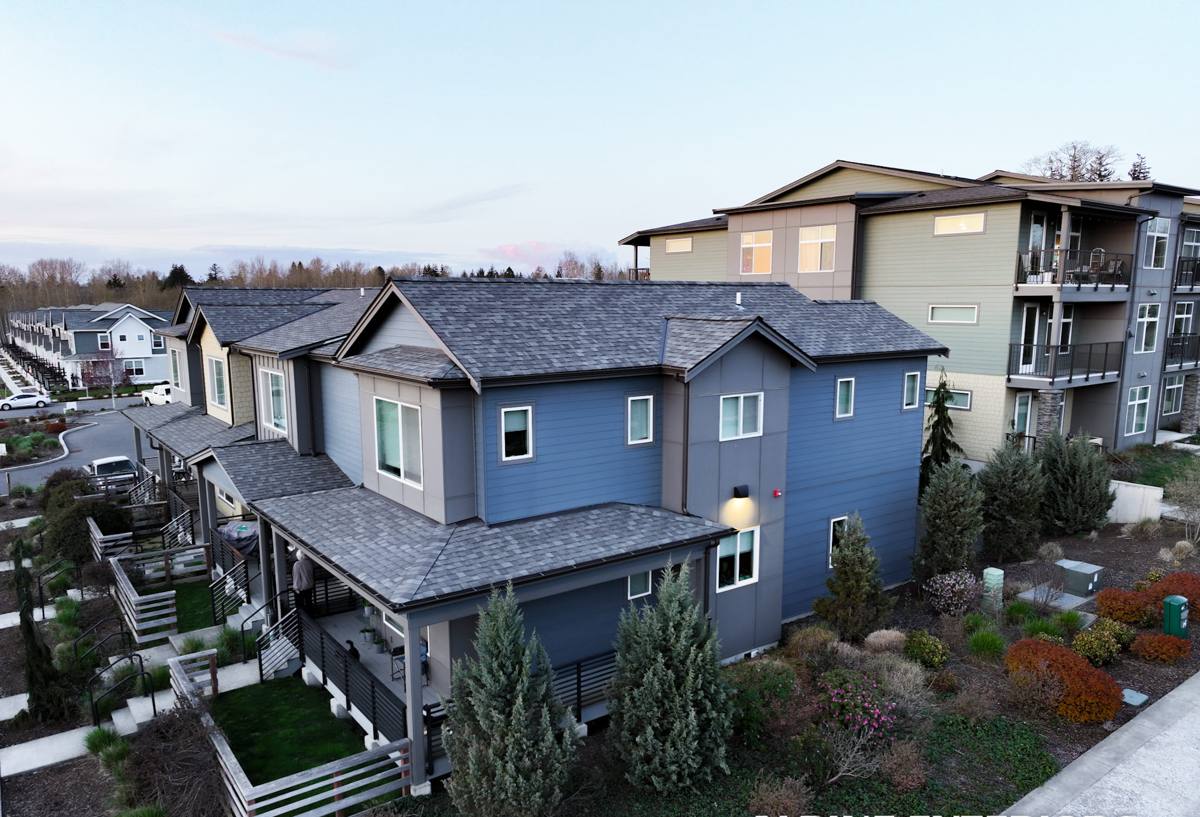
Why We Install James Hardie Fiber Cement, and Nothing Else
We are a James Hardie-only siding contractor. We don't install vinyl, LP SmartSide, cedar, primed spruce, or other fiber cement brands like Allura or Cemplank. That's not a marketing position — it's a standard we hold because of what we've seen this specific climate do to lesser or mismatched products over time.
Fiber cement is cement, sand, and cellulose fiber pressed and cured into a dense, stable board. It doesn't feed mold or moss the way wood-based siding can, it doesn't expand and contract with humidity swings the way vinyl does, and it's non-combustible. James Hardie backs its boards with a factory-applied ColorPlus finish baked on under controlled conditions, which holds up far better against UV and salt exposure than field-applied paint. For a Whatcom County home exposed to marine air on one side and heavy shade-driven moss growth on the other, that combination of moisture resistance and finish durability is what actually keeps a house looking good and staying protected for decades — not just at installation, but at year 15 and year 25.
What Correct Installation Actually Requires
Fiber cement is only as good as the install behind it. Hardie publishes detailed installation specs for a reason — the material performs as designed only when clearances, fastening, and flashing are done correctly. In a climate like Bellingham's, a few details matter more than they would in a drier region:
- Proper ground and roofline clearance so the bottom edge of the siding never sits in standing moisture or splash-back
- Correct nailing pattern and fastener type — stainless or coated fasteners rated for coastal exposure, not standard galvanized
- Weather-resistant barrier and flashing integrated at every window, door, and penetration before a single board goes up
- Butt joints and seams sealed or flashed per manufacturer spec, not just caulked over
- Adequate rain-screen or drainage gap where wall assembly and code call for it, so bulk water has somewhere to go
Skip any one of these and you get the same failure mode: water gets behind the siding, has nowhere to drain, and the wall assembly stays wet through Bellingham's long rainy stretches. The siding itself can be excellent and still fail if the install underneath it is careless.
How Salt Air, Rain, and Moss Each Attack a Wall Differently
Salt Air
Proximity to Bellingham Bay means airborne salt settles on exterior surfaces and accelerates corrosion of anything metal — fasteners, flashing, trim screws. Over years, corroding fasteners can loosen siding or stain the face of the boards. It's a slow problem, which is exactly why it gets ignored until a wall section starts to look tired.
Driving Rain
Storms moving through Whatcom County frequently bring rain at an angle, not straight down. That means water gets pushed sideways into every horizontal lap, seam, and penetration on a wall. A siding system with weak flashing details will let that wind-driven water in even if the boards themselves are watertight.
Moss and Algae
Shaded elevations, especially north- and east-facing walls under mature trees, stay damp for long stretches between rain events. That's ideal moss and algae territory. Beyond looking unattractive, established moss holds a wet layer against the siding surface, which keeps the substrate behind it damp far longer than an exposed, sun-drying wall would be.
Comparing How Common Siding Materials Hold Up Here
| Material | Moisture Behavior | Moss/Algae Resistance | Finish Longevity in Marine Air |
|---|---|---|---|
| James Hardie Fiber Cement | Dimensionally stable, doesn't swell or rot | Doesn't feed organic growth; cleans up well | Factory ColorPlus finish resists fading and salt exposure |
| Vinyl | Won't rot, but expands/contracts with temperature and can warp | Growth sits on surface but can hide seams and get trapped at laps | Color is through-body but can chalk and fade over time; brittle in cold |
| Cedar / Primed Spruce | Absorbs moisture; prone to swelling, cupping, rot at joints | Wood is an organic surface — moss and mildew take hold readily | Field-applied paint/stain needs recoating every few years |
| LP SmartSide / Other Composites | Engineered wood strand core; sensitive to sustained moisture exposure at cut edges and seams | Better than raw wood but still an organic-based substrate | Factory finish varies by product line; edge sealing is critical |
This isn't a claim that other materials fail outright — it's why, for a climate that combines salt air, wind-driven rain, and a long moss season, we've standardized on the one product system that handles all three without asking the homeowner to maintain it constantly.
What a Bellingham Fiber Cement Project Actually Involves
Assessment First
We start by looking at the existing wall assembly, not just the old siding. That means checking for trapped moisture, soft sheathing, existing flashing condition, and which elevations are getting hit hardest by moss or rain exposure. A house facing the water needs different attention on its windward side than its sheltered side.
Removal and Wall Prep
Old siding comes off, and we inspect the sheathing and weather-resistant barrier underneath before anything new goes on. Any water damage found here gets addressed — covering it up with new siding doesn't fix a rotted stud or delaminated sheathing, it just hides the problem for a few more years.
Installation to Spec
James Hardie boards, trim, and fasteners go up following manufacturer clearance, fastening, and flashing requirements, with extra attention to butt joints, penetrations, and the transitions where siding meets roofline, windows, and foundation — the spots that leak first in a driving rain.
Finish and Walkthrough
Because ColorPlus finish is factory-applied, there's no field painting required for color — just careful handling to protect the finish during installation and a final walkthrough covering care and what to watch for over the coming seasons.
Why Hiring a Crew That Already Works Bellingham Matters
Siding installation isn't uniform across the country, and it isn't even uniform across Washington. A crew that mostly works drier inland areas may not default to marine-grade fasteners, may under-detail flashing at penetrations, or may not think twice about clearance at grade — details that matter far less somewhere without Bellingham's rain and salt exposure. A crew that already works Whatcom County knows which elevations of a house need the most attention before they even walk the property, because they've seen the same bay-facing exposure and the same shaded, moss-prone walls on other jobs nearby.
That familiarity shows up in small decisions during the job — where to add extra flashing, which fastener spec to use, how much clearance to leave at grade — that don't show up on an invoice but show up in how the wall performs ten winters later.
Maintenance Expectations After Installation
- Rinse siding periodically, especially shaded or moss-prone elevations, to keep organic growth from establishing
- Keep gutters and downspouts clear so overflow doesn't run down the wall face
- Trim back vegetation and tree cover where it keeps a wall surface damp and shaded
- Have caulking at trim and penetrations checked periodically — sealant is a maintenance item even on a low-maintenance siding system
- Address any impact damage or loose boards promptly rather than letting a small gap turn into a moisture entry point
None of this is heavy maintenance — that's the point of a correctly installed fiber cement system — but it's not zero-maintenance either, and being upfront about that is part of doing this job honestly.
Get a Straightforward Estimate
If your Bellingham home's siding is showing moss staining, worn caulking, soft spots, or just age, we're happy to take a look and give you an honest read on what it needs. There's no pressure and no obligation — just a straight assessment and a written estimate for James Hardie fiber cement done right for this climate. Use the form below to request a free estimate.