 Blaine
 Nooksack's Exterior Climate: What Homes Are Really Up Against
Nooksack sits in the northern reach of Whatcom County, close enough to the Salish Sea and the Fraser Valley corridor that homes here deal with a specific combination of weather stresses most siding products were never designed to handle well over the long term. Salt-laden air moves in off the water and settles on exterior surfaces, wind-driven rain hits siding sideways during fall and winter storms rather than falling straight down, and the region's long stretch of overcast, damp months creates ideal conditions for moss, algae, and mildew to take hold on anything that stays wet for extended periods.
None of this is dramatic on its own. It's the accumulation that matters. A house that gets a few days of hard rain followed by weeks of low sun and high humidity is a house where paint fails early, wood swells and shrinks, and anything with a seam or a joint becomes a place for moisture to work its way in. Over ten or fifteen years, that slow accumulation is what separates siding that still looks tight and holds paint from siding that's chalking, cupping, or rotting at the bottom courses.
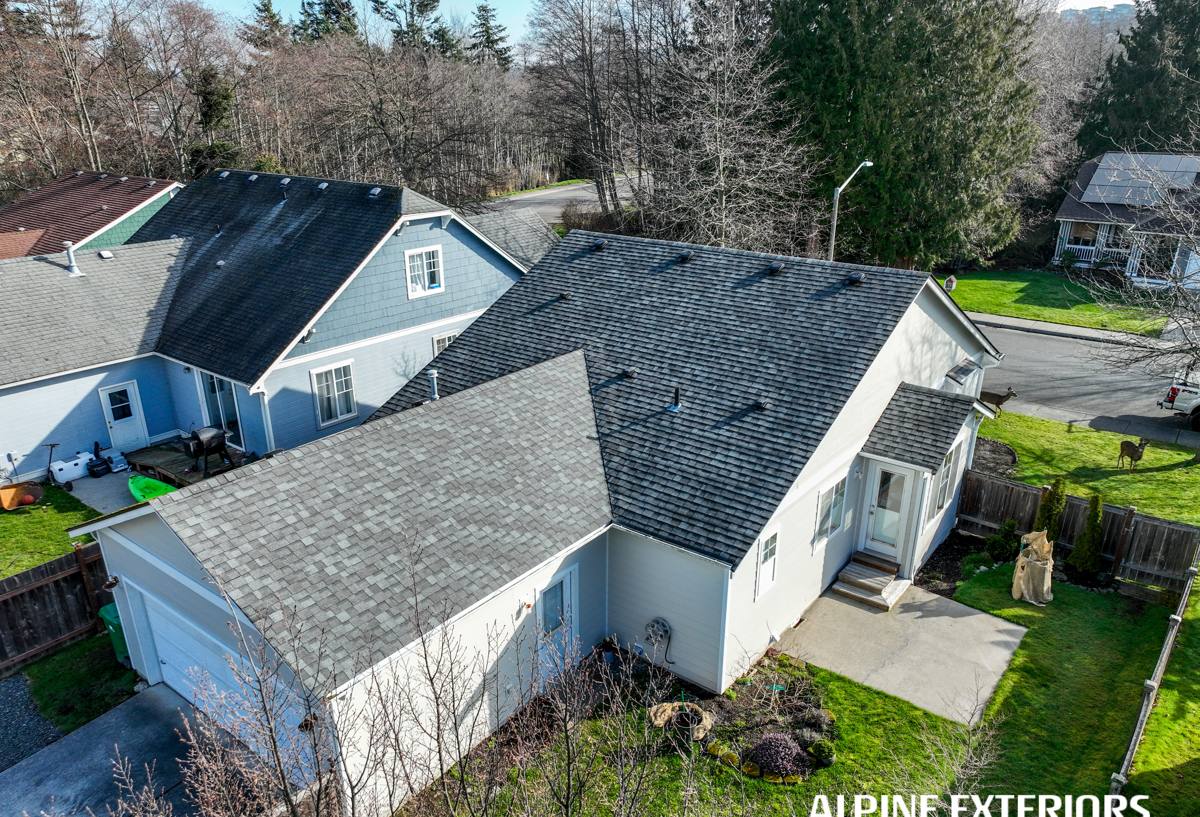
Why This Matters More for Some Materials Than Others
Not every siding product responds to this climate the same way. Products that rely on caulked seams, factory coatings that weren't engineered for marine air, or wood-based cores are the ones that tend to show problems first in areas like Nooksack. Moss holds moisture against a surface longer than open air does, and driving rain finds any weak point in a seam or a fastener pattern faster than it would in a drier, calmer climate.
This is why we standardized on James Hardie fiber cement siding for every job we do, including work in Nooksack. It isn't a marketing position — it's a decision based on what actually holds up here. Fiber cement doesn't have an organic core for moisture to feed on, it's non-combustible, and Hardie's ColorPlus factory finish is baked on under controlled conditions rather than applied on-site, which gives it meaningfully better resistance to fading and moisture intrusion than field-applied paint. We don't install LP SmartSide, vinyl, Cemplank, Allura, primed spruce, or cedar, and we're upfront with homeowners about why — those products can be reasonable choices in the right circumstances, but the trade-offs in maintenance, moisture behavior, or long-term appearance aren't ones we're willing to put our name behind in this climate.
What Moss Season Actually Does to a House
Moss doesn't just grow on roofs. In shaded areas, under eaves, and on north-facing walls, it establishes on siding too, and once it's rooted it holds water against the surface far longer than the surface would otherwise stay wet. On wood-based products, that's a direct path to rot. On vinyl, it's mostly cosmetic but tends to recur every season without treatment. On properly installed fiber cement with a factory finish, moss can still grow, but it doesn't compromise the material underneath the way it can with organic substrates — it's a cleaning issue rather than a structural one.
Full Exterior Work, Not Just Siding
Most homes that need new siding aren't dealing with siding problems in isolation. Roofing, windows, and siding all interact — a roof that's shedding water onto a wall, a window that's not flashed correctly, or trim that's failed at a butt joint will undermine even a well-installed siding job. We handle siding, roofing, windows, and decks as an integrated exterior, which matters in a climate like this one because the places where these systems meet — roof-to-wall transitions, window openings, deck ledger connections — are exactly where water intrusion problems start.
For a Nooksack property, that often means we're looking at the whole envelope during an estimate, not just the walls. If your roof is past its service life or your deck ledger board has been holding moisture against the house for years, we'll tell you, because ignoring it and just re-siding around the problem doesn't actually solve anything.
How We Approach a Nooksack Siding Project
Assessment
We start by walking the exterior and looking at where the house is actually taking on water — not just the siding surface, but flashing details, caulk joints, deck attachments, and roof edges. In a driving-rain climate, the failure points are rarely random; they tend to cluster at the same handful of vulnerable transitions on every house.
Prep and Moisture Barrier
Correct water-resistive barrier and flashing work underneath the siding matters as much as the siding itself. This is the part of the job that's invisible once it's finished, and it's also the part most likely to be shortcut on a rushed installation. We don't skip it, because in an area that sees this much wind-driven rain, a compromised weather barrier will show up as a problem eventually — just not on the day the job is finished.
Installation to Manufacturer Spec
James Hardie's warranty coverage depends on installation following their published specifications — proper fastener spacing, correct clearance from grade and roof lines, and proper joint treatment. We install to that spec on every job, which is also what keeps the transferable warranty valid if you sell the home.
Final Walkthrough
We go over the finished work with the homeowner, including care and cleaning guidance specific to this climate — what to expect with moss and algae growth, and simple maintenance that keeps the finish looking right for years.
Comparing Siding Materials for This Climate
| Material | Behavior in Salt Air & Driving Rain | Moss/Algae Resistance | Typical Maintenance |
|---|---|---|---|
| James Hardie Fiber Cement | Non-combustible, dimensionally stable, factory finish resists moisture intrusion | Surface growth cleans off; material doesn't degrade | Periodic washing; repaint only after 15+ years if desired |
| Vinyl | Can warp or crack under freeze-thaw and impact; seams are a water entry point | Growth is cosmetic but recurring | Regular cleaning; replacement of damaged panels |
| Cedar / Primed Spruce | Organic material absorbs moisture; prone to swelling and rot in sustained damp conditions | Moss and mildew can take hold in the wood itself | Repainting/staining every few years; ongoing rot inspection |
| LP SmartSide | Engineered wood strand product; performs reasonably when perfectly maintained, but edges and cuts are moisture-sensitive | Requires diligent sealing at seams and cuts | Careful caulk maintenance; touch-up painting |
What Drives Cost on a Nooksack Project
Every home is different, but the same handful of factors move the price up or down on most siding jobs in this area:
| Factor | Why It Matters |
|---|---|
| Extent of existing damage | Rotted sheathing or trim found during tear-off adds repair scope before new siding goes on |
| House size and complexity | More corners, dormers, and trim details mean more labor and material cuts |
| Siding profile and color | ColorPlus factory colors and certain plank widths carry different material costs |
| Access and site conditions | Steep lots, limited driveway access, or tight setbacks affect staging and labor time |
| Scope beyond siding | Bundling roofing, window, or deck work can be more efficient than separate projects later |
We give straightforward, itemized estimates so you can see what's driving the number, rather than a flat quote with no explanation behind it.
Why a Local Crew Matters Here
Whatcom County's microclimates aren't uniform. A crew that mostly works drier inland areas won't have the same instinct for where water collects on a coastal-influenced property near Blaine and Nooksack as a crew that works this specific area regularly. Local experience means knowing which details tend to fail first in this weather, what moss and algae patterns to expect on shaded elevations, and how to sequence a job around the region's wetter months so the house isn't left exposed longer than necessary.
It also means being reachable after the job is done. If a warranty question comes up or you want maintenance guidance five years down the road, you're dealing with a company that's still working in your area, not one that did a job and moved on.
Homeowner Maintenance Checklist for This Climate
- Rinse siding annually to remove salt residue and organic buildup, especially on shaded or north-facing walls
- Keep gutters clear so overflow doesn't run down the siding face repeatedly
- Trim back vegetation and tree cover that keeps walls shaded and damp longer than necessary
- Inspect caulking at trim joints, window edges, and butt seams once a year and touch up as needed
- Watch for moss buildup at the base of walls and under eaves, and clean it before it spreads
- Have flashing and roof-to-wall transitions checked periodically, since these are common water entry points
What to Ask Before Hiring a Siding Contractor
Whoever you choose to work with, it's worth asking direct questions: Are they a manufacturer-certified installer? Will they put the installation spec and warranty terms in writing? Do they carry proper insurance and offer local references? A contractor who's confident in their work won't hesitate to answer any of these plainly.
If you're weighing siding, roofing, window, or deck work on a Nooksack-area home, we're happy to walk the property, look at what your exterior is actually dealing with, and put together a straightforward, no-pressure estimate using the form below.