 Blaine
 Why Birch Bay's Waterfront Climate Wears Out Siding Faster
Birch Bay sits right where Whatcom County's marine weather hits hardest. Homes here take a three-part beating that inland Blaine properties see in a milder form: salt-laden air off the water, wind-driven rain that gets pushed sideways into wall assemblies instead of just running down them, and a long, damp shoulder season that keeps north- and west-facing walls shaded and wet for weeks at a stretch. Add the moss and algae growth that thrives in that combination, and you've got a climate that punishes any siding material with a weak point at the seams, fasteners, or finish.
None of this is unique to any one house — it's the baseline condition for the whole Birch Bay waterfront and the neighborhoods set back from it. What changes house to house is how much exposure a given wall gets, and whether the siding installed on it was built and detailed to handle that exposure. That's the real difference between a siding job that looks fine for two years and one that still looks fine in twenty.
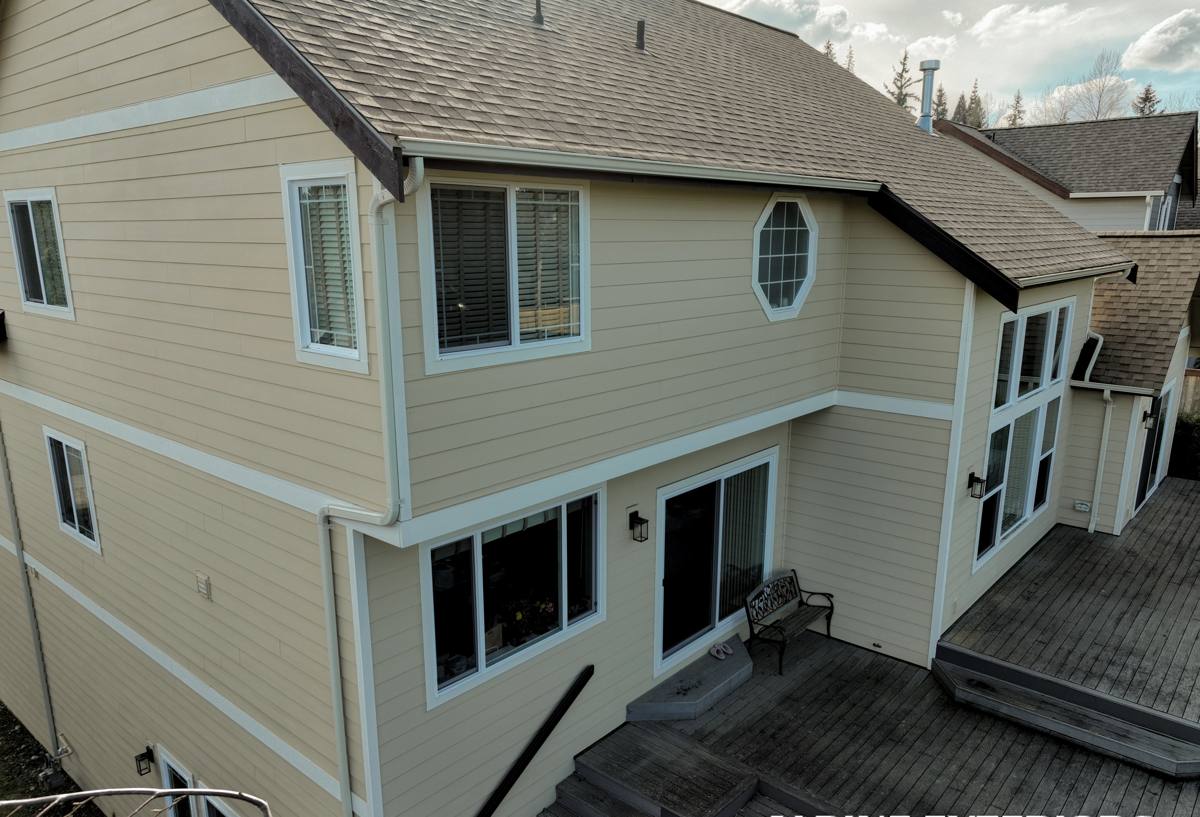
What Driving Rain and Salt Air Actually Do to a Wall
Driving Rain
Wind off the water doesn't just fall on a house — it drives rain horizontally into siding laps, around window and door trim, and into any gap where two materials meet. Over time, water that gets behind the siding and can't drain or dry out is what causes rot in sheathing and framing, not water that hits the face of the siding and runs off. A correct installation assumes some water will get past the outer layer and gives it a way out.
Salt Air
Airborne salt accelerates corrosion on anything metal — fasteners, flashing, trim connectors — and it degrades paint and coatings faster than it would a few miles inland. Materials and finishes that hold up fine in Bellingham or Ferndale can fail noticeably sooner right on the Birch Bay waterfront if they weren't specified with salt exposure in mind.
Moss and Algae Season
Whatcom County's wet stretch runs long, and shaded or north-facing walls in Birch Bay often stay damp far longer than walls with more sun exposure. Moss and algae need sustained moisture to establish, and once they take hold on a porous or poorly finished surface, they trap even more moisture against it — which speeds up whatever degradation is already happening underneath.
What a Correct Siding Installation Involves in This Environment
Good siding installation in Birch Bay isn't just nailing boards to a wall — it's a system, and every layer matters:
Drainage Plane and Rain Screen Gap
Behind the siding, a properly lapped water-resistive barrier gives incidental moisture a continuous path down and out. In high-exposure spots, a rain screen gap adds an air space that lets the wall dry from both sides instead of trapping moisture against the sheathing.
Flashing and Sealant Detail
Windows, doors, and any wall penetration are where driving rain finds its way in. Flashing has to be layered correctly — upper pieces overlapping lower ones — so water sheds outward at every transition, with sealant used to back up the flashing, not substitute for it.
Fastening for Wind and Salt Exposure
Fastener spacing and type matter more on exposed, wind-loaded walls, and corrosion-resistant fasteners are worth the small upcharge anywhere salt air is a factor. A fastener that starts rusting is a weak point that eventually telegraphs through the siding face.
Clearance and Ground Contact
Siding that sits too close to grade, decks, or roof lines stays wetter longer and is more likely to wick moisture. Proper clearances are a small detail that has an outsized effect on how a wall performs over the following decade.
Why We Install Only James Hardie Fiber Cement
We standardized on James Hardie fiber cement siding for every home we work on, including in Birch Bay, and we don't install vinyl, LP SmartSide, Cemplank, Allura, or wood siding like primed spruce or cedar. That's a deliberate professional standard, not a sales preference, and it comes down to how these products actually perform in a marine climate over time:
- Non-combustible core: Hardie's fiber cement doesn't burn, which matters in a region where wildfire smoke seasons have made ember exposure a real consideration even near the water.
- Built for moisture, not just painted against it: Hardie's HZ5 product line is engineered specifically for wet, freeze-humid climates like the Pacific Northwest coast — it's not a general-purpose board adapted after the fact.
- ColorPlus factory finish: The color is baked on in a controlled factory process rather than field-applied, which gives more consistent coverage and better resistance to fading and moisture intrusion at the finish layer than a job-site paint job.
- Fiber cement doesn't feed moss and algae the way wood-based products can, and it doesn't warp, rot, or attract insects the way solid wood siding does.
- Strong transferable warranty: Backed by a manufacturer warranty that transfers to a new owner, which matters for resale in a market like Birch Bay where a lot of buyers are looking hard at exterior condition.
We're not going to tell you vinyl or engineered wood siding is garbage — plenty of homes have it and it does a job. What we will say is that after years of installing and repairing siding in this exact climate, we've seen where each of those products tends to give out first — vinyl at the seams and fasteners in wind, engineered wood at any spot where the factory edge seal gets compromised, painted wood wherever maintenance lapses even briefly. Fiber cement, installed correctly, doesn't have those same failure points, and that's why it's the only thing we put on a house.
Our Installation Process
Every Birch Bay siding job we take on follows the same sequence, adjusted for the specific exposure of that lot:
- On-site assessment: We walk the exterior, check current siding and sheathing condition where accessible, and note which walls take the worst weather exposure.
- Detailed estimate: A written scope covering tear-off (if applicable), water-resistive barrier, flashing plan, Hardie product line and color, and fastening approach.
- Prep and moisture check: Any existing damage to sheathing or framing gets addressed before new siding goes on — covering up a wet wall is how small problems become expensive ones.
- Barrier and flashing installation: The water-resistive barrier, window and door flashing, and rain screen detailing go in first, and this is the step that determines how the wall performs for the next 30 years.
- Hardie siding installation: Panels or planks installed to manufacturer spec, with fastener type and spacing matched to the wall's wind and salt exposure.
- Trim, caulking, and final inspection: Trim and corner details finished, sealant applied only where it belongs, and a final walk-through before we call it done.
Cost Factors for a Birch Bay Siding Job
Every home is different, but these are the variables that most affect the scope and cost of a siding installation in Birch Bay specifically:
| Factor | Why It Matters in Birch Bay | Effect on the Job |
|---|---|---|
| Wall exposure to prevailing wind and rain | Waterfront and west-facing walls take more direct, driving rain | May call for added rain screen detailing or upgraded fastening |
| Existing siding and sheathing condition | Long moss/algae seasons can mask moisture damage underneath old siding | Tear-off jobs sometimes reveal sheathing repair needs once opened up |
| Home size and wall complexity | More corners, dormers, and trim details mean more flashing work | Directly affects labor time and material cutting |
| Hardie product line and finish selected | HZ5 and specific ColorPlus finishes are matched to climate and style | Material cost varies by plank profile and finish |
| Access and site conditions | Waterfront lots and sloped sites can limit staging and equipment access | May add setup time or require different scaffolding approach |
Signs a Birch Bay Home Needs New Siding
Homeowners in this area should watch for a specific set of warning signs, since the climate here tends to produce them earlier than it would inland:
- Persistent moss or algae growth that returns quickly after cleaning, especially on north- or water-facing walls
- Soft or spongy spots when you press on siding, particularly near the bottom edge or around windows
- Visible rust streaking from fasteners or metal flashing
- Paint that's peeling, bubbling, or chalking faster than expected for its age
- Warping, cupping, or separation at seams and butt joints
- A musty smell or visible staining on interior walls that back up to exterior siding
- Gaps opening up around window and door trim
Any one of these is worth a look. Several at once usually means it's time for a real evaluation rather than another round of patching.
Maintenance in a Moss-Prone, Salt-Air Environment
Even the right siding, installed correctly, benefits from a little seasonal attention in Birch Bay's climate. A soft wash to knock back moss and algae buildup before it establishes, a periodic check of caulking around windows and trim, and keeping gutters clear so water isn't sheeting down the wall face all go a long way. Hardie's factory ColorPlus finish reduces how often repainting is needed compared to field-painted wood siding, but it's not zero-maintenance — it's low-maintenance, which in this climate is still a meaningful advantage over the alternatives.
Why a Crew That Already Works Birch Bay Matters
Siding installation done to spec on paper can still underperform if the crew installing it hasn't accounted for how this specific stretch of coastline behaves. A contractor who works Birch Bay regularly already knows which walls tend to take the worst of the wind-driven rain, where moss establishes fastest, and how much clearance and flashing detail actually holds up here versus what a generic installation guide assumes. That local pattern recognition is the difference between a spec-compliant install and one that's genuinely built for this address.
If you're seeing early wear on your current siding, dealing with recurring moss, or just planning ahead for a home on or near the Birch Bay waterfront, we're happy to take a look and walk you through what correct installation would involve for your specific walls. Reach out for a free, no-pressure estimate — there's no obligation, just a straight assessment of what your home needs.