 Blaine
 California Creek's Climate Puts Real Demands on Exterior Siding
Homes in and around California Creek sit close enough to the water that salt-laden air is a daily fact of life, not an occasional event. Add in Whatcom County's long wet season, wind-driven rain that hits exposed walls at an angle instead of straight down, and the shade and humidity that come with the tree cover common in this part of Blaine, and you have a climate that is genuinely tough on exterior materials. Moss doesn't just grow on roofs here — it takes hold on north-facing walls, under eaves, and anywhere siding stays damp longer than it should.
None of this is unusual for coastal Whatcom County, but it does mean siding decisions that work fine in a drier inland climate can fail early here. Moisture that gets behind a wall assembly and can't dry out is the single biggest cause of premature siding failure we see, and it's the reason we treat every California Creek project as a moisture-management job first and a cosmetic upgrade second.
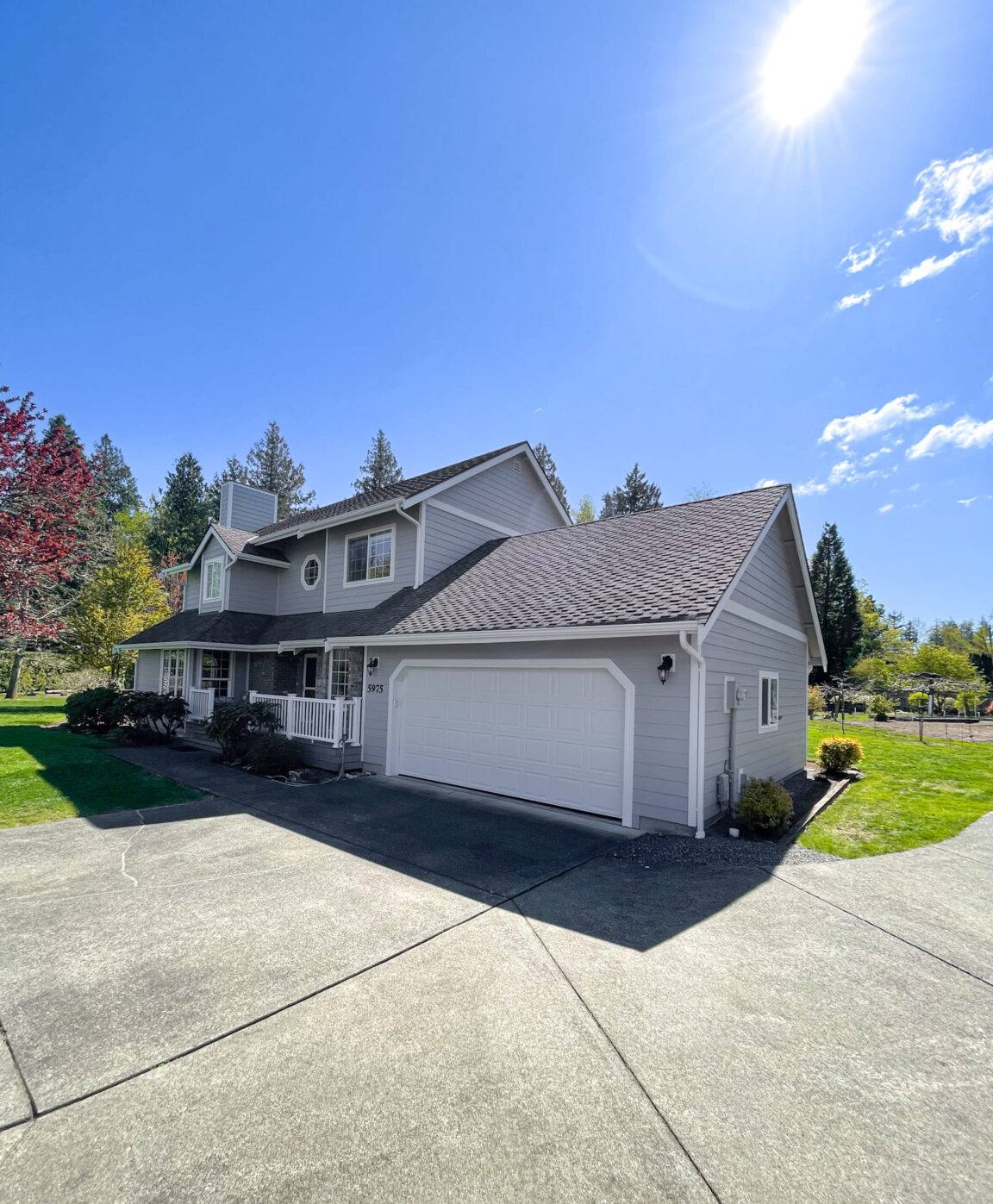
Why We Standardized on James Hardie for Homes Like Yours
We install James Hardie fiber cement siding exclusively. We don't install vinyl, LP SmartSide, Cemplank, Allura, primed spruce, or cedar, and that's a deliberate standard, not a limitation of what we're capable of installing. Each of those alternatives has real strengths, but each also comes with a trade-off — vinyl can warp and fade in direct salt exposure, wood-based products need more diligent maintenance to keep moisture out, and engineered wood siding is more sensitive to the kind of sustained dampness this area gets for months at a stretch.
James Hardie fiber cement is non-combustible, dimensionally stable in wet-dry cycling, and comes with a factory-applied ColorPlus finish that's baked on rather than field-painted, which matters in a climate where paint failure and moss staining are constant threats to a fresh-looking exterior. Hardie also engineers its siding by climate zone, with product formulations matched to freeze-thaw, high-moisture regions like ours rather than a single one-size-fits-all board. That's the combination we've built our business around, and it's what goes on every home we work on in California Creek.
What This Means for Your Project
Because we only work with one manufacturer's system, our crews aren't relearning installation details from job to job. Flashing details, fastener spacing, and caulking practices stay consistent, which is a meaningful advantage in a climate where small installation mistakes show up as moisture problems within a few wet seasons rather than a few decades.
What a Correct James Hardie Installation Involves Here
Fiber cement siding is only as good as the assembly behind it. In a marine climate like California Creek's, the installation details matter more than the brand name on the board. A correct job includes:
- A continuous weather-resistive barrier installed and lapped correctly, with no gaps at seams, corners, or penetrations
- Proper flashing above windows, doors, and any horizontal trim, plus kickout flashing where roof lines meet walls
- Correct gapping between boards and trim per Hardie's published specifications, so the material can expand and contract without trapping moisture
- Fasteners driven at the correct depth and spacing — overdriven nails crack the board's edge and create a moisture entry point
- Sealant used only where Hardie's installation instructions call for it, not as a substitute for proper flashing
Skipping any one of these doesn't show up on day one. It shows up two or three winters later as staining, soft trim, or moss establishing itself at a seam that should have stayed dry. That delayed feedback loop is exactly why installation quality matters more here than in a drier climate, where a minor flashing gap might never become a real problem.
Moisture Management Is the Real Job
We treat drainage planes, kickout flashing at roof-wall intersections, and proper clearance between siding and grade or decking as non-negotiable, not optional upgrades. In a location that gets sustained wind-driven rain, these details are what keep water moving down and away from the wall assembly instead of soaking into it.
Hardie Product Lines That Fit California Creek Homes
James Hardie makes several siding profiles, and the right choice depends on your home's style and how exposed different elevations are to wind and rain. We walk through these options during the estimate rather than defaulting to one look for every house.
| Profile | Typical Use | Notes for This Climate |
|---|---|---|
| HardiePlank lap siding | Most common choice for full re-sides | Clean, traditional look; performs well on exposed elevations when flashed correctly |
| HardieShingle | Accent areas, gables, some full facades | More seams than lap siding, so installation detail at each course matters more in wet weather |
| HardiePanel | Modern or board-and-batten styles | Fewer horizontal joints; good option for simplifying drainage detailing on complex walls |
| HardieTrim | Corners, window and door casing, fascia | Matched material and finish avoid the rot risk of wood trim in a moss-prone environment |
Our Process, Start to Finish
- Free on-site estimate, including a look at current siding condition, moisture staining, and any soft or damaged sheathing
- Product and color selection from Hardie's ColorPlus and primed lines, matched to your home's exposure and style
- Removal of existing siding and inspection of the wall sheathing underneath, with repairs made before anything new goes up
- Installation of the weather-resistive barrier, flashing, and drainage details specific to your home's roof lines and window openings
- Hardie siding installation following manufacturer fastening and gapping specifications
- Trim, caulking, and touch-up work at cut edges
- Final walkthrough and warranty registration
We don't skip the sheathing inspection step to save time. In this climate, hidden rot behind old siding is common enough that finding it before the new siding goes on — rather than after — is what keeps the new installation from failing early.
What Affects the Cost of a James Hardie Project in This Area
Every home is different, but the same handful of factors drive most of the cost variation we see on California Creek projects.
| Cost Factor | Why It Matters |
|---|---|
| Home size and wall complexity | More corners, gables, and dormers mean more cutting, flashing, and trim work |
| Condition of existing sheathing | Rot or moisture damage found during tear-off needs repair before new siding goes on |
| Siding profile chosen | Shingle and mixed-material designs generally take more labor than straight lap siding |
| Trim and accent scope | Full trim replacement adds cost but removes wood rot risk long-term |
| Site access and exposure | Steep grades, limited access, or heavy tree cover can add setup and protection time |
We give straightforward, itemized estimates so you can see where the money is going, rather than a single lump number that hides which parts of the job are driving cost.
Maintenance in a Salt Air, Moss-Prone Climate
James Hardie siding is low-maintenance compared to wood, but "low-maintenance" isn't "no-maintenance" in a climate like this. A few simple habits go a long way toward protecting the investment:
- Rinse salt residue and general grime off the siding once or twice a year, especially on wind-exposed walls
- Keep gutters clear so overflow isn't running down the siding face during heavy rain
- Trim back vegetation and tree limbs that shade a wall constantly, since shaded, damp walls are where moss takes hold first
- Check caulking at trim joints and penetrations every couple of years and have any cracked sealant redone
- Address any soft trim or staining early rather than waiting, since moisture problems in this climate rarely stay small
Why Hire a Crew That Already Works in California Creek
Siding crews that mostly work drier, inland climates don't always carry over the flashing and drainage habits this area demands. A crew that regularly works Blaine and the surrounding Whatcom County coastline already knows which elevations take the worst wind-driven rain, how much moss pressure to expect on shaded walls, and where sheathing rot tends to show up first on homes of this age and construction. That familiarity shows up in the details — the kickout flashing that actually gets installed, the gapping that's done to spec instead of eyeballed, the trim choices that hold up instead of needing attention again in a few years.
It also matters for warranty support after the job is done. A local crew that's still working in the area is easy to reach if a question comes up down the road, rather than a contractor who was passing through for one project and is gone.
If you're weighing your siding options for a home in or near California Creek, we're happy to walk the property, look at what's driving wear on your current siding, and put together a straightforward, no-pressure estimate for a James Hardie installation built for this exact climate. There's a form below to get that conversation started.