 Blaine
 Decking Built for Cherry Point's Weather, Not Against It
Cherry Point sits close enough to open water that homes here deal with a version of the weather that inland Whatcom County properties mostly avoid. Salt-laden air off the water accelerates corrosion on anything metal. Driving rain, pushed by wind rather than falling straight down, gets up under rail caps and into end grain that a calmer climate would leave alone. And the long stretch of overcast, damp months every year gives moss and algae a real head start on any deck surface that doesn't shed water well. None of this makes composite decking a bad idea for Cherry Point — it makes it the right idea, but only when the install accounts for these conditions instead of following a generic spec sheet.
A composite deck built for a dry inland yard and a composite deck built for a Cherry Point shoreline lot should not look identical underneath the surface. The boards might be the same product, but the fasteners, the substructure, the flashing, and the airflow details all need to change to match what this location actually throws at a deck year after year.
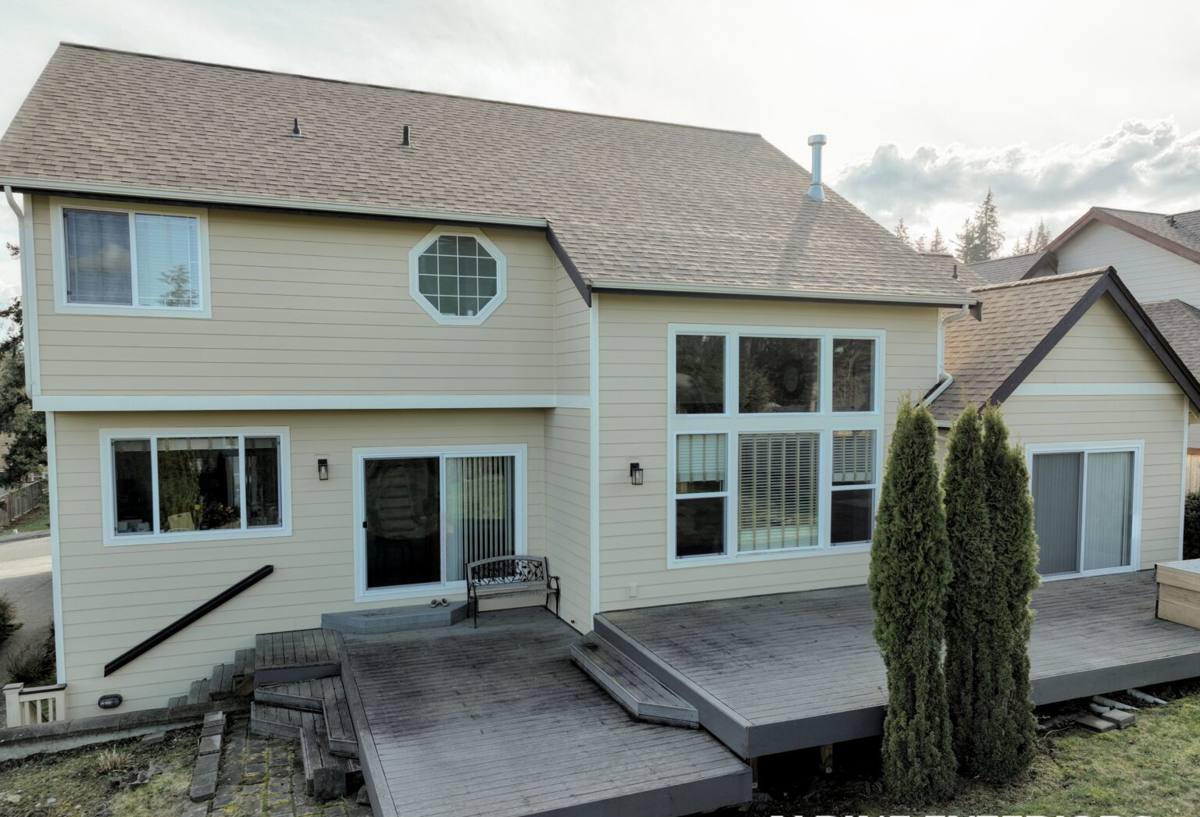
What Cherry Point's Climate Demands From a Deck
Salt Air and Hardware
Composite boards themselves don't rust or rot, which is a big part of their appeal here. But every deck still depends on fasteners, brackets, post bases, and railing hardware — and standard galvanized hardware degrades faster in marine-influenced air than it does twenty miles inland. We spec stainless steel or coated fasteners rated for coastal exposure on Cherry Point jobs, because a deck that looks fine on the surface but has corroding connectors underneath is a problem waiting to surface in a few years, not a decade.
Driving Rain and Water Management
Wind-driven rain doesn't behave like a straight-down shower. It gets pushed sideways into ledger connections, under poorly flashed rim joists, and into any gap where two materials meet without a proper seal. A deck built for this area needs real flashing at the house attachment point, not just caulk, and board layouts that account for water actually running off rather than pooling at low spots.
Moss Season and Airflow
Whatcom County's damp season runs long, and a deck with poor ventilation underneath stays wet longer than one that can breathe. Composite decking resists rot, but a damp, shaded understructure still grows moss and algae on the board surface itself, especially on the north side of a house or under heavy tree cover. Proper joist spacing, deck height off grade, and gaps between boards all affect how quickly a Cherry Point deck dries out after a week of rain — and how much moss you're scrubbing off it every spring.
Composite vs. Other Decking Materials for This Location
Homeowners near Cherry Point usually compare composite against wood or PVC before deciding. Here's how they stack up against this specific climate:
| Material | Salt Air / Corrosion | Rain & Moisture | Moss / Algae Resistance | Typical Maintenance |
|---|---|---|---|---|
| Wood (cedar, treated pine) | Fasteners corrode faster; wood itself is unaffected by salt but needs regular sealing | Absorbs moisture, prone to cupping and splitting over time | Grows moss readily if not cleaned and treated | Annual staining/sealing, regular cleaning |
| Composite (capped) | Board unaffected; hardware still needs coastal-rated fasteners | Doesn't absorb water into the board core | Resists staining better than wood; still needs periodic cleaning in shaded/damp spots | Occasional washing, no sealing or staining |
| PVC | Board unaffected; same fastener consideration as composite | Fully water-resistant board | Similar resistance to composite; can show surface grime in low-airflow areas | Occasional washing |
Composite is our standard recommendation for most Cherry Point homes because it balances upfront cost, appearance, and long-term maintenance well for this climate. PVC is a reasonable step up for homeowners who want to minimize moisture concerns even further and are comfortable with the added cost. Wood can still make sense on a budget, but the maintenance schedule needed to keep it looking good in this climate is real and ongoing — that's a trade-off, not a defect in the wood.
Cost Factors on a Cherry Point Deck Project
Every deck is different, so we won't quote a number without seeing the site, but these are the variables that actually move the price:
| Factor | Why It Matters Here |
|---|---|
| Existing structure condition | Older wood decks near the water often have hidden corrosion or rot at ledger and post connections that isn't visible until demo starts |
| Height and railing requirements | Elevated decks common on sloped or view lots require code-compliant guardrails, which adds material and labor |
| Board and fastener grade | Coastal-rated hardware and higher-tier capped composite cost more upfront but reduce callbacks and corrosion issues |
| Site access | Waterfront and bluff-adjacent lots can complicate material staging and equipment access |
| Substructure ventilation needs | Low-clearance decks may need additional grading or venting work to manage moisture properly |
How We Approach a Cherry Point Composite Deck
Our process doesn't change dramatically from site to site, but the details we check are shaped by what this area does to a deck over time.
- On-site assessment — we look at existing structure (if replacing an old deck), grade and drainage around the footprint, sun/shade exposure, and how exposed the site is to prevailing wind and rain.
- Structural and code check — ledger attachment, footings, joist sizing, and railing height are verified against current code requirements before any material is ordered.
- Demo (if applicable) — old decking and, where needed, damaged framing are removed and hauled off; we flag any rot or corrosion found underneath before closing anything back up.
- Framing and flashing — joists are set with proper spacing for the composite product chosen, and flashing is installed correctly at the house connection to manage driving rain.
- Fastener selection — coastal-rated hardware and hidden fastener systems are used throughout, matched to the specific composite product's requirements.
- Decking and railing install — boards are laid with correct expansion gaps and, where the site calls for it, ventilation gaps to help the structure dry out after wet weeks.
- Final walkthrough — we cover basic care, what to expect in the first year, and answer any questions before we consider the job done.
Moss, Algae, and Keeping a Cherry Point Deck Looking Right
Composite decking is low-maintenance, not no-maintenance, especially with a moss season as long as Whatcom County's. A well-built deck with good airflow underneath and a decent amount of sun exposure will need far less attention than a shaded, low-clearance deck tucked against tree cover. Either way, a little seasonal upkeep goes a long way toward keeping the surface clean and slip-resistant.
- Sweep off leaves, needles, and debris regularly, especially in fall — trapped organic matter holds moisture and feeds moss growth
- Rinse the deck surface periodically during the wet months, particularly in shaded areas
- Use a soft-bristle brush and a cleaner rated for composite decking if moss or algae does take hold — avoid pressure washing at close range, which can damage the board surface
- Check that gaps between boards stay clear so water can drain through rather than sitting on top
- Inspect railing posts and fastener points once a year for any signs of loosening or corrosion, especially on decks closer to the water
- Trim back overhanging branches or vegetation that keeps a section of the deck shaded and damp longer than the rest
Permits, Railings, and Building Code in Whatcom County
Most deck rebuilds and new installs in this area require a permit, and inspectors will look closely at ledger attachment, footing depth, and guardrail height and spacing — details that matter more on elevated or waterfront lots where a fall has real consequences. We handle the permitting process as part of the job rather than leaving homeowners to sort out paperwork on their own, and we build to the code requirements that apply here, not a generic national minimum.
Why Hiring a Crew That Already Works Cherry Point Matters
A contractor who mostly builds decks in drier, inland parts of the county can still do competent work — but they may not automatically reach for coastal-rated fasteners, may not think twice about ventilation on a shaded lot, and may not have a feel for how a particular slope or tree line affects moss growth on a deck through the winter. Those aren't exotic skills, but they're the kind of judgment calls that come from having actually built and maintained decks in this specific setting, near this specific water, through more than one wet season. That's the difference between a deck that looks good on installation day and one that still looks good five winters later.
If you're planning a new composite deck or replacing an aging one near Cherry Point, we're happy to come take a look and walk the site with you. There's no cost and no pressure — just a straightforward assessment and an honest estimate based on what your property actually needs. Use the form below to get in touch.