 Blaine
 Decking Built for Blaine Harbor, Not Just for Whatcom County in General
Blaine Harbor sits close enough to Semiahmoo Bay and the Strait of Georgia that salt air is part of daily life, not an occasional visitor. That changes what a deck has to survive. A composite deck built for a home a few miles inland in Whatcom County can get away with a little less attention to fastener choice and airflow underneath the boards. A deck at Blaine Harbor doesn't get that pass. Between salt-laden air, driving rain off the water, and a moss season that can run from fall through spring, the harbor asks more of every material in the build — the boards, the frame underneath them, and every screw and bracket holding it together.
This page is specifically about composite decking for homes in and around Blaine Harbor — what the local conditions demand, what a correct installation actually involves, and what we do differently because we already work this stretch of coastline.
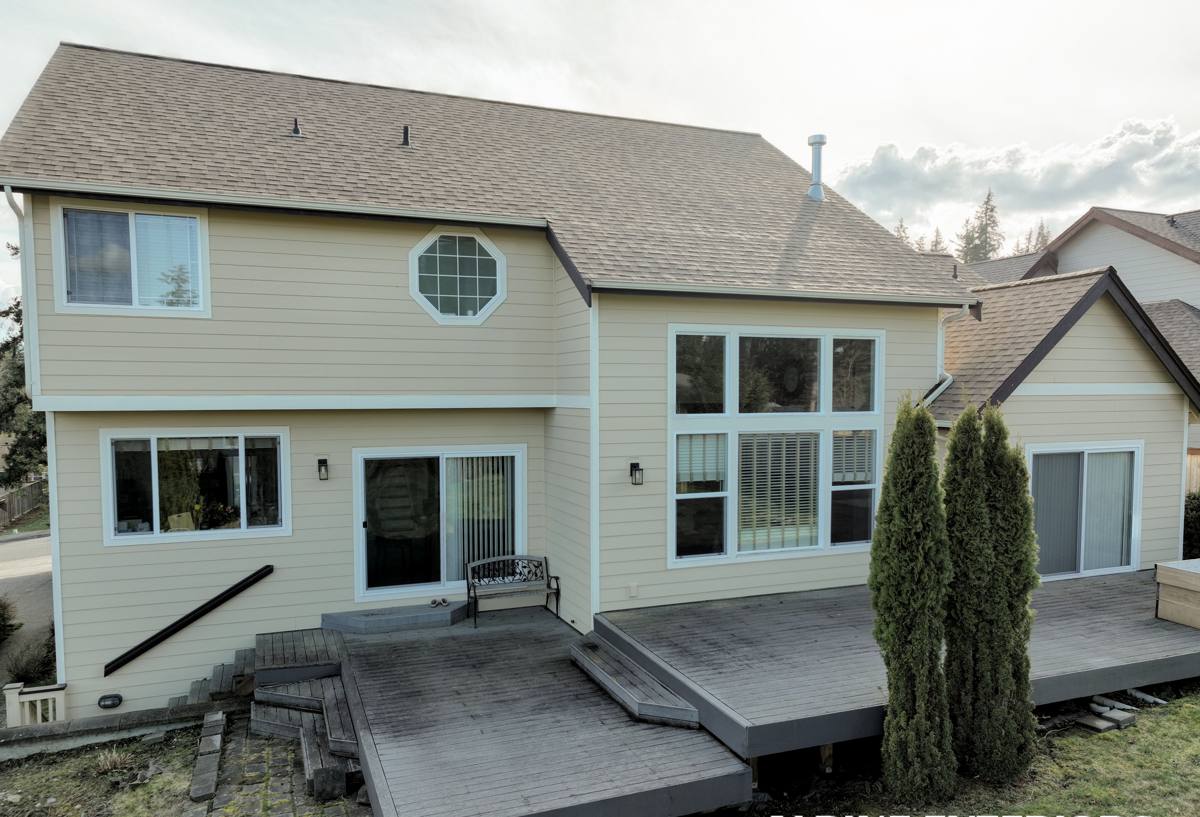
What Salt Air, Rain, and Moss Actually Do to a Deck
Salt Air
Airborne salt doesn't just sit on the surface — it works into any exposed metal fastener, bracket, or ledger connection over time. On a standard wood deck this shows up as rusting nail heads and corroded joist hangers years before the boards themselves fail. Composite decking boards are largely unaffected by salt exposure directly, but the frame and fasteners underneath them are not, which is why the substructure matters just as much as the decking material itself in a location like this.
Driving Rain
Wind off the water pushes rain sideways and up under railings, fascia, and board ends more than a typical inland storm would. Water finds the same weak points every time: end cuts that weren't sealed, ledger boards without proper flashing, and gaps where boards butt against the house. A deck that's only built to shed water straight down will let water into places a well-flashed deck keeps dry.
Moss Season
Blaine's long stretch of cool, wet months gives moss and algae plenty of time to take hold on any surface that stays damp and shaded. Composite boards resist rot, but a textured composite surface with poor drainage underneath can still grow a moss film if air can't move beneath the deck and water has nowhere to go. That's a maintenance and slip-hazard issue more than a structural one, but it's worth planning for at the design stage rather than fighting with a pressure washer every spring.
Why Composite Makes Sense in This Environment
Composite decking is a reasonable fit for Blaine Harbor precisely because it removes the failure mode that hurts wood decks fastest here: moisture absorption into the board itself. Wood decking in a salt-air, high-rain environment cups, splinters, and rots at a pace that surprises a lot of homeowners who installed it expecting a 20-year deck. Composite boards don't absorb water the way wood does, so they hold their shape and color longer under the same exposure.
That doesn't mean composite is maintenance-free or bulletproof to the elements — it means the risk shifts from the boards to the structure underneath and the details of the install. Get those right, and composite is one of the more sensible long-term choices for a harbor-adjacent home. Get them wrong, and you can still end up with a deck that traps moisture, grows moss, or loosens at the frame within a few seasons.
What a Correct Composite Deck Build Involves Here
- Pressure-treated or naturally decay-resistant framing lumber, sized and spaced to the manufacturer's specification for the board profile used
- Corrosion-resistant fasteners and joist hangers rated for coastal or treated-lumber exposure — not standard interior-grade hardware
- Proper ledger flashing where the deck attaches to the house, so wind-driven rain can't track behind the siding
- Deck board spacing and hidden-fastener systems set to the manufacturer's expansion and drainage tolerances
- Airflow underneath the deck — adequate joist height off grade and, where the deck is low to the ground, ventilation that lets the structure dry out between rains
- Sealed or capped board end cuts wherever a factory-capped edge was cut on site
- Railing posts and baluster hardware matched to the same corrosion-resistant standard as the deck fasteners
Skipping any one of these doesn't usually show up on install day. It shows up two or three winters later, as a squeaky board, a rusted hanger stain bleeding through, or a soft spot at the ledger. That lag is exactly why the framing and fastener choices matter more than the composite brand name on the box.
Composite vs. Wood vs. PVC — What Fits a Harbor-Adjacent Deck
| Material | Salt Air Behavior | Rain / Moisture Behavior | Maintenance |
|---|---|---|---|
| Pressure-treated wood | Fasteners corrode faster; wood itself is unaffected by salt directly | Absorbs water, prone to cupping and splitting over time | Regular staining/sealing required to hold up |
| Composite | Board unaffected; frame and fasteners still need corrosion resistance | Doesn't absorb water into the board; drainage design still matters | Periodic cleaning; no staining or sealing |
| PVC/cellular | Fully unaffected | Fully water-resistant; can trap moisture under low-airflow installs if not detailed correctly | Low; can show surface wear differently than composite over time |
We install composite most often in this area because it balances upfront cost, appearance, and long-term durability well for the conditions. Where a homeowner wants the lowest possible moisture risk and budget allows for it, PVC decking is a reasonable alternative — we'll walk through that trade-off honestly rather than push one product regardless of the situation.
Our Process for a Blaine Harbor Composite Deck
1. Site and Exposure Assessment
We look at how much direct salt exposure the deck location gets, which direction the prevailing wind and rain come from, how much shade it holds through the wet months, and how the current structure (if replacing an old deck) has held up. That tells us where extra flashing, drainage, or ventilation attention is needed.
2. Frame Inspection or Rebuild
If we're replacing decking over an existing frame, we inspect every joist, ledger connection, and post base before we put a single composite board down. A frame with hidden rot or corroded hardware doesn't get covered up — it gets repaired or rebuilt, because composite boards on a compromised frame just hide the problem instead of solving it.
3. Fastening and Flashing
Ledger flashing, hanger hardware, and fasteners are chosen for the exposure level, not the cheapest compliant option. This is the step that determines whether the deck is still tight and quiet in five years.
4. Board Installation
Boards are installed to the manufacturer's spacing and fastening spec, with attention to drainage slope and end-cut sealing at every cut made on site.
5. Railings and Final Details
Railing and baluster hardware is matched to the same corrosion standard as the deck itself, since railing posts take direct weather exposure and see the most stress from daily use.
What to Ask Any Contractor Before They Touch Your Deck
- What fastener and hanger hardware will be used, and is it rated for coastal or treated-lumber exposure?
- How will the ledger be flashed where the deck meets the house?
- What's the plan for airflow underneath the deck if it sits low to the ground?
- Will exposed end cuts be sealed, and how?
- Do they have experience with decks specifically in Blaine Harbor or comparable waterfront conditions in Whatcom County — not just decking in general?
A contractor who can answer these specifically, without generic reassurances, is one who has actually built decks in this kind of exposure before.
Why Local Experience at the Harbor Matters
Composite decking installation itself isn't exotic — plenty of crews can fasten boards to a frame. What separates a deck that holds up at Blaine Harbor from one that doesn't is the set of decisions made before the first board goes down: fastener grade, flashing detail, ventilation, and drainage slope, all sized to the actual exposure the deck will see. Those decisions come from having built and later serviced decks in this specific environment, not from a generic install checklist written for a national market.
We work Blaine and the surrounding Whatcom County coastline regularly, which means we've seen how decks in this area actually age — what holds up after a few winters of salt air and driving rain, and what doesn't. That's the difference we bring to a Blaine Harbor composite deck project.
Get a Straight Answer on Your Deck
If you're planning a new composite deck or replacing an aging one at Blaine Harbor, we're happy to take a look and give you an honest read on what your specific site needs — no pressure, no upsell. Use the form below to request a free estimate.