 Blaine
 Building Decks for Nooksack's Particular Climate
Nooksack sits inland along the river valley in Whatcom County, close enough to the Strait of Georgia and the Salish Sea that the same moisture-heavy marine air that soaks Blaine and the rest of northwest Washington still settles here. What makes decks in this area behave differently than decks built in drier parts of the state isn't one dramatic weather event — it's the steady, unglamorous combination of long wet seasons, humid river-valley air, and short winter days that never quite dry a deck out before the next rain arrives. A deck built here needs to be planned around that reality from the first sketch, not patched up for it after the fact.
We build and repair decks throughout the Nooksack area and the surrounding Whatcom County communities, and the patterns repeat: decks that looked fine going into their third or fourth winter start showing soft spots, dark staining, and moss creeping across boards that never get direct sun. None of that is inevitable. It's the predictable result of a deck that was designed for a drier climate, or built without enough attention to drainage, airflow, and material choice.
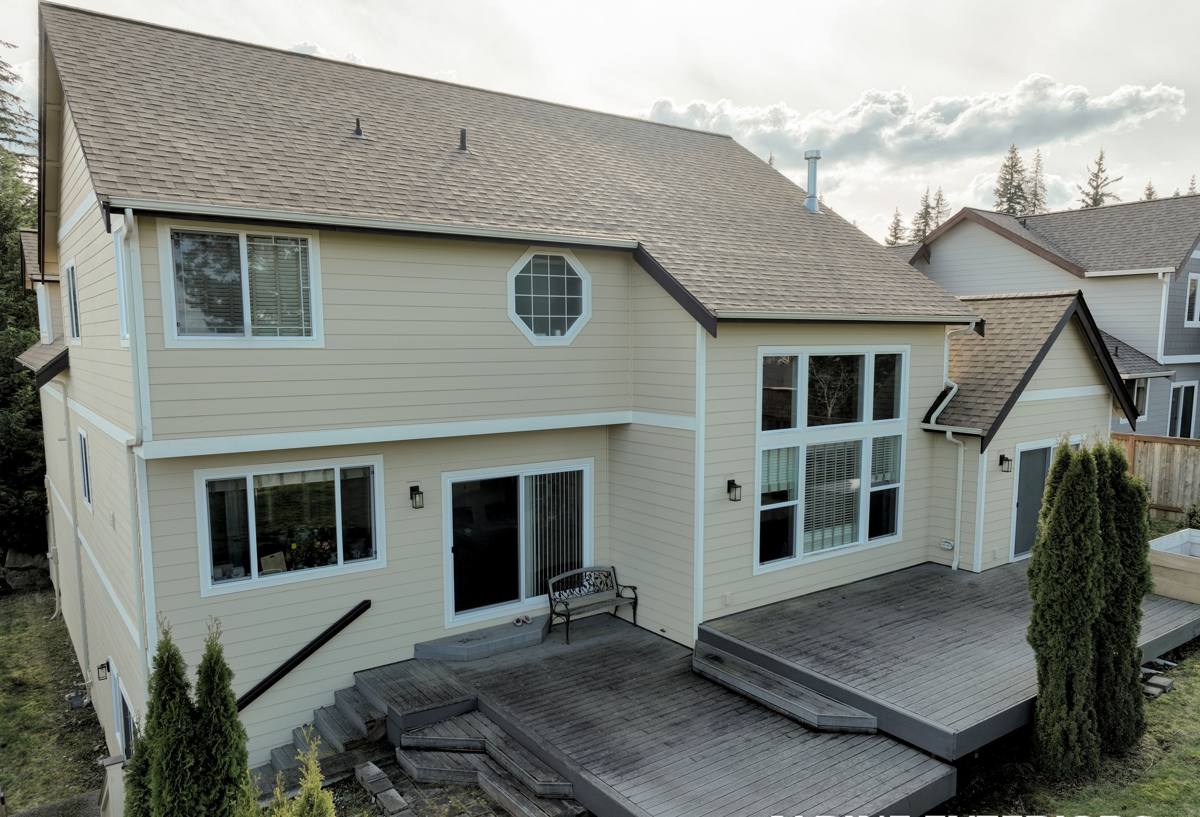
What Damp Northwest Weather Actually Does to a Deck
Understanding the failure modes is the first step to avoiding them. In a climate like this, decks don't usually fail all at once — they fail slowly, in ways that are easy to miss until the damage is structural.
Wood Rot and Soft Spots
Untreated or poorly sealed wood absorbs moisture faster than it can release it during our long stretches of overcast, damp weather. Rot typically starts where water sits the longest: under railing posts, around fastener heads, and at the ledger board where the deck attaches to the house.
Moss, Algae, and Surface Staining
Moss needs shade, moisture, and time — Nooksack winters supply all three. Moss on a deck surface isn't just cosmetic; it holds water against the wood, feeds mildew growth, and turns boards slick and genuinely dangerous underfoot.
Corroding Fasteners and Hardware
Standard hardware corrodes faster in persistently damp, mineral-rich Northwest air. Rust stains bleed into the wood around screw heads and joist hangers, and weakened fasteners are one of the more common hidden problems we find on older decks.
Decking Materials That Hold Up in Whatcom County
There's no single "best" decking material — the right choice depends on budget, how much upkeep you want to do, and how much shade or sun the deck actually gets. Here's how the common options compare for our climate specifically:
| Material | Moisture Resistance | Moss/Mold Resistance | Upkeep |
|---|---|---|---|
| Pressure-treated pine | Good, if properly sealed and resealed | Fair — needs regular cleaning in shaded areas | Highest — annual inspection and periodic sealing |
| Western red cedar | Good natural resistance to rot | Fair to good, naturally rot-resistant oils help | Moderate — occasional cleaning and oiling |
| Capped composite | Excellent — won't absorb water or rot | Good — surface sheds moss more easily than wood | Low — occasional washing |
| PVC decking | Excellent — fully impervious to moisture | Good, though shaded areas still need occasional cleaning | Lowest of the group |
We'll walk you through these trade-offs honestly during your estimate rather than pushing whatever has the highest markup. A shaded, north-facing deck under mature trees is a different project than a sunny, open deck off a south-facing wall, even on the same street.
Framing and Substructure: Where Most Deck Failures Start
The parts of a deck nobody sees are the parts that determine how long it lasts. This is especially true in a climate where moisture works on a structure year-round instead of drying out for months at a time.
- Ledger board flashing — where the deck attaches to the house is the single most common source of hidden rot; proper flashing and a water-resistant barrier behind it are non-negotiable.
- Footing depth — footings need to be set below the frost line and properly drained so seasonal freeze-thaw cycles don't shift or crack them over time.
- Joist protection — joist tape or a comparable moisture barrier over the tops of joists keeps water from wicking into the wood through every single fastener hole.
- Fastener grade — corrosion-resistant, code-rated fasteners matched to the decking material prevent the rust staining and hardware failure that plague budget builds.
Cutting corners here is invisible on install day and expensive five years later. A deck's substructure is the part worth spending on, even if it means a slightly plainer railing or a smaller footprint.
Design Choices That Cut Down on Moss and Standing Water
A well-designed deck fights moss and moisture passively, through its shape and layout, instead of relying entirely on maintenance to keep up. A few details make an outsized difference here:
Gapping and Board Orientation
Correct spacing between boards lets water drain through instead of pooling on the surface. Board orientation and gap width should account for shaded sections separately from sun-exposed ones — a uniform gap that works in full sun can be too tight in a shaded corner where debris and needles collect.
Airflow Underneath
Skirting and understructure design should allow air to move beneath the deck rather than sealing in moisture. Solid, unventilated skirting looks tidy but traps the exact damp conditions that accelerate rot in framing.
Water Management Around the Deck
Gutters, downspouts, and grading near the house should route water away from deck footings and ledger connections, not toward them. This is a detail that's easy to overlook when the deck is designed separately from the rest of the drainage on the property.
Our Process for a Nooksack Deck Project
We keep the process straightforward because a deck project shouldn't feel like a mystery to the homeowner paying for it.
- On-site assessment — we look at sun exposure, shade patterns, drainage, existing structure (for replacements), and how you actually plan to use the space.
- Design and material selection — we walk through decking, railing, and framing options against your budget and how much maintenance you're willing to take on.
- Permitting — Whatcom County deck permitting requirements depend on the deck's height and attachment to the house; we handle that process rather than leaving it to you.
- Construction — proper footings, flashing, and framing first, with inspections built into the schedule, then decking, railings, and finishing.
- Final walkthrough — we go over the finished deck together and cover basic care so it holds up the way it's built to.
Maintenance Checklist for Nooksack Deck Owners
Even the best-built deck needs some seasonal attention in this climate. This is the routine we recommend to homeowners after a new build or a rebuild:
- Sweep debris out of board gaps before it decomposes and holds moisture against the wood
- Scrub visible moss and algae off the surface as soon as it appears, especially in shaded areas
- Check and reseal or refinish wood decking on the schedule appropriate to the product (annually for most treated wood)
- Inspect fasteners and hardware for rust staining or loosening once a year
- Confirm gutters and downspouts near the deck are clear and still draining away from the structure
- Trim back overhanging vegetation to reduce shade and improve airflow across the deck surface
- Look under the deck periodically for signs of moisture buildup or soft framing
Why Local Experience in the Nooksack Area Matters
A deck built by a crew that hasn't worked much in Whatcom County tends to make the same avoidable mistakes: not enough attention to shaded-area moss, generic material recommendations that ignore the local moisture load, or drainage details that work fine in a drier climate but fall short here. Crews who already work in Nooksack and the surrounding area know the permitting process, understand how the region's rain and humidity patterns actually stress a deck year over year, and design around that from the start instead of learning it the hard way on your project.
That local familiarity also means fewer surprises during permitting, more realistic timelines around the wetter months, and material recommendations based on what actually performs here rather than what performs well in a showroom or a different climate zone.
Get a Straightforward Estimate
If you're planning a new deck or replacing one that's showing its age, we're happy to come take a look and talk through what makes sense for your home, your budget, and this climate — no pressure, no upsell. Use the form below to request a free estimate.