 Blaine
 Siding Replacement in Peace Arch: A Border Neighborhood That Wears Fast
Peace Arch sits at the edge of Blaine, right by the international border crossing and close enough to the water that salt air is a daily fact of life here, not an occasional nuisance. Homes in this part of Whatcom County take on a steady combination of salt-laden air, wind-driven rain rolling in off the water, and a moss season that barely lets up between fall and spring. That combination wears down exterior siding faster than it does in more sheltered parts of the county, and it's a big part of why siding replacement, not just patch repair, comes up so often for homeowners here.
We install James Hardie fiber cement siding exclusively, and Peace Arch is regular territory for our crew. This page is about one job specifically: full siding replacement on Peace Arch homes, what the climate demands of it, what a correct replacement actually involves, and how our process works from first estimate to final walkthrough.
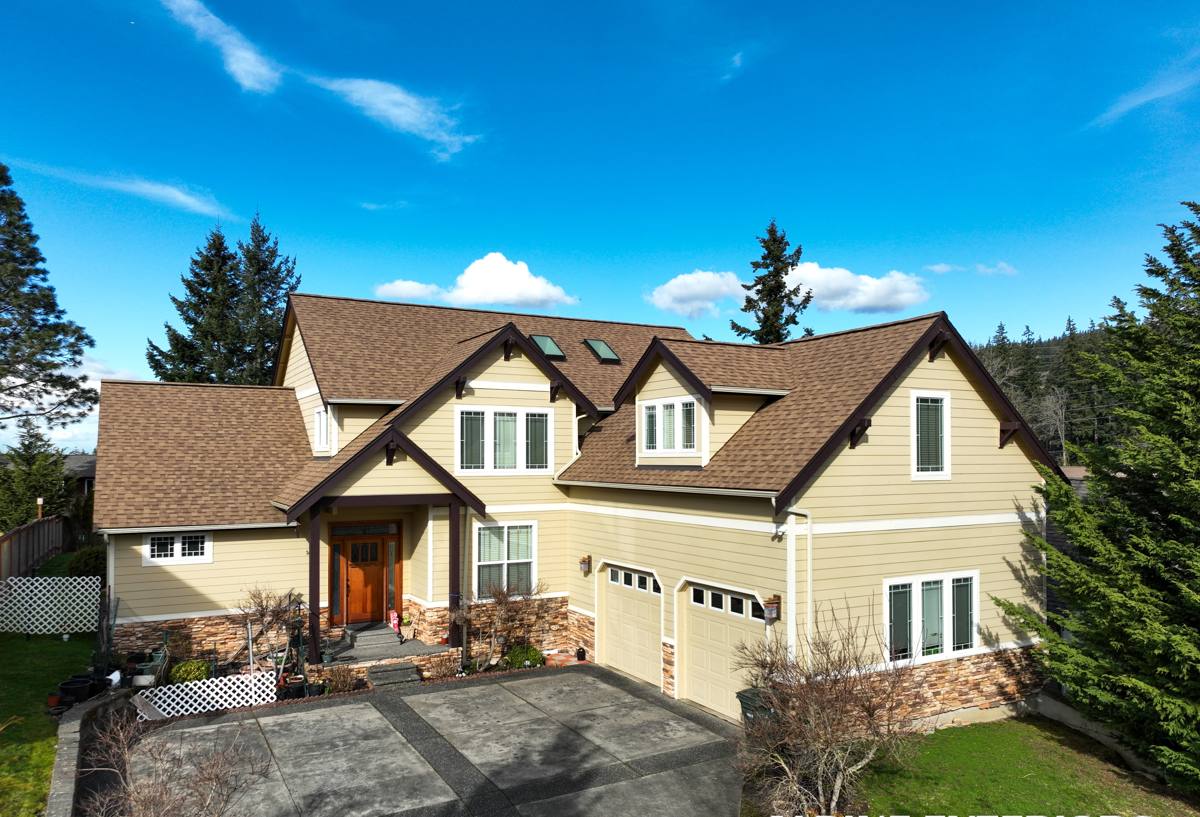
Why Peace Arch Wears Out Siding Faster Than Average
Salt Air Off the Water
Being this close to the border and the water means Peace Arch homes get a steadier dose of salt-laden air than towns set further inland. Salt speeds up corrosion in fasteners, flashing, and any exposed metal trim, and it breaks down lower-grade paints and coatings faster than a dry climate ever would. On a siding replacement, that means material and hardware choices carry more weight here than they would on an equivalent job twenty miles inland.
Driving Rain With Nothing to Block It
Storms coming off the water don't fall straight down on Peace Arch — wind pushes rain sideways into wall assemblies, window flashing, and the joints where trim meets siding. That sideways load finds gaps a rushed installation would leave behind, which is exactly why so many of the siding failures we see out here started as a flashing or joint problem rather than a failure of the siding material itself.
A Moss Season That Runs Most of the Year
Mild temperatures and near-constant moisture add up to a moss and mildew season that can run eight or nine months out of twelve on shaded or north-facing walls. Any siding material with even a little surface porosity becomes a growth surface over time, and Peace Arch's mix of mature trees and closely spaced lots means plenty of walls stay damp and shaded long after a storm has passed.
Signs Your Peace Arch Home Needs Replacement, Not Just Repair
Not every siding problem calls for a full tear-off. But in a climate like this, a handful of signs usually mean the underlying material or the original installation has failed in a way that repair alone won't fix.
- Soft, spongy, or crumbling spots when you press on the siding, especially near the bottom courses or under windows
- Persistent staining or dark streaking that comes back within weeks of being cleaned
- Paint that's peeling, bubbling, or chalking heavily across large sections rather than one isolated spot
- Visible gaps, warping, or cupping in individual boards or panels
- A musty smell near exterior walls, which often points to moisture already inside the wall assembly
- Siding that's original to a home built more than 20-25 years ago, especially if it's never been fully inspected behind the surface
Any one of these on its own might be a localized repair. Several together, especially on a home that's taken a few decades of salt air and driving rain, usually means the whole wall assembly needs a proper look before deciding what's actually salvageable.
Why We Replace With James Hardie Fiber Cement, and Nothing Else
We used to install a wider range of siding products. We stopped, and the decision came from what we found tearing off failed siding on homes in exposed, moisture-heavy spots like Peace Arch — not from a supplier deal or a marketing angle.
- Non-combustible core: fiber cement doesn't feed a fire the way wood-based siding products can.
- Factory-applied ColorPlus finish: the color is baked on in a controlled factory process instead of brushed on in the field, so it holds up longer against fading and moisture.
- Climate-engineered HZ5 line: built specifically for regions with sustained moisture and freeze-thaw cycling, which describes coastal Whatcom County well.
- Dimensional stability: it doesn't swell, cup, or warp the way engineered wood products can after repeated wet-weather exposure.
- Strong transferable warranty: backed by one of the stronger warranty structures in the industry when installed to spec.
We don't install LP SmartSide, vinyl, Cemplank, Allura, primed spruce, or cedar. Each has its place in the market, and plenty of homeowners are satisfied with them elsewhere. But on a border-town property this exposed to salt air and driving rain, we've made a professional call to stand fully behind one system rather than offer something cheaper that quietly passes maintenance risk on to the homeowner a few years down the road.
What a Correct Siding Replacement Actually Involves
Replacing siding is more than pulling off old boards and nailing up new ones. The parts nobody sees once the job is finished are usually what determines whether it lasts.
Tear-Off and Sheathing Inspection
Every board comes off so the wall sheathing underneath can be checked directly, not guessed at from the outside. In a wet climate like this, it's common to find soft or water-damaged sheathing behind old siding that looked fine from the street, and that gets repaired or replaced before anything new goes back on.
Weather-Resistive Barrier and Rain Screen
A new weather-resistive barrier goes on correctly lapped, shingle-style, so water sheds down and out rather than working its way behind a seam. Behind that, a rain screen gap gives any moisture that does get past the surface a way to drain and evaporate instead of sitting against the wall.
Fastening and Flashing
Hardie specifies fastener type and spacing for a reason, and skipping that spec is one of the more common causes of early failure we find on tear-offs. Flashing at every window, door, and penetration gets lapped correctly so wind-driven rain off the water has nowhere to collect. Peace Arch homes also deal with roof-to-wall transitions and gutter overflow that can send extra water down the wall right where new siding meets flashing, so a replacement crew needs to check those transitions carefully, not just the flat wall sections.
Ventilation, Clearances, and Timing
Hardie's install spec calls for a minimum clearance between the bottom edge of the siding and grade, roofing, or paved surfaces, and for open vents at the top and bottom of the rain screen cavity so air can actually move through it. Skipping either of those is a common shortcut that looks fine on day one and causes moisture problems within a few wet seasons. Because tear-off leaves the wall sheathing exposed to the weather until the new barrier and siding go back on, we watch the forecast and sequence the work to limit how long any section sits open, tarping and adjusting the schedule around Whatcom County's wetter stretches rather than pushing through them.
Finish Details
Butt joints, corner trim, and transitions get sealed and finished to the manufacturer's spec, not just caulked over at the end. Those small joints are usually where a salt-air climate finds its way behind the siding first if they're rushed.
Our Siding Replacement Process, Start to Finish
- On-site inspection and estimate: we look at the current siding, check for signs of moisture behind it where possible, and give an honest read on whether repair or full replacement makes sense.
- Material order and scheduling: once a scope is agreed on, we order the Hardie products needed and schedule around weather windows, since tear-off exposes the wall to the elements until the new siding and barrier are back on.
- Site protection and tear-off: landscaping, walkways, and windows get protected before old siding comes off down to the sheathing.
- Sheathing repair: any damaged sheathing found during tear-off gets addressed before the weather-resistive barrier goes on — this step is non-negotiable, not an upsell.
- Barrier, rain screen, and Hardie installation: installed to manufacturer spec, including fastener type, spacing, and flashing at every penetration.
- Trim, caulking, and finish work: corners, joints, and transitions get finished and sealed properly.
- Cleanup and final walkthrough: the site gets cleared and we walk the finished job with the homeowner before calling it done.
Cost Factors for a Peace Arch Siding Replacement
| Factor | What Drives It | Peace Arch Consideration |
|---|---|---|
| Tear-off scope | Number of layers, whether sheathing repair is needed | Homes with older siding often have hidden moisture damage from years of driving rain |
| Home size and complexity | Square footage, number of stories, roofline complexity | Standard across the board, not climate-specific |
| Trim and detail work | Amount of corner trim, window and door casing, architectural detail | More transitions mean more joints that need sealing against wind-driven rain |
| Product selection | Lap siding vs. panel vs. shingle-style Hardie profiles, color selection | HZ5 formulation recommended given the salt-air and moisture exposure here |
| Access and site conditions | Lot size, landscaping, proximity to neighboring structures | Some Peace Arch lots sit close together, which affects staging and material handling |
Why It Matters to Hire a Crew That Already Works Peace Arch
A siding replacement is only as good as the crew's judgment on the parts that aren't in the brochure — how much rain screen gap to leave, which fastener spacing actually holds up here, where moisture tends to collect on a home this close to the water. A crew that's worked Peace Arch and the surrounding Blaine waterfront before has already seen how the local combination of salt air, driving rain, and a long moss season plays out on real tear-offs, not just in a manufacturer's install guide. That experience shows up in fewer surprises mid-project and a finished job that's built for the conditions it actually has to survive, not just the conditions on a spec sheet.
It also means fewer generic assumptions. A crew unfamiliar with this stretch of Whatcom County might size up a Peace Arch home the same way they would a job forty miles inland, missing details a local crew catches automatically — from how close a lot sits to salt water to how shaded a north wall stays through the winter.
If you're weighing siding replacement on a Peace Arch home, we're glad to come take a look and give you a straight, no-pressure estimate — what we'd recommend, why, and what it would involve for your specific house.