 Blaine
 Roof Replacement Built for Everson's Climate
Everson sits inland from Blaine but still catches the same wet, marine-influenced weather that defines Whatcom County — long stretches of driving rain from fall through spring, heavy morning dew off the Nooksack valley, and enough shade from mature trees on many lots to keep roofs damp well after a storm passes. Add in the salt-carrying air that moves inland off the Strait of Georgia on windier days, and you have a combination that ages roofing faster than most manufacturers' warranty literature accounts for. A roof replacement here isn't just about swapping old shingles for new ones — it's about choosing materials and details that hold up under sustained moisture exposure and moss pressure year after year.
We've replaced roofs across this part of the county long enough to know which failure patterns show up on Everson homes specifically: moss bridging shingle tabs on north-facing slopes, valley flashing that was never sealed correctly the first time, and ventilation that was adequate when the home was built but hasn't kept pace with attic insulation upgrades since. A correct replacement addresses all of that, not just the shingles on top.
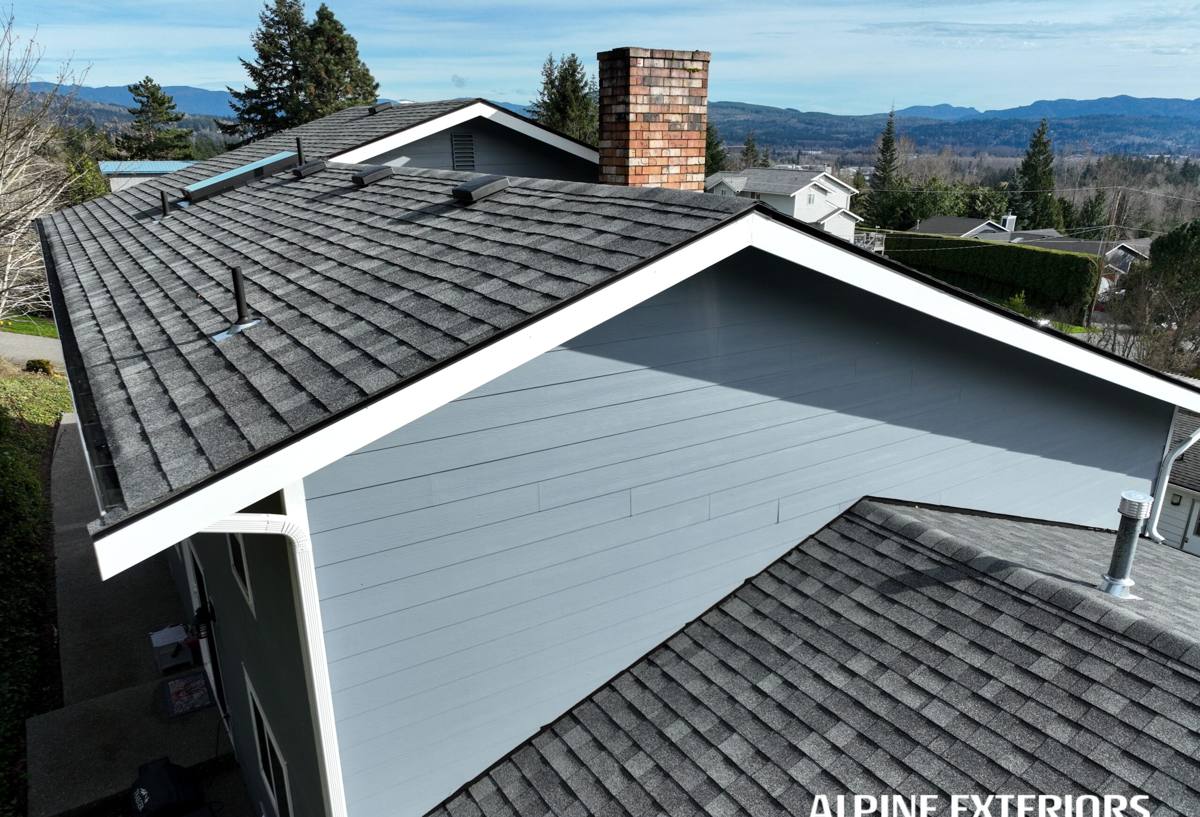
Signs an Everson Roof Is Ready for Replacement
- Moss established in mats rather than surface streaks, especially on shaded or north-facing slopes
- Granule loss visible in gutters or at downspout outlets after normal rain
- Shingles that are cupping, curling, or cracking at the tab edges
- Soft spots or spongy feel underfoot when walked (a sign of deck moisture, not just surface wear)
- Daylight visible through the roof deck from inside the attic
- Repeated leaks around the same penetration or valley despite past patch repairs
- Roof age past 20-25 years for asphalt composition, regardless of visual condition
Any one of these on its own might still be a repair. Two or three together, especially on a roof already past 18-20 years old, usually means the underlying materials are tired and a replacement is the more honest recommendation than another round of patching.
Why Moss Matters More Here Than in Drier Climates
Moss isn't just cosmetic. Once it establishes on a shaded slope, it holds moisture against the shingle surface for days after the rest of the roof has dried out. That constant dampness accelerates granule loss, softens the mat beneath the granules, and — over enough seasons — can lift shingle edges enough to let wind-driven rain work underneath. In a county with Whatcom's rain totals, a roof that fights moss poorly from day one is a roof that ages in half the time it should.
What a Correct Roof Replacement Involves
A roof replacement done right is a sequence, and skipping steps to save a day of labor is where most premature failures start. Here's what we consider non-negotiable on every full replacement:
Tear-Off and Deck Inspection
We remove the existing roofing down to the deck rather than layering over it. This is the only point in the project where hidden deck damage — soft plywood, old leaks that never showed inside, delaminated sheathing — is visible and fixable. Any compromised decking gets replaced before anything new goes down; covering bad decking with new shingles just hides the same problem under a new layer.
Ice and Water Barrier at Vulnerable Points
Eaves, valleys, and roof-to-wall transitions get a self-adhering waterproof membrane underneath the field underlayment. These are the spots where wind-driven rain and ice damming (even the occasional cold snap Whatcom County gets) push water backward under standard felt. This barrier is cheap insurance relative to what a valley leak costs to repair after it's damaged interior framing or drywall.
Ventilation Balance
Intake at the eaves and exhaust at the ridge need to work together, not against each other. Unbalanced ventilation traps warm, moist attic air against the underside of the deck, which speeds up both moss growth on top and rot from below. We check net free ventilation area against current code minimums and correct it as part of the replacement, not as an afterthought.
Flashing Detail Work
Chimneys, skylights, and wall step-flashing are where most leaks actually originate — not in the open field of shingles. New flashing, properly lapped and sealed, is standard on every replacement we do.
Field Shingle Installation
Correct nail placement (not staples, not overdriven or underdriven nails), proper exposure per course, and manufacturer-specified fastener patterns for the wind zone. This is the step most visible to a homeowner and, ironically, the one where corner-cutting is hardest to spot until years later.
Material Options for Everson Homes
Most Everson homeowners land on architectural asphalt shingles, and for good reason — the price-to-performance balance is strong and the moss-shedding profile on a well-ventilated roof is solid. Metal roofing comes up more often now, particularly for homeowners planning to stay long-term or dealing with a steep, hard-to-maintain slope. We'll walk through the honest trade-offs rather than push whichever product has the best margin.
| Material | Typical Lifespan | Moss Resistance | Upfront Cost |
|---|---|---|---|
| Architectural asphalt (standard) | 20-25 years | Good with proper ventilation | Lowest |
| Algae-resistant asphalt (copper-infused granules) | 25-30 years | Better — actively resists moss/algae growth | Slightly higher than standard |
| Standing seam metal | 40-50+ years | Excellent — moss struggles to grip smooth panels | Highest |
| Composite/synthetic shake | 30-40 years | Good, varies by product | Mid-to-high |
For most Everson roofs with any shaded exposure, we lean toward algae-resistant shingles as the baseline recommendation — the cost premium over standard architectural shingles is modest and the payback in reduced moss treatment and extended lifespan is real. We don't install every product on the market; some options look fine on a spec sheet but create maintenance headaches or moisture problems specific to this climate, and we'd rather tell you that upfront than sell you something we'll be back to fix.
Our Process, Start to Finish
- On-site assessment — we walk the roof (not just look from the ground), check the attic for ventilation and moisture signs, and photograph problem areas
- Written estimate — material options, scope of work, and a clear price, no vague allowances
- Scheduling around weather windows — we plan tear-off for dry stretches whenever the forecast allows, given how quickly an exposed deck can take on water in this climate
- Tear-off and deck repair — full removal, deck inspection, and replacement of any compromised sheathing
- Underlayment and flashing — waterproof membrane at vulnerable points, new flashing throughout
- Shingle or panel installation — per manufacturer spec, correct fastening and exposure
- Ventilation check and final walkthrough — confirming intake/exhaust balance and reviewing the finished roof with you before we leave
- Cleanup — magnetic sweep for nails, full debris removal
Why a Crew That Already Works Everson Matters
A roofing crew based elsewhere in Whatcom County can certainly do competent work, but there's a real advantage to hiring one that already knows this specific area's conditions. We know which slopes in this part of the county tend to hold moss longest, how tree cover on wooded lots affects drying time after a storm, and what ventilation upgrades typically make sense on the housing stock common here. That familiarity shows up in fewer surprises during tear-off and a scope of work that's realistic from the first estimate, not revised twice after we've already started.
It also matters for warranty follow-through. A local crew is the one that answers the phone in year eight if a flashing detail needs a second look, not a company that moved on to the next region after the invoice cleared.
Cost Factors Worth Understanding Upfront
Every roof is different, so we won't quote a number without seeing yours, but the main variables that move a price are consistent:
| Factor | Why It Matters |
|---|---|
| Roof size and number of planes | More squares and more complex geometry means more material and labor time |
| Pitch and access | Steep or high roofs require more safety setup and slow the pace of work |
| Deck condition | Rotten or delaminated sheathing found at tear-off adds material and labor not visible in a pre-project estimate |
| Layers to remove | Roofs with existing layered roofing take longer and cost more to tear off than a single-layer roof |
| Material choice | Standard asphalt, algae-resistant asphalt, and metal carry different material costs per square |
| Ventilation or structural upgrades | Adding intake vents, ridge vent, or correcting undersized ventilation adds modest cost but pays off in roof life |
We'd rather flag a likely deck repair or ventilation upgrade during the initial walk than surprise you with it after tear-off has already started — it's part of why we inspect from the attic side, not just the ground.
Get a Straight Answer on Your Roof
If your roof is showing moss buildup, granule loss, or you're just past the point where another patch repair makes sense, we're happy to take a look and give you a clear, no-pressure estimate. Use the form below to get in touch — we'll schedule a time to walk the roof and talk through what it actually needs.