 Blaine
 Why Point Roberts Roofs Wear Out Faster Than Homes Inland
Point Roberts sits on its own peninsula at the very edge of Whatcom County, with water on three sides. That location is part of what makes it a beautiful place to live, and it's also exactly why roofs here take more abuse than roofs twenty miles inland. Salt-laden air off the water accelerates corrosion on exposed metal fasteners, flashing, and vents. Driving rain off the Strait doesn't just fall straight down — wind-driven moisture gets pushed sideways and upward under shingle edges and around penetrations that would stay dry in a calmer climate. And the long, wet moss season that Western Washington is known for hits waterfront and tree-shaded properties especially hard, since moisture-holding moss mats never really get a chance to dry out between storms.
None of that means a roof in Point Roberts is doomed to fail early. It means the roof has to be built and installed with those specific stresses in mind, from the fasteners up to the ridge vent. That's the difference between a roof that looks fine for a few years and one that actually holds up through Whatcom County winters.
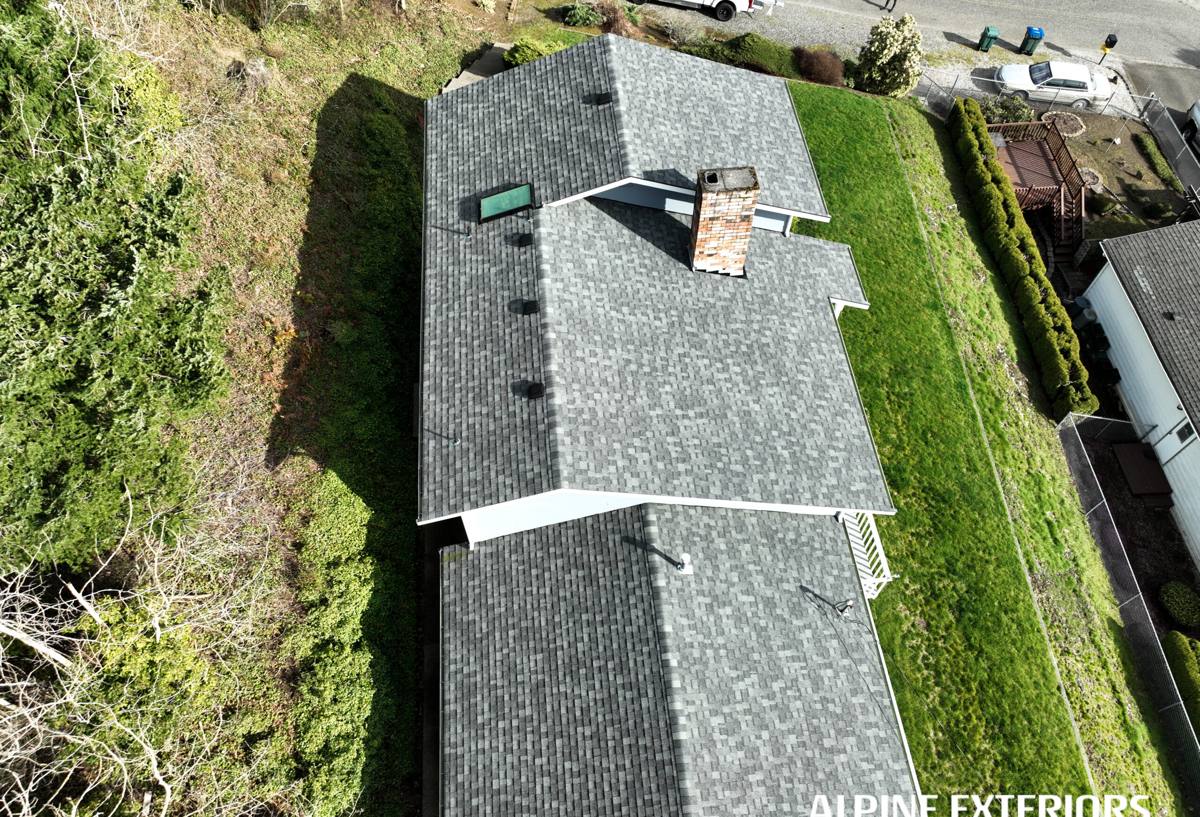
Signs a Point Roberts Roof Needs Replacement, Not Just Repair
Not every roof problem calls for a full tear-off. But there are signs that patching is just delaying the inevitable, and on a coastal roof those signs tend to show up together rather than one at a time.
Warning signs worth taking seriously
- Granule loss heavy enough that you're finding grit in gutters or downspouts every time it rains
- Shingles that are cupping, curling, or cracking, especially on south- and west-facing slopes exposed to sun and wind
- Moss and algae staining that keeps returning within a season or two of cleaning
- Soft spots in the decking, visible sagging along the ridge or eaves, or daylight visible through the attic roof boards
- Rusted, lifted, or missing flashing around chimneys, skylights, and roof-to-wall transitions
- Interior stains on ceilings or in the attic that show up after wind-driven storms specifically
- A roof that's approaching or past the expected lifespan of its material, especially if it was never properly ventilated
If you're seeing two or three of these at once, that's usually a sign the underlayment and decking are compromised, not just the surface layer — and at that point, a repair is a temporary fix on a roof that's already failing underneath.
Choosing a Roofing Material for a Salt-Air, High-Moss Climate
There's no single "best" roofing material for every home — it depends on your roof pitch, your budget, and how much long-term maintenance you're willing to do. What matters is picking a material with a clear understanding of how it behaves in this specific environment.
| Material | How it handles salt air & rain | Moss resistance | Typical lifespan |
|---|---|---|---|
| Architectural asphalt shingle | Good when installed with corrosion-resistant fasteners and proper flashing; the standard choice locally | Moderate — benefits from algae-resistant granules and good airflow | 25–30 years |
| Standing seam metal | Excellent water shedding on driving rain; needs marine-grade or coated fasteners near the water to resist salt corrosion | Good — smooth surface sheds debris and dries fast | 40–50+ years |
| Cedar shake | Natural material that needs consistent maintenance to resist moisture intrusion in a wet coastal climate | Poor without regular treatment — holds moisture in a moss-prone environment | 20–30 years with upkeep |
| Synthetic/composite shake | Handles moisture well with a consistent manufactured profile | Good — resists the moisture retention that feeds moss | 30–50 years |
We're honest with clients about trade-offs rather than pushing one product. Cedar shake, for example, can look great, but it demands a maintenance commitment that a lot of homeowners underestimate — and in a climate with this much rain and moss pressure, that upkeep isn't optional, it's the difference between the roof lasting or not. If low maintenance matters more to you than a specific look, we'll say so plainly.
Fasteners and flashing matter as much as the shingle itself
A premium shingle installed with standard-grade nails and flashing in a salt-air environment will still fail early at the fastener and flashing level long before the shingle itself wears out. For roofs on or near the water, we account for that in the materials we spec, not just the visible roofing layer.
What a Correct Roof Replacement Actually Involves
A roof replacement is more than swapping old shingles for new ones. Done right, it addresses everything underneath that determines whether the new roof actually performs in this climate.
Tear-off and deck inspection
We remove the old roofing down to the deck rather than layering over it. That's the only way to find soft, rotted, or delaminated decking — which is common on older Point Roberts roofs that have dealt with years of driving rain finding its way under aging shingles.
Underlayment built for wind-driven rain
A synthetic underlayment with proper lap and fastening, plus self-adhered membrane at eaves, valleys, and other vulnerable transitions, gives the roof a real second line of defense when wind pushes rain up under the shingle edge instead of straight down.
Flashing at every penetration
Chimneys, vents, skylights, and wall transitions are where roofs actually fail. New, correctly lapped flashing at each of these points matters more to long-term performance than almost anything else on the job.
Ventilation
Balanced intake and exhaust ventilation keeps the attic dry and temperature-regulated, which reduces condensation, extends shingle life, and helps prevent the ice and moisture buildup that shortens a roof's life in a wet climate.
Our Roof Replacement Process
We keep the process straightforward and communicate clearly at each stage, since a roof replacement is disruptive enough without surprises.
- On-site inspection and honest assessment of whether you need a repair or a full replacement
- Material recommendation based on your roof's exposure, pitch, and your budget — with trade-offs explained plainly
- Written estimate with a clear scope, so you know exactly what's included
- Scheduling that accounts for weather windows, since a tear-off left exposed overnight is a real risk in this climate
- Full tear-off, deck inspection and repair as needed, new underlayment, flashing, and roofing material installation
- Final walkthrough and cleanup, including magnetic sweep for stray fasteners
The Point Roberts Logistics Factor
Point Roberts is a bit different to work in than most communities, and it's worth being upfront about that. As a U.S. exclave connected to the rest of Whatcom County only by a route through Canada, material deliveries and crew scheduling need to be planned with that in mind — you can't treat it like a job five minutes off the highway. Crews that regularly work in Point Roberts know how to plan material staging and scheduling around that reality so it doesn't turn into delays or surprise costs mid-project. A crew that's never worked out there before is learning that logistics lesson on your job, on your timeline.
Moss Prevention and Long-Term Roof Care
A correctly installed roof replacement gives you a strong start, but moss season comes back every year in this part of Washington. A few habits go a long way toward protecting the investment:
- Keep overhanging branches trimmed back so shaded, damp areas of the roof get more light and airflow
- Clean gutters and downspouts each fall before the heavy rains set in, so water isn't pooling against the roof edge
- Have moss growth removed gently rather than pressure-washed, which can strip granules and shorten shingle life
- Schedule a roof check after major windstorms to catch lifted flashing or shingles early, before rain gets underneath
None of this replaces a solid installation — it just protects it. A roof with poor ventilation or weak flashing will struggle no matter how well you maintain it, which is why we treat the installation itself as the foundation of everything else.
Why Local Experience in Point Roberts Matters
Roofing in a coastal, salt-air, high-moss climate isn't the same trade as roofing in a dry inland region, and a crew that mostly works elsewhere in Whatcom County may not automatically think about fastener corrosion resistance or the logistics of getting materials into Point Roberts. We work in this specific environment regularly, which means the material choices, flashing details, and scheduling decisions on your project are based on what actually holds up here — not on assumptions carried over from a different climate.
If your roof is showing its age or you're planning ahead for a replacement, we're happy to take a look and give you a straight answer about what your roof actually needs. Reach out for a free, no-pressure estimate using the form below.