 Blaine
 Metal Roofing for a Different Kind of Roof Climate
Sandy Point sits right up against the water at the northern edge of Whatcom County, and that changes what a roof has to deal with compared to a home even a few miles inland. Salt-laden air moves off the Strait year-round, wind-driven rain comes in sideways during winter storms, and the tree cover and shaded north sides of many roofs stay damp long enough for moss to take hold and never really let go. A metal roof can handle all of that better than most other roofing materials — but only if it's specified and installed with this exact environment in mind. A metal roof built for a dry inland subdivision is not automatically the right metal roof for a home three blocks from saltwater.
This page is about what that means in practice: what local homes actually need from a metal roof, what a correct installation looks like out here, and why the details matter more in Sandy Point than they would somewhere without salt spray and a five-month moss season.
Why Sandy Point's Setting Changes the Metal Roofing Equation
Salt Air and Slow Corrosion
Airborne salt doesn't damage a roof overnight — it works slowly, settling on metal surfaces and fasteners and accelerating oxidation over years. On a standard-grade panel or an under-rated fastener, that shows up eventually as rust bleed, pitting at cut edges, or corrosion around screw heads long before the panel itself would otherwise fail. The fix isn't complicated, but it does require choosing materials rated for a marine or near-marine environment rather than defaulting to whatever is cheapest at the supply house.
Driving Rain and Water Management
Storms coming off the water tend to push rain horizontally, not just straight down. That puts real pressure on laps, seams, flashing, and any penetration in the roof plane — vent stacks, chimneys, skylights. A seam or flashing detail that would be fine in a calm inland rain can leak under wind-driven rain if it wasn't built with that load in mind from the start.
A Long Moss Season
Whatcom County's wet, mild winters and the shade from mature trees on many Sandy Point lots create ideal conditions for moss and algae growth on roofing — often for most of the year, not just a few weeks. Moss holds moisture against a roof surface and, on organic materials, can shorten roof life significantly. Metal is naturally more moss-resistant than asphalt shingle or wood shake, but it's not immune, and panel profile and slope both affect how much moss ends up taking hold.
What a Correct Metal Roof Installation Needs Out Here
None of the following are exotic requirements — they're standard best practice for coastal and high-moisture installations. The issue is that they're easy to skip if a crew is used to working conditions that are less demanding than Sandy Point's.
Material and Fastener Selection
The panel material, coating, and fastener hardware all need to be matched to a salt-air environment, not just a rainy one. This is the single biggest factor separating a roof that looks good for five years from one that still looks good after twenty.
| Component | Coastal-Suited Choice | Why It Matters Here |
|---|---|---|
| Panel material | Aluminum, or steel with a marine-grade protective coating | Aluminum doesn't rust; coated steel needs a coating rated for salt exposure, not standard exposure |
| Finish | PVDF-type baked-on finish over a quality primer | Holds color and resists chalking longer under salt air and UV than lighter-duty coatings |
| Fasteners | Stainless steel or coated fasteners rated for marine use | Fastener corrosion is often the first visible failure point on a coastal metal roof |
| Underlayment | High-temp, self-adhered synthetic underlayment | Adds a real water barrier under the panels if wind-driven rain gets past a seam |
| Flashing detail | Formed, sealed, and mechanically fastened — not just caulked | Sealant alone breaks down faster in this climate than a properly formed flashing joint |
Panel Profile and Slope
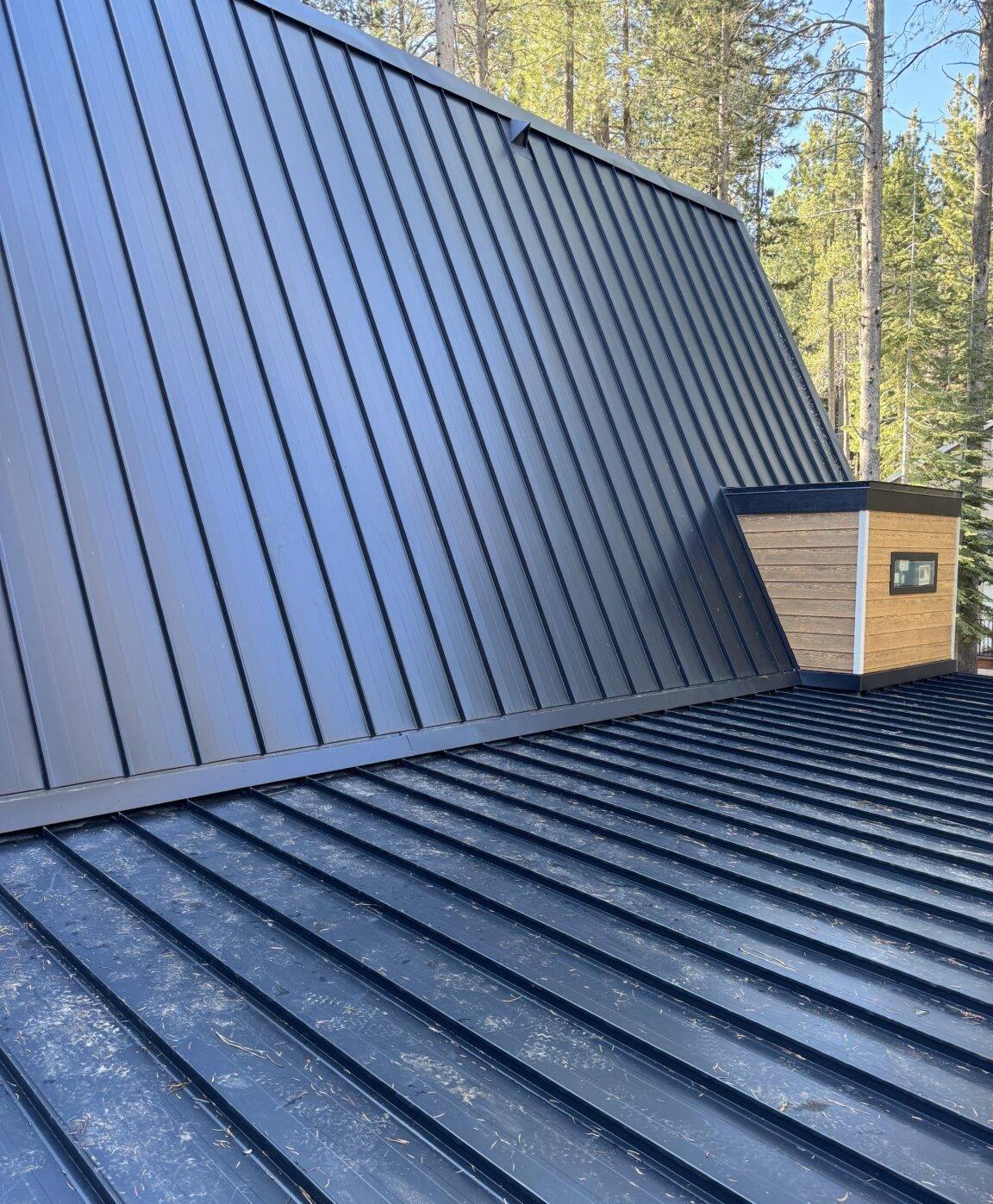
Standing seam panels with raised, mechanically locked seams generally shed water and resist wind uplift better than exposed-fastener panels, which is worth weighing on a roof exposed to the kind of gusts Sandy Point gets off the water. Slope also matters for moss: a roof plane that stays shaded and low-slope will hold moisture longer than a steeper, sun-exposed one, and that should factor into how aggressively you plan for periodic cleaning.
Where Standard Installations Fall Short Near the Water
Most of the metal roof problems we get called out to look at on homes near the water trace back to a handful of shortcuts, not to metal roofing as a material:
- Mismatched metals — for example, steel fasteners on aluminum panels, or dissimilar flashing metals in contact — which sets up galvanic corrosion that eats away at the contact point over time
- Standard-grade fasteners used because they were on hand, instead of marine-rated hardware
- Sealant used as the primary defense at flashing joints instead of proper formed and lapped flashing
- Panel profiles chosen for price rather than wind and water performance
- No plan for moss and debris removal, letting organic buildup sit against the panel finish for years
Every one of these is avoidable with the right material choices and installation sequence — but they're also easy to miss if the roof was designed for a less demanding location and just happens to end up in Sandy Point.
How Our Process Works
1. On-Site Assessment
We walk the roof and the property, not just the plans. That means checking exposure direction relative to the water, existing moss and moisture staining, tree cover, roof slope, and the condition of existing flashing and penetrations.
2. Material Selection Built for the Site
We spec panel material, coating, fastener hardware, and underlayment based on that assessment — not a one-size answer used on every job regardless of location. A home on a more sheltered inland lot may not need the same spec as one facing open water.
3. Tear-Off and Deck Prep
We check the roof deck for rot or soft spots before anything goes down, since a metal roof installed over a compromised deck will develop problems no matter how good the panels are. Any deck repair happens before underlayment goes on.
4. Underlayment and Flashing First
Water management starts before the first panel is installed. Self-adhered underlayment at eaves, valleys, and penetrations, plus properly formed flashing, is what actually keeps a roof dry during a wind-driven storm — the panels are the visible layer, not the only layer.
5. Panel Installation
Panels are installed to manufacturer spec for fastener spacing and seam engagement, with attention to how the panel run terminates at ridges, rakes, and penetrations — the places where most leaks actually originate.
6. Final Walkthrough
We review the finished roof with the homeowner, including what routine maintenance looks like for their specific site and exposure.
Living With a Metal Roof in a Moss-Prone, Salt-Air Climate
A metal roof built correctly for this environment needs less maintenance than shingle or wood, but "less" isn't "none." A short annual routine keeps a coastal metal roof performing the way it's supposed to for its full service life.
- Rinse off accumulated salt residue, pollen, and debris once or twice a year, especially on roof planes facing the water
- Clear moss and organic buildup from valleys, gutters, and shaded roof sections before it packs in against the panel finish
- Walk the roofline visually after major windstorms and check for lifted flashing or displaced panels
- Keep gutters and downspouts clear so wind-driven rain has somewhere to go besides pooling at the eaves
- Trim back overhanging branches that keep sections of the roof shaded and damp
- Have flashing and sealant points inspected every few years rather than waiting for a visible leak
None of this requires specialized equipment, and most of it is a homeowner-manageable routine once a roof is installed correctly — the goal is catching small issues before salt air and moisture turn them into bigger ones.
Metal Roofing Compared to Other Options for This Location
Homeowners in Sandy Point weighing roofing materials are usually comparing metal against asphalt shingle or cedar/wood shake, since those are the common alternatives in this part of Whatcom County.
| Factor | Metal Roofing | Asphalt Shingle | Wood Shake |
|---|---|---|---|
| Moss resistance | High — smooth, non-porous surface | Low to moderate — granules trap moisture | Low — organic material holds moisture |
| Salt-air durability | High, with correct material spec | Moderate — granule loss accelerates near salt air | Moderate — weathers faster with salt and moisture |
| Wind-driven rain performance | Strong with sealed seams and proper flashing | Moderate — depends heavily on install quality | Moderate — gaps between shakes are a common leak point |
| Typical lifespan here | Several decades with proper coating/fasteners | Shorter in this climate than in drier regions | Shorter still, with more upkeep required |
| Upfront cost | Higher | Lower | Moderate to higher |
Metal costs more upfront than shingle. The trade-off is a longer service life and lower maintenance burden in a climate that's genuinely hard on roofing — which is a fair trade for a lot of Sandy Point homeowners, but it's a decision worth making with real numbers for your specific roof, not a general rule.
Why Local Experience in Sandy Point Matters
A lot of roofing problems near the water aren't caused by bad materials — they're caused by a spec or an installation method that was fine somewhere else and just wasn't built for salt air, wind-driven rain, and a moss season that doesn't really end. Working in Blaine and communities like Sandy Point means already knowing which fastener grades hold up, which flashing details actually keep wind-driven rain out, and which roof planes on a given lot are going to need extra attention for moss. That local pattern recognition is hard to substitute for on a one-off job.
Many homes in Sandy Point are also part of a private, deed-restricted community with its own architectural or design review process. If that applies to your property, it's worth checking exterior material, profile, and color requirements with your HOA or architectural committee before finalizing a metal roofing plan — we're glad to work around whatever approval process is in place.
Get a Free, No-Pressure Estimate
If you're weighing a metal roof for a Sandy Point home — whether you're dealing with an aging roof that's showing its age from salt air and moss, or planning ahead for a new one — we're happy to take a look and walk you through what a correctly built roof would involve for your specific site. Use the form below to request a free estimate, no pressure and no obligation.