 Blaine
 Asphalt Shingle Roofing Built for Everson's Weather, Not Just a Warmer Climate's
Everson sits inland from the coast, but Whatcom County still gets the same wet, marine-influenced weather pattern that defines this corner of Washington: long stretches of low-intensity rain, wind that drives moisture sideways instead of straight down, and short, cool summers that never fully dry out a roof deck before the next system rolls in. Add a canopy of fir and cedar trees common around Everson properties, and you get near-constant shade on parts of most roofs — exactly the conditions moss and algae need to take hold.
A lot of asphalt shingle products sold today are engineered and rated for climates that dry out for months at a time. That's not what a roof here deals with. When we install or replace asphalt shingle roofing in Everson, we're building for a roof that stays damp more often than not, sheds wind-driven rain instead of just vertical rain, and needs airflow underneath the shingles to keep moisture from getting trapped against the deck.
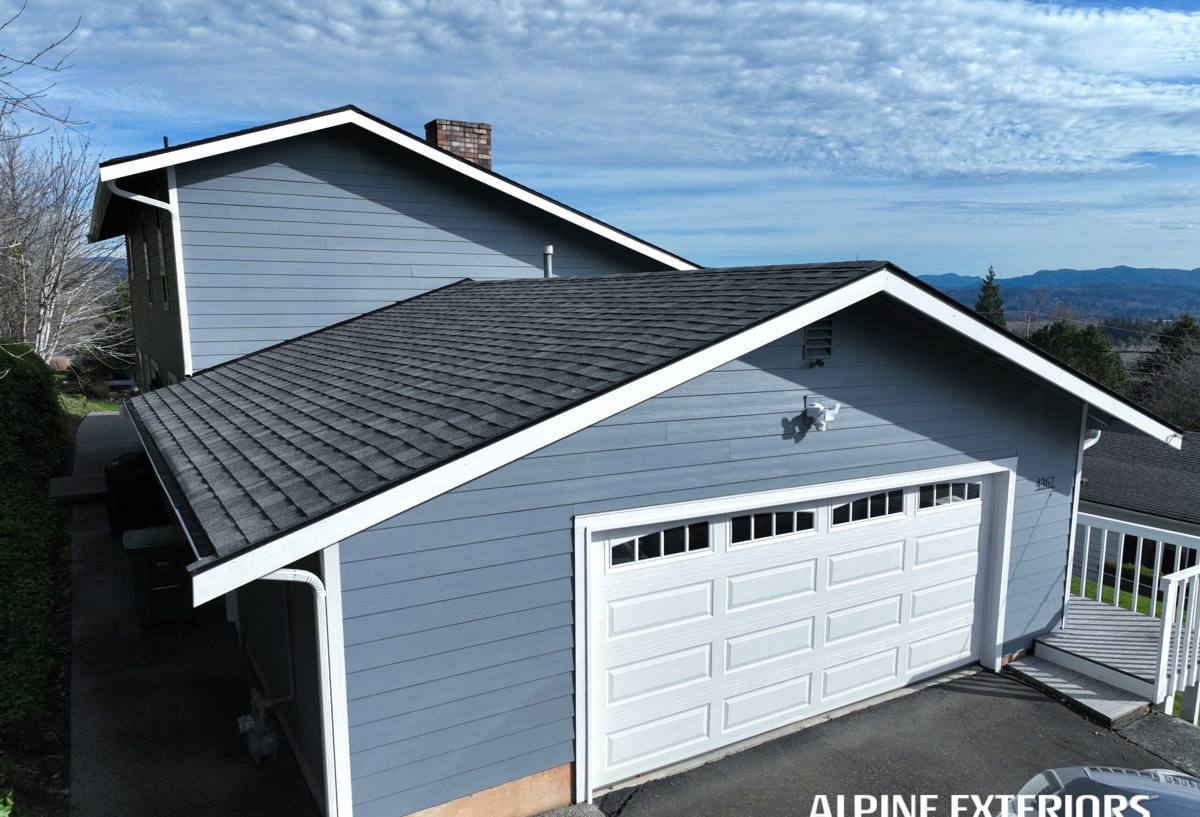
What This Climate Actually Does to a Shingle Roof
Moss and Algae Growth
Moss doesn't just sit on top of shingles looking bad — it holds moisture against the granule surface, works its way under shingle tabs as it grows, and gradually lifts them. Once shingles are lifted even slightly, wind-driven rain can get underneath instead of running off. Shaded roof sections, north-facing slopes, and areas near overhanging trees are where we see this first and worst.
Wind-Driven Rain and Flashing Failures
Straight-down rain is easy for any roof to handle. The problems start when wind pushes rain sideways and upward under shingle edges, around chimneys, at wall-to-roof transitions, and through valleys. Most leaks we find on older roofs in this area trace back to flashing that was undersized, poorly lapped, or sealed with caulk instead of properly integrated — not failed shingles themselves.
Freeze-Thaw and Granule Loss
Whatcom County doesn't get deep freezes often, but the occasional cold snap combined with a saturated roof deck can still stress shingles that are already brittle from age or sun exposure on unshaded slopes. Over time this shows up as granule loss, cracking, and shingles that curl at the edges.
Choosing the Right Asphalt Shingle for This Property
Not every asphalt shingle is built the same way, and the right choice depends on how much shade and moss exposure a particular roof gets, how steep the pitch is, and the homeowner's budget and how long they plan to stay in the home. Here's how the common options compare for a climate like this one:
| Shingle Type | Typical Lifespan Here | Best Suited For | Trade-Offs |
|---|---|---|---|
| Standard 3-tab | 15–20 years | Budget-conscious re-roofs, low-slope accessory structures | Thinner profile, less algae resistance, shows aging faster in shaded areas |
| Architectural (laminated) | 25–30 years | Most Everson homes, especially anything with shaded or partially shaded roof planes | Higher upfront cost than 3-tab, but far better wind and moss resistance |
| Algae-resistant (copper-granule) architectural | 25–30 years, with slower moss/algae staining | Heavily shaded roofs, north-facing slopes, properties surrounded by trees | Modest cost premium over standard architectural; the trade-off usually pays for itself in appearance and reduced cleaning |
| Impact-resistant (Class 4) | 25–30+ years | Homeowners prioritizing long-term durability and possible insurance discounts | Higher material cost; benefit is more about impact resistance than moisture performance |
For most Everson homes with any tree coverage, we steer people toward algae-resistant architectural shingles. The copper-infused granules actively slow the algae and moss growth that standard shingles are prone to in shaded, damp conditions — it's a straightforward way to keep the roof looking better longer without adding real cost to the project.
What a Correct Asphalt Shingle Installation Actually Involves
A roof's long-term performance is decided by what's underneath the shingles as much as by the shingles themselves. In a climate that stays wet this often, cutting corners on the underlayment or flashing shows up as a leak within a few years, not decades. A correct installation includes:
- Full tear-off and deck inspection — soft, delaminated, or water-stained decking gets replaced, not covered over
- Ice-and-water shield membrane at eaves, valleys, and around roof penetrations, where wind-driven rain and ice damming are most likely
- Synthetic underlayment across the full roof for a secondary water barrier beneath the shingles
- New drip edge at eaves and rakes so runoff sheds away from the fascia instead of behind it
- Properly lapped step and counter-flashing at chimneys, walls, and skylights — not caulk used as a substitute for flashing
- Balanced intake and exhaust ventilation sized to the attic, not just a token ridge vent
- Correct nailing pattern and fastener count per shingle, matched to the manufacturer's high-wind specifications
- Valleys installed with the method appropriate to the shingle line — woven, closed-cut, or open metal — rather than whatever's fastest
Ventilation and Moisture Control
An asphalt shingle roof isn't just a surface — it's part of a system that includes the attic below it. Without balanced airflow (intake at the eaves, exhaust at the ridge), warm, moist air from the house gets trapped in the attic, condenses against the underside of the roof deck, and slowly rots it from the inside. This happens regardless of how good the shingles are. In a climate where the roof rarely gets a long dry stretch to recover, we treat ventilation as a required part of every reroof, not an optional upgrade. On older Everson homes we often find intake vents that were painted over, blocked by insulation, or never sized correctly to begin with — we address that as part of the job, not as a surprise add-on afterward.
Signs a Roof in Everson Needs Attention
Because moss and slow leaks develop gradually, a lot of homeowners don't realize a roof needs work until there's active water intrusion. Worth checking for or having inspected:
- Visible moss lines running down from ridges or around chimneys and vents
- Granules collecting in gutters or at downspout outlets
- Shingle tabs that are curling, cracking, or lifting at the edges
- Dark streaking or staining, especially on shaded north- or west-facing slopes
- Soft spots underfoot on the roof, or sagging visible from the ground
- Water stains or musty odor in the attic, particularly near roof penetrations
Any one of these on its own isn't necessarily an emergency, but they're worth a proper look before the next wet season rather than after a leak shows up on a ceiling.
Our Process for an Everson Roofing Project
We start with an on-site inspection — from the ground and, where it's safe and useful, on the roof itself — to actually see the condition of the shingles, flashing, and ventilation rather than quoting off a photo or a guess. From there we walk the homeowner through what we found, what's actually needed versus what's optional, and give a written estimate with shingle options and pricing that make sense for that specific roof's shade exposure, pitch, and condition.
Once a project is scheduled, the crew handles tear-off, deck repair as needed, underlayment, flashing, ventilation, and shingle installation as a single coordinated job — not a patchwork of shortcuts. We protect landscaping and gutters during tear-off, do a magnetic nail sweep of the property afterward, and do a final walkthrough with the homeowner before calling the job done.
Moss Prevention and Maintenance After Installation
A new roof lowers maintenance, but it doesn't eliminate it in this climate. A few things extend the life of any asphalt shingle roof around Everson:
| Maintenance Item | Why It Matters Here | Rough Frequency |
|---|---|---|
| Gentle moss/debris removal | Prevents moisture and organic buildup from holding against shingles | Annually, more often under heavy tree cover |
| Gutter cleaning | Clogged gutters back water up under the eave edge during heavy rain | Twice a year, spring and fall |
| Trimming overhanging branches | Reduces shade, debris, and physical abrasion on shingles | As needed, typically every year or two |
| Attic ventilation check | Confirms vents stay clear and insulation hasn't blocked airflow | Every few years, or after attic work |
We're upfront that pressure washing a shingle roof is not something we recommend — it strips granules and shortens the shingle's life. Gentle, low-pressure moss treatment and physical removal is the safer approach, and it's something we can advise on even outside of a full roofing project.
Why It Matters to Hire a Crew That Works This Area
Roofing crews that mostly work drier climates tend to under-spec ventilation and treat ice-and-water shield as an eaves-only formality. That approach holds up fine somewhere with long dry summers — it doesn't hold up on a roof that's damp more days than not. Working regularly in Whatcom County means seeing, season after season, exactly where roofs in this area actually fail: shaded valleys, undersized flashing, blocked intake vents, moss-driven shingle lift. That's the experience that shapes how we spec and install every asphalt shingle roof, not a generic install checklist written for a different climate.
If you're weighing a repair versus a full replacement, or just want an honest read on how much life is left in your current roof, we're happy to take a look. Reach out for a free, no-pressure estimate using the form below.