 Blaine
 Semiahmoo's Waterfront Setting Puts Real Stress on Siding
Homes along Semiahmoo sit close to open water, and that changes what siding has to deal with day to day. Salt-laden air moves off Semiahmoo Bay and Drayton Harbor and settles on exterior surfaces, driving rain comes in almost horizontally during winter storms, and the combination of shade, moisture, and mild temperatures keeps moss and algae active for much of the year. Whatcom County's marine climate is milder than inland Washington, but "milder" does not mean easier on a house. It means near-constant dampness, salt exposure that ages cheaper materials faster, and long stretches where siding rarely gets a chance to fully dry out.
Siding in this specific setting needs to resist moisture intrusion, hold up to salt spray without pitting or corroding, and shed water fast enough that algae and moss don't get a permanent foothold. That's a different set of demands than siding installed a few miles inland, and it's why we treat Semiahmoo jobs as their own category rather than a copy-paste of a standard install.
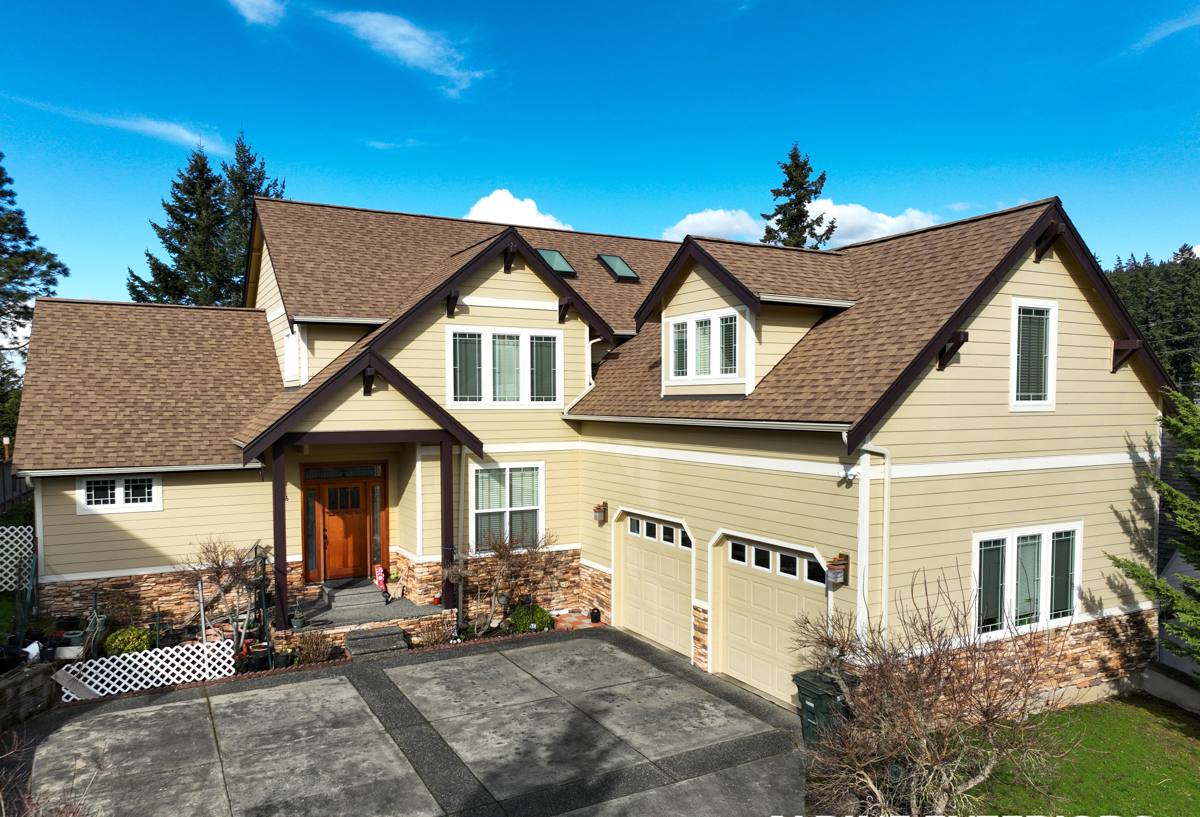
Why We Only Install James Hardie in This Kind of Environment
We install James Hardie fiber cement siding exclusively — we don't offer vinyl, LP SmartSide, Cemplank, Allura, or unfinished wood siding like primed spruce or cedar. That's a deliberate standard, not a sales preference, and it matters more in a salt-air, high-moisture environment like Semiahmoo than almost anywhere else in Whatcom County.
What Salt Air and Rain Do to Other Materials
Vinyl siding can hold up reasonably well in dry climates, but sustained damp exposure accelerates warping and fading, and its seams and J-channels give moisture more opportunities to work behind the panel over time. Wood-based products — including LP SmartSide's engineered wood, and traditional cedar or primed spruce — are organic materials at their core. In a maritime climate that rarely lets a wall assembly fully dry, that means a higher long-term risk of swelling, rot at butt joints and cut edges, and repeated repainting or resealing to keep water out. None of these are defects exactly — they're trade-offs that show up faster in a place like Semiahmoo than in a drier inland town.
What James Hardie Does Differently
James Hardie siding is fiber cement — sand, cement, and cellulose fiber, not wood or vinyl. It doesn't absorb and swell the way wood does, it's non-combustible, and its ColorPlus factory finish is baked on and warrantied against fading and flaking, which matters when salt air and sun both work against paint over the years. Hardie also engineers specific product lines for different climate zones, accounting for moisture exposure and freeze-thaw cycling rather than using one formulation everywhere. For a bayfront community like Semiahmoo, that climate-specific engineering is the whole point.
What Correct Installation Looks Like in a Salt-Air, High-Moisture Zone
Fiber cement siding is only as good as its installation. In a marine environment, a handful of details separate a job that performs for decades from one that develops moisture problems within a few years.
- Proper water-resistive barrier and flashing at every window, door, and penetration — this is the first line of defense behind the siding itself
- Correct fastener type and spacing to prevent the panel from working loose under wind-driven rain and gusty bay-front conditions
- Minimum clearance between siding and grade, decks, and roof lines so water has somewhere to go instead of wicking into the bottom edge of the boards
- Properly gapped and sealed joints, using sealants rated for the exposure, not just whatever's on hand
- Back-priming and sealing of any field-cut edges before installation, since a cut edge is the most vulnerable point on any fiber cement board
- Attention to rainscreen or drainage plane detailing where the wall assembly calls for it, so incidental moisture can drain and the assembly can dry
Skip any one of these and you can end up with a house wearing a premium siding product that still fails early — usually at the joints, corners, and bottom courses first, which is exactly where salt spray and splash-back rain hit hardest.
Moss, Algae, and the Long Maritime Growing Season
Anyone who has owned a home near Blaine's waterline knows moss doesn't take a season off. Shaded north- and west-facing walls, gutter overflow, and tree cover all create the damp, low-light conditions moss and algae need. ColorPlus finishes are formulated to resist mildew growth better than bare or field-painted surfaces, and Hardie's dense fiber cement composition doesn't provide the same porous surface that bare wood does for spores to take hold in. That's not a claim that siding will never see any growth near the water — it will, especially in shaded corners — but a correctly installed Hardie system gives you a harder, more washable surface and fewer failure points where trapped moisture can feed sustained growth behind the wall.
Our Process for Semiahmoo Projects
1. On-Site Assessment
We walk the exterior, check the current siding and any trim or fascia condition, look at drainage around the foundation, and note exposure — which walls take the brunt of storms coming off the water versus which are more sheltered.
2. Tear-Off and Substrate Check
Once old siding comes off, we inspect the sheathing and water-resistive barrier underneath. In a damp coastal environment, this step matters more than people expect — hidden moisture damage doesn't announce itself until the old siding is gone.
3. Install to Manufacturer Spec
Flashing, fastening, clearances, and joint treatment are done to James Hardie's published installation requirements, not shortcuts. This is also what keeps the manufacturer's warranty intact — Hardie's warranty coverage depends on the product being installed correctly.
4. Final Inspection and Walkthrough
We check every elevation before calling the job done, and walk the finished work with the homeowner so there are no surprises.
Why a Crew That Already Works Semiahmoo Matters
Siding work near the water isn't identical to siding work a few miles inland, and a crew that's done both knows the difference. Wind exposure on an open, bayfront lot changes fastening decisions. Salt spray reach changes how much attention lower courses and corners need. And local permitting and inspection through the City of Blaine and Whatcom County moves faster when a contractor already knows the process instead of learning it project by project. Hiring a crew with actual experience on Semiahmoo and Blaine homes means fewer guesses and a job built for the conditions your house actually faces, not generic conditions.
Cost Factors on a Semiahmoo Siding Job
Every home is different, but these are the main factors that move the scope and cost of a James Hardie install in this area. We don't publish fixed prices because exposure, current wall condition, and home size all vary too much house to house — but this gives a realistic sense of what drives the number.
| Factor | Why It Matters in Semiahmoo |
|---|---|
| Waterfront exposure level | Direct bay-facing walls need more attention to flashing, fastening, and sealant detail than sheltered elevations |
| Condition of existing sheathing | Hidden moisture damage from years of salt air and rain sometimes isn't visible until old siding comes off |
| Home size and wall complexity | More corners, windows, and rooflines mean more flashing and joint work, which affects both material and labor |
| Trim, fascia, and soffit scope | These areas take similar weather stress and are often replaced or refinished at the same time for a consistent, weathertight result |
| Product line and finish selection | James Hardie offers different plank profiles, panel styles, and ColorPlus color options, which affect material cost |
Ongoing Care for Semiahmoo Homeowners
Even the right siding, correctly installed, benefits from a little regular attention in this climate. None of this is heavy maintenance — it's mostly about staying ahead of the moisture and salt this location deals with year-round.
- Rinse salt residue and grime off exterior walls periodically, especially on bay-facing sides
- Keep gutters and downspouts clear so water isn't overflowing directly onto siding and trim
- Trim back vegetation and tree cover that keeps shaded wall sections damp and encourages moss
- Check caulking at joints, windows, and corners every year or two and have any cracked sealant redone before it lets water behind the siding
- Address any small paint or finish damage promptly rather than letting a bare spot sit through a wet winter
If you're planning a siding project on a Semiahmoo or Blaine home and want a straightforward look at what your house actually needs, we're happy to walk the property with you and put together a free, no-pressure estimate.