 Blaine
 Composite Decking for Bellingham-Area Homes Near Blaine
Homeowners in and around Bellingham are asking for composite decking more often than wood these days, and once you've watched a few wood decks go gray, spongy, and moss-streaked out here, it's easy to see why. This corner of Whatcom County sits right up against the water, which means decks take a beating that inland decks never see: salt-laden air off the Strait, wind-driven rain that gets up under railings and ledger boards, and a moss season that can run most of the year in shaded spots. Composite decking, installed correctly, handles that combination far better than dimensional lumber — but "installed correctly" is doing a lot of work in that sentence, and it's the part that separates a deck that looks good for two years from one that still looks good in fifteen.
This page is specifically about composite decking for homes in the Bellingham area we serve out of Blaine — what the local climate actually does to a deck, what a correct installation involves, and how our process works from first estimate to final walkthrough.
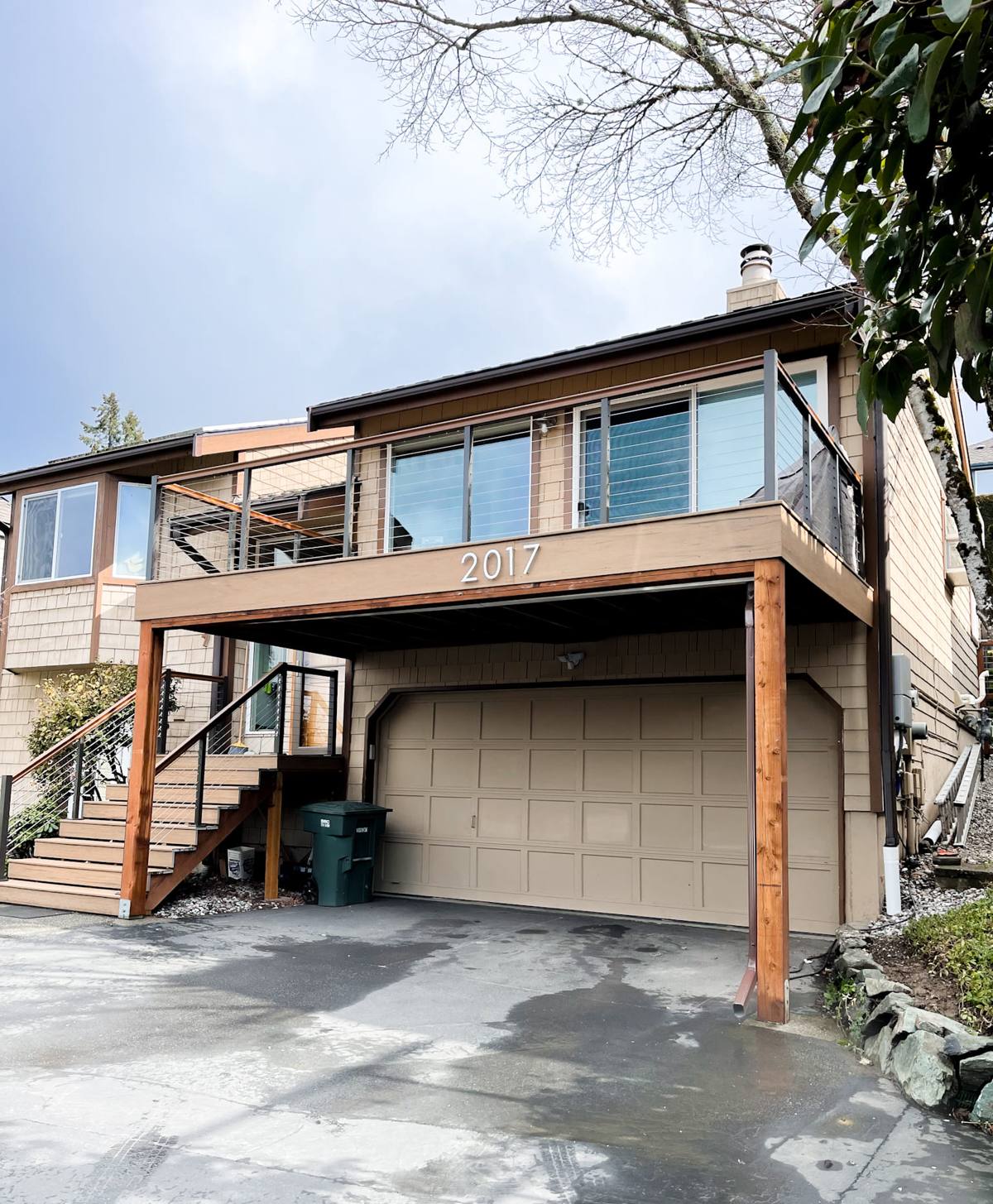
What Whatcom County's Marine Climate Does to a Deck
Every material decision on a coastal deck should start with the weather it has to survive, not the weather on the sales brochure. A few things are consistent up here:
- Salt air accelerates corrosion. Fasteners, brackets, and any exposed metal hardware corrode faster near the water than they would twenty miles inland. Standard hardware store screws are not built for this.
- Driving rain finds gaps. Wind off the water pushes rain sideways and upward, not just straight down. Flashing, ledger connections, and board spacing all have to account for water moving in directions a dry-climate installer might not plan for.
- Moss season is long. Shaded decks, north-facing decks, and decks under tree cover stay damp for extended stretches of the year, which is exactly what moss and algae need to take hold on a walking surface.
- Freeze-thaw cycling is mild but real. Whatcom County doesn't get the deep freezes of the interior, but repeated freeze-thaw on a wet surface still stresses joints, fasteners, and any material that absorbs moisture.
None of this is exotic — it's just consistent, year-round exposure that adds up. A deck built for a drier climate and shipped up here without adjustments will show its age faster than one built with these specific conditions in mind.
Why Composite Holds Up Better Than Wood in This Climate
Wood decking can absolutely be built well, and there are still good reasons homeowners choose it. But wood is a porous, organic material, and porous organic materials in a wet, salty, moss-prone climate are working against themselves. Composite decking is engineered specifically to resist moisture absorption, which is the root cause of most of the problems wood decks develop here: warping, splintering, graying, and the kind of soft, punky spots that show up around fastener holes after a few wet winters.
Capped vs. Uncapped Composite
Not all composite decking is built the same way, and this matters more here than in a drier climate. Capped composite boards have a polymer shell wrapped around a wood-plastic composite core, which blocks moisture from reaching the core and resists staining and fading. Uncapped composite (older generation product, still sold at lower price points) has the core exposed on some or all sides, which means it can absorb some moisture over time — not to the degree wood does, but enough that it matters in a marine climate. Our standard recommendation for Bellingham-area installs is capped composite on all exposed faces, particularly the board ends and any cut edges, which is where uncapped or improperly sealed boards let water in first.
Fading and Fastening
Composite boards handle UV exposure and salt spray better than wood finishes, which fade, chalk, and need to be reapplied every couple of years to keep protecting the wood underneath. That said, composite still needs the right fastening hardware — coated or stainless-steel fasteners rated for coastal exposure — because the hardware, not the board, is usually the first thing to show corrosion on a salt-air deck.
What a Correctly Installed Composite Deck Involves
The composite boards get most of the attention, but the substructure underneath them is what actually determines how long a deck lasts in this climate. A composite deck installed over a poorly protected frame will still fail — just from the frame up instead of the boards down.
Framing and Ledger Attachment
The ledger board — where the deck attaches to the house — is the single most common point of water intrusion on any deck, coastal or not. Proper flashing behind and above the ledger, with correct fastener spacing and structural connectors sized for the load, keeps wind-driven rain from working its way behind the siding and into the wall framing. This is not an area to cut corners in a climate that gets sideways rain regularly.
Joist Protection and Drainage
Untreated or under-protected joists are where a lot of "hidden" deck rot starts, because the composite decking on top hides the problem until it's advanced. We use joist tape or an equivalent waterproofing membrane on top of the joists before the decking goes down, which keeps standing moisture off the wood framing and significantly extends the life of the structure underneath your composite boards.
Fasteners and Hardware
Every screw, bracket, and hanger on a coastal deck should be rated for the exposure it's actually going to see — not just whatever is cheapest at the supply house. Stainless steel or heavily coated fasteners cost more up front and save you from streaking, corrosion, and loosened connections down the road.
Board Spacing for Wet Climates
Composite boards need consistent gapping for drainage and seasonal expansion. In a climate that sees this much rain, correct spacing isn't cosmetic — it's what keeps water moving through the deck surface instead of pooling on top of it, which is exactly the kind of standing moisture that invites moss and algae growth.
Comparing Decking Materials for This Climate
There's no single "best" decking material for every homeowner — budget, maintenance tolerance, and how long you plan to stay in the home all factor in. Here's how the common options actually compare for a Whatcom County marine environment:
| Material | Upfront Cost | Maintenance in This Climate | Moisture Performance | Typical Lifespan |
|---|---|---|---|---|
| Pressure-treated wood | Lowest | Annual cleaning, periodic staining/sealing | Absorbs moisture; prone to warping, splintering, moss | 10–15 years |
| Cedar | Moderate | Regular sealing to hold color and resist rot | Better rot resistance than PT wood, still porous | 12–18 years |
| Uncapped composite | Moderate | Occasional cleaning; watch board ends for moisture | Better than wood; some absorption at exposed core | 15–20 years |
| Capped composite | Higher | Periodic rinsing/cleaning, no sealing needed | Strong resistance to moisture, staining, and fading | 25–30 years |
| PVC decking | Highest | Minimal; occasional cleaning | Fully synthetic, essentially moisture-proof | 25–30+ years |
For most Bellingham-area homes, capped composite is the sweet spot: meaningfully better moisture and fade performance than wood or uncapped composite, without the premium cost and different feel underfoot of full PVC decking.
Our Process, Start to Finish
1. Site Visit and Estimate
We look at the deck's exposure — how much direct rain and wind it takes, how much shade it sits in, proximity to the water — because that exposure profile drives our material and hardware recommendations more than personal preference does.
2. Substructure Assessment
If we're replacing an existing deck, we check the ledger connection, joists, and posts for existing rot or corrosion before we ever talk about board color. Building new composite decking on top of a compromised frame just hides the problem for a few years.
3. Material and Hardware Selection
We walk you through composite options at different price points, explain the tradeoffs honestly, and spec fasteners and flashing rated for this specific coastal exposure — not generic hardware.
4. Installation
Framing and waterproofing first, then decking, with attention to board spacing, fastener pattern, and drainage at every rail post and stair stringer, which are common weak points if rushed.
5. Final Walkthrough
We go over basic care with you before we leave, including what to expect from your specific board type through a Whatcom County winter.
Maintenance Composite Decking Needs Through Moss Season
Composite decking is low-maintenance compared to wood, but "low-maintenance" doesn't mean "no maintenance," especially in a climate with a long damp season. A simple seasonal routine keeps a composite deck looking and performing the way it should:
- Sweep off leaves, needles, and debris regularly — trapped organic matter holds moisture against the board surface and is the main thing that lets moss and algae get started.
- Rinse or lightly scrub the deck a couple of times a year, more often in heavily shaded areas, using a soft brush and a composite-safe cleaner.
- Check board ends and areas around railing posts for any dirt buildup in gaps, since that's where moisture tends to sit longest.
- Inspect visible fasteners and hardware once a year for early signs of corrosion or loosening, particularly after a stretch of storms.
- Keep gutters and downspouts near the deck clear so runoff isn't dumping extra water directly onto the deck surface.
- Trim back overhanging branches where practical to cut down on shade and debris buildup on the most moss-prone sections.
Why Hiring a Crew That Already Works This Area Matters
A composite deck built to a generic national spec sheet isn't the same as one built for Bellingham's specific exposure to salt air, wind-driven rain, and long wet shoulder seasons. Crews that work this area regularly already know which fastener grades hold up, which framing details actually stop water intrusion in this kind of weather, and how Whatcom County permitting and inspection expectations apply to deck attachments, guardrails, and stair construction. That local familiarity shows up less in the sales pitch and more in the parts of the deck you don't see once it's finished — the flashing behind the ledger, the tape on the joists, the fasteners holding the rail posts — which is exactly where coastal decks tend to fail first when that experience isn't there.
If you're weighing composite decking for a home in the Bellingham area, we're happy to come take a look, walk the site, and give you a straightforward estimate — no pressure, no upsell script, just an honest read on what your deck needs. Use the form below to request a free estimate.