 Blaine
 Blaine Harbor is about as close to open water as a house in Whatcom County gets. The homes clustered around the marina and the waterfront blocks nearby sit with almost nothing standing between their walls and the wind, salt spray, and rain coming straight off the bay. That exposure doesn't just mean a nicer view — it means siding here works harder and wears out faster than siding on a house set back even a few blocks inland. This page is about one job specifically: replacing siding on a Blaine Harbor home correctly, done by a crew that already spends regular time working this stretch of waterfront.
Why Blaine Harbor Wears Out Siding Faster Than the Rest of Town
Salt Air With No Buffer
Homes set back from the water get some benefit from trees, other buildings, and simple distance cutting down how much salt-laden air reaches their walls. Houses fronting Blaine Harbor don't get that buffer. Salt in the air settles on siding, trim, and fasteners day after day, and it accelerates corrosion and finish breakdown at a pace that's hard to appreciate until you've compared a tear-off here to a similar tear-off a mile inland.
Driving Rain That Hits Walls Directly
Storms moving across open water pick up speed and reach harborfront homes with little to slow them down first. That means rain arrives sideways more often here than in more sheltered parts of Blaine, driving into siding seams, trim joints, and anywhere a flashing detail was left loose or undersized. A siding system that performs fine on a sheltered, inland lot can start taking on water at Blaine Harbor simply because the wind load pushing against it is that much higher.
A Moss Season That Rarely Lets Up
Constant moisture off the water, combined with Whatcom County's mild temperatures, gives moss and mildew a long growing window, and harborfront homes with any shaded or north-facing wall area tend to see it earliest. Older siding with a worn or chalking finish gives moss spores something to grip onto; a tight, factory-sealed surface gives them far less to work with.
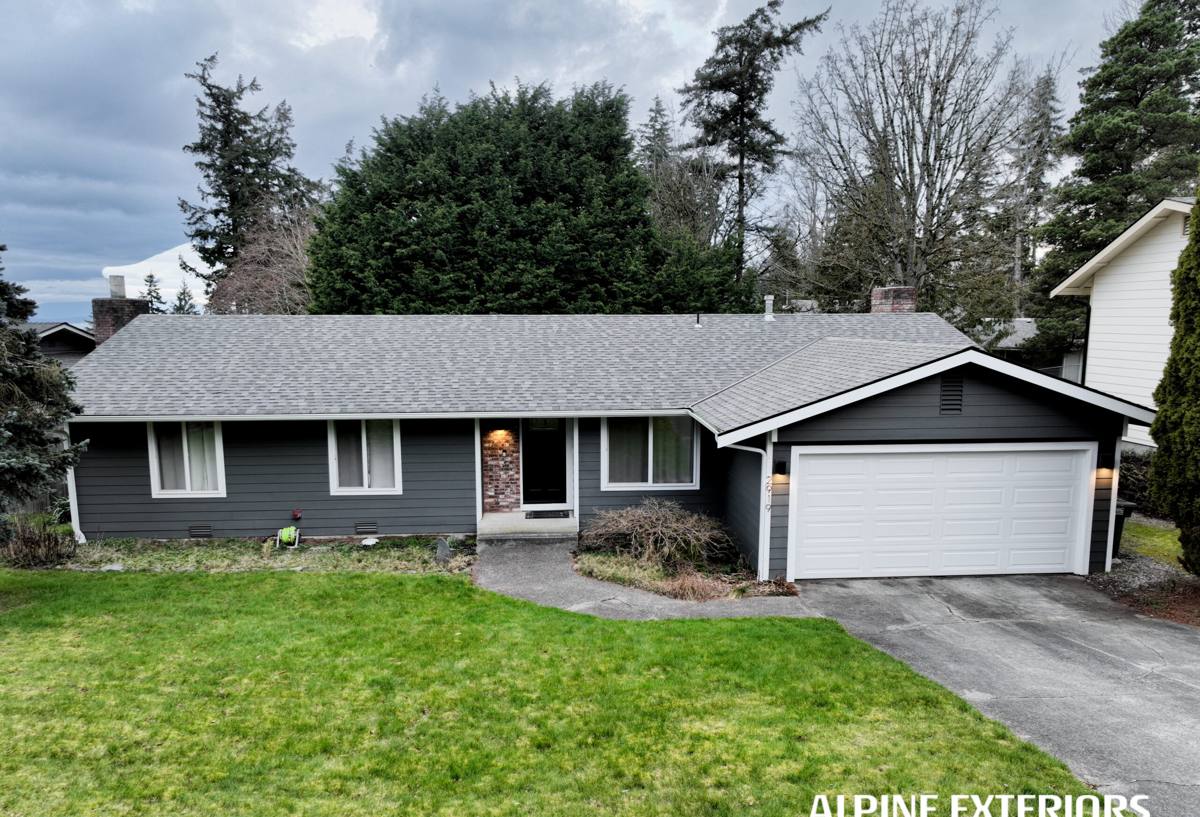
Signs a Blaine Harbor Home Needs Replacement, Not a Patch
Repair makes sense for isolated, minor damage. Full replacement makes sense once siding is failing broadly enough that patching it just delays the same problem showing up somewhere else on the wall. On harborfront homes specifically, we look for:
- Soft, spongy siding anywhere on the wall, not just low down near grade
- Moss or dark staining that returns within weeks of being cleaned off
- Cracked, buckled, or missing sections after a windstorm off the water
- Paint or finish that's chalking, peeling, or bubbling across multiple wall sections
- Rust streaking below fasteners or metal trim pieces
- A musty smell or staining on interior walls that back up to exterior siding
- Siding original to a home built more than two decades ago, with no record of replacement
One or two of these on their own might mean a repair is enough. Several at once, especially on a home fronting the harbor directly, usually means the siding is failing as a system rather than in isolated spots — and that's a replacement conversation, not a patch job.
What a Correct Replacement Actually Involves
Tear-Off and an Honest Look at What's Underneath
Old siding comes off first, all of it, so the sheathing underneath can be checked properly. This step matters more at Blaine Harbor than almost anywhere else in town, because water that's found its way behind failing siding for years tends to have done real damage to the sheathing by the time it's visible from outside. Covering that over with new siding just buries the problem; we'd rather find soft or rotted sheathing now and deal with it before anything new goes up.
Weather Barrier and Flashing, Rebuilt Correctly
This is the part of a replacement that decides whether the next few decades go well, and it's invisible once the job is finished. House wrap gets lapped correctly at every seam, window and door flashing gets integrated into the new weather barrier rather than left as-is, and every wall penetration gets sealed to shed water outward and down. On a harborfront wall taking direct, wind-driven rain, shortcuts here show up as leaks within a season or two, not years.
Installation to Manufacturer Spec
Correct fastener type and spacing, proper clearance above grade and rooflines, and field-cut edges sealed the way the manufacturer specifies — none of this is optional if the product warranty is going to mean anything. We treat the spec as the minimum standard on every job, and hold to it more carefully, not less, on the homes taking the harbor's full weather exposure.
Final Walkthrough
We go over the finished work with the homeowner, explain what maintenance the new siding actually needs in this environment, and confirm the finished job matches what was estimated before calling it done.
Why We Install Only James Hardie Fiber Cement
We don't offer a menu of siding brands, and that's a deliberate choice rather than a limitation. James Hardie fiber cement is non-combustible, which matters for both safety and insurance considerations, and it holds its shape without swelling, cupping, or warping the way engineered wood products can after repeated wetting. The HZ5 product line is formulated specifically for regions with sustained moisture exposure, which describes a harborfront wall in Blaine about as well as any spec sheet can. Its ColorPlus finish is baked on at the factory rather than applied on site, so it holds color and adhesion longer against constant salt air and UV than a field-applied paint job would. And it carries a strong, transferable warranty, provided installation follows Hardie's own published spec — which is exactly the standard we hold every job to.
We don't install LP SmartSide, vinyl siding, Cemplank, Allura, primed spruce, or cedar. Each has customers who are satisfied with it in the right setting. Our position is specific to what we've seen holding up, and not holding up, on homes taking this much direct salt and moisture exposure — and on a property fronting Blaine Harbor itself, that exposure is about as demanding as it gets in this county.
Siding Materials Compared for a Harborfront Property
| Material | Moisture & Salt Air Behavior | Ongoing Maintenance | Fire Resistance |
|---|---|---|---|
| James Hardie fiber cement | Dimensionally stable, engineered for sustained moisture exposure | Low — factory finish holds color and seal for years | Non-combustible |
| Vinyl siding | Can warp or grow brittle under constant UV and salt air; seams can admit wind-driven rain | Low, but limited repair options once damaged | Combustible |
| Engineered wood siding | Wood-strand core is moisture-sensitive at cut edges and fasteners | Moderate — depends on sealing edges and joints correctly | Combustible |
| Primed spruce or cedar | Requires an intact paint film to resist rot; salt air shortens repaint cycles | High — regular repainting and moisture checks | Combustible |
Our Replacement Process, Start to Finish
- On-site assessment: we look at the whole house, note which walls face the water directly, and check for existing moisture or sheathing concerns before writing an estimate.
- Honest estimate: a scope and number based on what we actually find, not a flat per-square-foot guess that ignores your home's specific exposure.
- Tear-off: old siding comes off completely, and the sheathing underneath gets inspected before anything new is planned.
- Substrate repair: any rot or soft sheathing gets addressed and documented, so there are no surprises buried behind the new siding.
- Weather barrier and flashing: house wrap, window flashing, and penetrations get rebuilt to shed water, prioritized on the walls facing the harbor directly.
- Installation to spec: James Hardie fiber cement installed to the manufacturer's fastening, clearance, and sealing requirements.
- Final walkthrough: we confirm the finished work with you and go over what maintenance to expect in this environment.
Cost Factors for Blaine Harbor Siding Replacement
| Factor | Why It Moves the Price |
|---|---|
| Total square footage and number of stories | More wall area means more material, labor, and time |
| Sheathing condition once old siding is off | Rot or soft spots found during tear-off need repair before new siding goes up |
| Direct water-facing exposure | Walls taking the harbor's wind and salt directly often need more flashing attention and detail work |
| Trim and architectural detail | Homes with more windows, corners, and trim transitions take more time to flash and finish correctly |
| Product line and color selection | James Hardie's various HZ lines and ColorPlus color options carry different material costs |
These are the factors that consistently move a number, not a quote. Every home fronting Blaine Harbor sits at a slightly different angle to the wind and water, and we won't put a real price on a job without walking the property and, where old siding needs to come off, getting eyes on the sheathing underneath.
Why Hiring a Crew That Already Works Blaine Harbor Matters
A contractor who only passes through Blaine Harbor occasionally sees the neighborhood the way a spec sheet describes it — generic coastal exposure, generic recommendations. A crew that works this waterfront regularly sees how it actually behaves: which walls stay soaked longest after a storm rolls in off the water, which flashing details are worth the extra time here even when they'd be optional somewhere calmer, and which corners never hold up to a shortcut no matter how good the material is. That local pattern recognition is the difference between a replacement that's still performing cleanly after two decades of harbor weather and one that needs another look within a handful of wet winters.
It also matters after the work is done. A warranty or maintenance question is a much shorter conversation with a crew still working the same stretch of waterfront than with a contractor who's moved on to other territory entirely.
If your Blaine Harbor home's siding is showing its age, or you're not sure whether it needs a repair or a full replacement, we're glad to take a look and give you a straightforward, no-pressure estimate. Reach out using the form below to get a time on the schedule.