 Blaine
 Composite Decking for the Peace Arch Area
Homes near the Peace Arch border crossing sit in one of the more exposed corners of Whatcom County. You're close to open saltwater, close to the border, and squarely in the path of the wind and rain that roll in off the Strait of Georgia and Boundary Bay through most of the year. That combination of salt air, driving rain, and a moss season that can stretch from October into May is hard on any outdoor structure, and a deck takes the brunt of it because it's flat, exposed, and in constant contact with whatever the weather is doing that day.
Composite decking exists largely because wood struggles in exactly this kind of environment. It doesn't mean every composite deck holds up — installation quality matters as much as the material — but for homeowners in the Peace Arch area weighing their options, it's worth understanding what this climate actually does to a deck, and what separates a build that lasts twenty-plus years from one that starts showing problems in five.
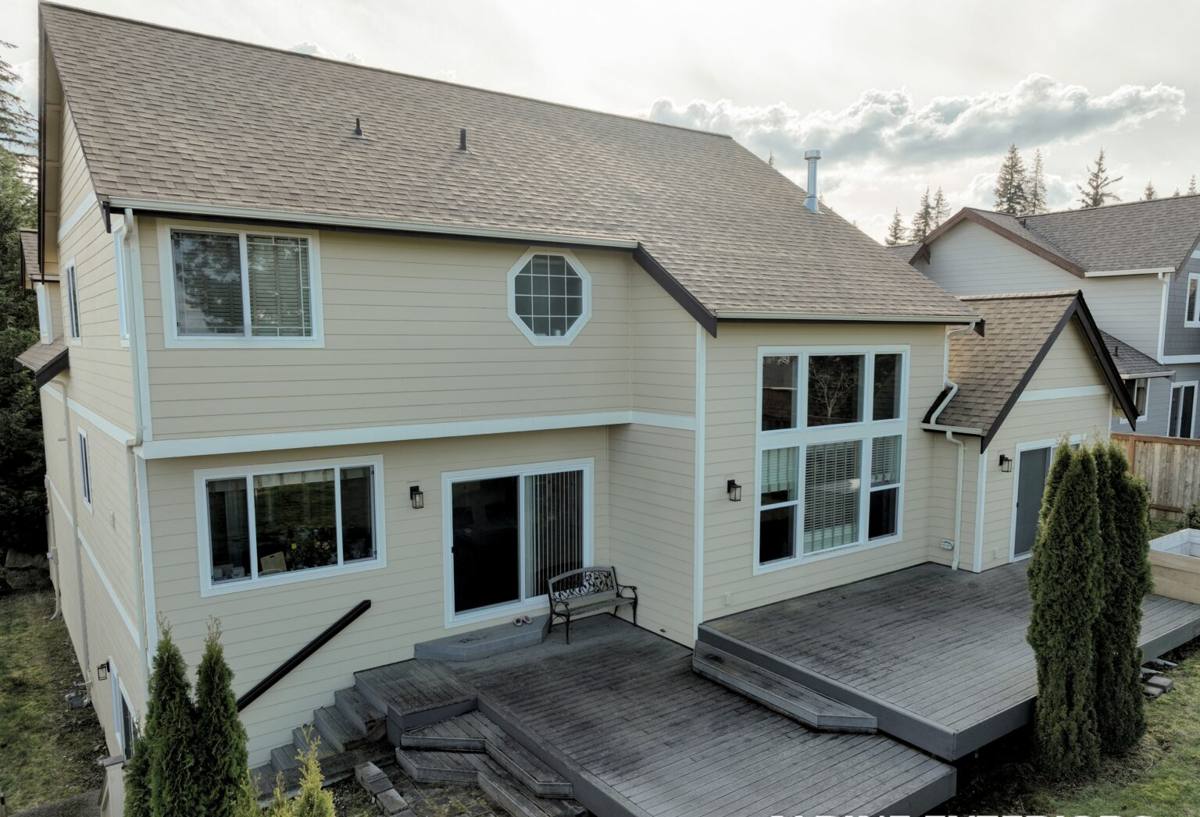
What Blaine's Coastal Climate Does to a Deck Over Time
Salt Air and Corrosion
Properties close to the water deal with airborne salt that settles on every exposed surface, including deck hardware. Fasteners, brackets, and railing hardware that would last decades a few miles inland can start showing rust and pitting much sooner near the shoreline. Not all "stainless" hardware is the same grade, and cheaper coated screws are often the first thing to fail on an otherwise sound deck — you'll see rust streaks bleeding out around every screw head within a few seasons.
Driving Rain and Wind-Driven Moisture
Rain in this part of Whatcom County doesn't always fall straight down. Wind off the water pushes it sideways, up under railings, and into joints and connection points that a calmer climate wouldn't stress the same way. The single most common point of hidden damage on any deck here is the ledger board — the framing member that bolts the deck to the house. If that connection isn't flashed correctly, water gets behind the siding and rots the structure from the inside, often for years before anyone notices.
Moss and Prolonged Dampness
Whatcom County's wet season keeps horizontal surfaces damp for long stretches at a time, and moss doesn't need much more than shade, moisture, and time to take hold. Any deck surface that doesn't shed water and dry out between rain events becomes a candidate for moss and algae growth, and that growth isn't just cosmetic — it holds moisture against the board surface and makes the deck slicker and more slippery underfoot, which matters on steps and ramps especially.
What a Correct Composite Deck Build Actually Involves
Composite boards are more forgiving than wood in this climate, but they don't fix a bad installation. A correct build addresses the things that actually cause problems here, not just the surface material.
- Ledger flashing done properly — the connection to the house is sealed and flashed so wind-driven rain can't work its way behind the siding.
- Joist tape on the substructure — covering the tops and cut ends of framing lumber so it isn't absorbing moisture at every screw penetration and saw cut.
- Correct board spacing — composite expands and contracts with temperature more than people expect, and gaps need to be sized to let water drain through rather than pool on top.
- Hidden fastener systems — clips instead of face screws where the product allows, which reduces the number of exposed metal points that can corrode or stain the board.
- Ventilation beneath the deck — skirting that allows airflow rather than sealing the underside completely, so moisture that does get underneath can dry out instead of sitting there through the winter.
Skip any one of these and you can still end up with rot, staining, or a soft substructure under a deck surface that looks fine from the top. Most of the composite deck failures we get called out to inspect aren't a problem with the boards — they're a substructure or drainage detail that was missed the first time.
Comparing Composite Decking Options
Not all composite decking is built the same, and the differences matter more in a marine climate than they would somewhere drier. Here's a general breakdown of how the main categories tend to perform:
| Decking Type | Moisture/Salt-Air Resistance | Fade Resistance | Relative Cost | Best Fit |
|---|---|---|---|---|
| Uncapped wood-composite | Moderate — surface can absorb moisture and stain over time | Fair — can fade and require occasional cleaning to keep color even | Lower | Budget-conscious projects, more sheltered locations |
| Capped composite | Strong — protective shell resists moisture absorption and staining | Good | Mid-range | Most Peace Arch homes; the common middle-ground choice |
| Capped PVC (cellular) | Very strong — no wood content to absorb moisture at all | Very good | Higher | Full sun/wind exposure, waterfront lots, low-maintenance priority |
Price isn't the only factor worth weighing. A capped product costs more up front but generally needs less cleaning and holds its color longer in a climate that puts a lot of moisture and UV cycling on a deck surface. For a covered or partly sheltered deck, an uncapped or mid-tier capped board can be a perfectly reasonable choice — the right answer depends on how exposed the specific lot is, not just the brand name on the board.
Our Process for a Peace Arch Composite Deck
Every deck we build near the border follows the same sequence, adjusted for the specific lot:
- Site assessment — we look at sun and wind exposure, existing drainage, and how close the deck sits to open water or prevailing weather, since that changes which product and detailing make sense.
- Substructure evaluation or rebuild — on replacement projects, we check the framing and ledger connection before assuming it can be reused. A new composite surface on a compromised substructure is a short-term fix.
- Framing and flashing — ledger flashing, joist tape, and proper fastening go in before a single composite board is installed.
- Composite installation — boards are laid with correct spacing and hidden fasteners where the product supports it, with cut ends properly capped or trimmed.
- Railings and finishing — railing systems, fascia, and edge details are installed with hardware rated for the exposure the deck actually faces.
- Final walkthrough — we go over drainage, ventilation, and basic care with the homeowner before calling the job done.
Railings, Fascia, and Hardware Near the Water
The decking surface gets most of the attention, but railings and hardware are often what shows wear first in a salt-air environment. Aluminum and composite railing systems generally hold up better than bare or lightly coated steel in this exposure. Where metal fasteners and brackets are unavoidable, we use hardware rated for the environment rather than defaulting to whatever is cheapest — the cost difference is small relative to the labor of replacing rusted-out hardware in a few years. Fascia boards and post wraps matter too; they're the first line of defense keeping moisture off the framing behind them.
Living With a Composite Deck Through Moss Season
Composite decking is genuinely lower-maintenance than wood, but "low-maintenance" doesn't mean "no maintenance" — especially through a Whatcom County winter. A little seasonal attention keeps a composite deck looking and performing the way it should:
- Sweep off leaves and debris regularly through fall — trapped organic material holds moisture and speeds up moss and algae growth.
- Keep gutters and downspouts above the deck clear so runoff isn't dumping directly onto one section of boards all winter.
- Rinse the deck periodically with plain water or a mild composite-safe cleaner rather than letting grime build up over the wet months.
- Check that under-deck skirting vents haven't been blocked by landscaping, storage, or debris.
- Lift planters and mats occasionally rather than leaving them in one spot all season, so moisture can't concentrate underneath them.
- Address any soft spots, movement, or staining near fasteners promptly — these are early signs of a substructure issue, not something to wait out.
Why a Crew That Already Works This Area Matters
Deck conditions can vary block to block near Peace Arch depending on how exposed a lot is to wind and water versus how sheltered it sits behind trees or a rise in the land. A crew that already works in and around Blaine has seen how that plays out on real houses — which details actually matter on an exposed waterfront-adjacent lot versus a more protected one, and which corners tend to get cut on decks that don't hold up. That local pattern recognition, combined with familiarity with Whatcom County and City of Blaine permitting expectations for deck construction, means fewer surprises during the build and a finished deck that's actually built for the conditions it will face, not a generic install.
If you're weighing options for a deck near Peace Arch, we're glad to come take a look, walk the site with you, and talk through what makes sense for your specific lot and budget. Reach out for a free, no-pressure estimate using the form below.