 Blaine
 Why Decks Near Lynden Wear Out Faster Than Homeowners Expect
A deck in Whatcom County lives a harder life than the same structure would in a drier climate. Between the driving rain that blows in off the water near Blaine, the damp marine air that sits over this part of Washington for months at a time, and a moss season that can run from early fall well into spring, wood decking is under near-constant moisture pressure. Add in UV exposure during the summer stretch that dries and cracks the wood surface, followed immediately by weeks of soaking rain that swells it back up, and you get the freeze-thaw-style stress cycle that eventually loosens fasteners, opens up joints, and lets rot get a foothold in places you can't see from the top of the deck.
Homes around Lynden also tend to sit on larger lots with more open exposure to wind-driven rain than tightly packed urban lots, which means water gets pushed sideways under railings, into end-grain cuts, and behind ledger boards more aggressively than a lot of homeowners assume. None of this means a deck is doomed — it means the repair work has to account for how water actually moves through the structure in this specific climate, not just patch what's visible on the surface.
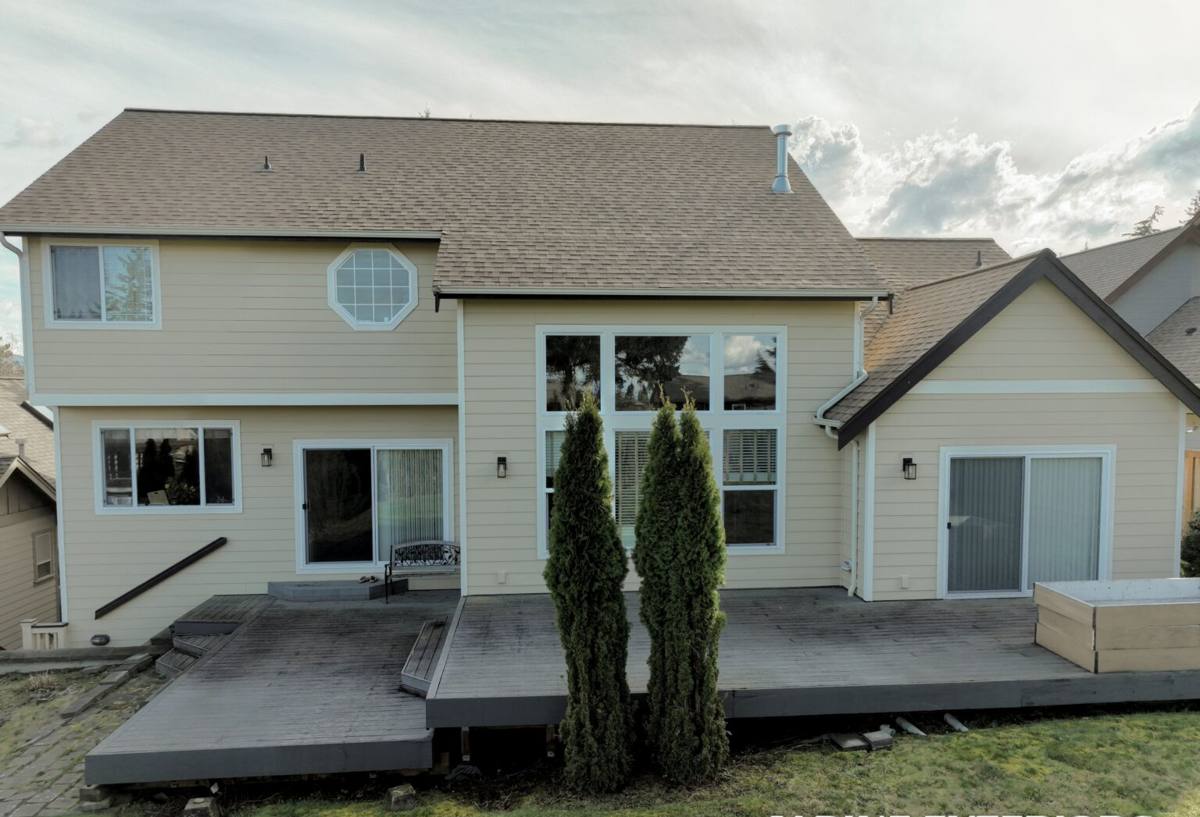
Signs Your Deck Needs Repair — Not Just a Pressure Wash
Most deck problems in this area start small and get dismissed as cosmetic until they aren't. Before you decide whether a repair is even worth scheduling, walk the deck and check for these:
- Boards that feel soft, spongy, or slightly springy underfoot, especially near the house or in shaded corners
- Gaps between boards that have widened noticeably compared to when the deck was built
- Nail or screw heads that have popped up above the board surface
- Railings or posts that wobble or flex when you lean on them
- Dark staining, streaking, or discoloration around fastener heads or board ends
- Moss or algae buildup that stays wet for days after rain instead of drying out
- Any visible gap or separation where the deck framing meets the house (the ledger board connection)
- Stairs that feel less solid than they used to, or treads that shift slightly
Any one of these on its own might just need a targeted fix. Several at once usually means moisture has been working on the structure for a while and it's worth a full inspection rather than a spot repair.
What a Correct Deck Repair Actually Involves
A repair that just replaces the boards you can see and leaves the framing alone is a repair that will need to be redone. Here's what we actually look at.
Framing and Structural Members
Joists, beams, and posts take the real load. In this climate, rot often starts on the top edge of a joist where it's been sitting under a deck board that trapped moisture, or at the bottom of a post where it meets a footing and never fully dries out. We probe suspect framing with an awl or screwdriver — sound wood resists the point; rotted wood gives way with almost no pressure. Any framing member that's compromised gets sistered with new lumber or replaced outright before anything else is touched.
The Ledger Board Connection
The ledger board — where the deck attaches to the house — is the single most common source of hidden failure on older decks in wet climates. Flashing that was installed incorrectly, or wasn't installed at all, lets water run behind the ledger and rot both the ledger itself and the rim joist of the house it's bolted to. We check this connection on every repair, even when it isn't the reason the homeowner called, because a failed ledger connection is a safety issue, not a cosmetic one.
Decking Boards and Surface
Individual boards that are cracked, cupped, or soft get pulled and replaced. We match spacing to allow proper drainage and airflow — tight, swollen boards with no gap are one of the biggest reasons moisture gets trapped against the framing underneath in the first place.
Railings and Guards
Railings take constant weather exposure and constant physical stress from people leaning on them, and they're a code and safety item, not just an appearance item. Loose posts, rotted balusters, or connections that have pulled away from the structure get rebuilt to hold real load, not just cosmetically tightened.
Fasteners and Hardware
Corroded or undersized fasteners are a quiet, common failure point. We replace them with corrosion-resistant hardware rated for exterior, damp-climate use rather than reusing whatever is already in the deck.
Repair or Replace? What Actually Determines the Right Call
Not every deck with problems needs to be torn out, and not every deck is worth saving as-is. The honest answer depends on a handful of factors, laid out here so you know what we're actually weighing when we give you a recommendation.
| Factor | Repair Usually Makes Sense | Replacement Usually Makes Sense |
|---|---|---|
| Extent of rot | Isolated to a few boards or one framing member | Widespread through multiple joists, beams, or the ledger |
| Age of the deck | Under roughly 15 years, built to a reasonable original spec | Original construction is old, undersized, or already patched multiple times |
| Ledger board condition | Sound, properly flashed | Rotted, poorly flashed, or never flashed |
| Railing and guard compliance | Structurally sound, just needs tightening or partial rebuild | Undersized, poorly attached, or doesn't meet current safety spacing |
| Your plans for the home | Staying put, want to extend the deck's life a reasonable number of years | Planning a bigger outdoor renovation or long-term hold |
We'll tell you honestly which side of this table your deck falls on. A repair that's really just delaying an inevitable full rebuild isn't a good use of your money, and we'd rather say so upfront.
Moss, Algae, and Managing Moisture Long-Term
The long moss season in this part of Washington means a deck surface can stay damp for a large portion of the year, and moss holds that moisture directly against the wood instead of letting it evaporate off. Beyond being a slip hazard on stairs and walking surfaces, sustained moss and algae growth is one of the more preventable causes of premature board failure. Part of a proper repair includes addressing why moisture is lingering in the first place — inadequate board spacing, poor airflow underneath low-clearance decks, or nearby vegetation and shade that keeps a section of the deck from ever fully drying between rain events. Cleaning the surface without correcting the underlying drainage and airflow issue just means the moss comes back within a season or two.
Materials We Use, and Why
Pressure-treated lumber, cedar, and composite decking each have real trade-offs, and we'll walk you through them honestly rather than pushing whatever's easiest for us to install.
- Pressure-treated lumber is cost-effective and easy to repair in sections, but it needs regular sealing or staining to perform well in a climate this wet, and it will move and check over time.
- Cedar has natural rot resistance and looks great, but it's a softer wood that dents more easily and still needs maintenance to hold up through repeated wet-dry cycles.
- Composite decking resists moisture and moss better than wood over the long run and needs less maintenance, but it costs more up front, and not every composite product performs the same — some are more prone to surface fading or moisture wicking at cut edges than others, so we're selective about installation details like edge sealing regardless of brand.
Whatever material a repair uses, we're strict about fasteners and hardware — stainless steel or hot-dip galvanized only. In an area with damp, occasionally salt-tinged air, standard coated fasteners corrode faster than the wood around them fails, and a repair is only as good as the hardware holding it together.
How Our Repair Process Works
- On-site inspection. We walk the full deck, probe the framing, and check the ledger connection — not just the boards you called about.
- Moisture and damage mapping. We identify which issues are cosmetic and which are structural, so you know exactly what you're paying to fix and why.
- Written scope and estimate. You get a clear breakdown before any work starts — no surprise change orders for problems we should have caught during inspection.
- Permit check. If the repair involves structural framing, railings, or stairs, we confirm whether local permitting applies before work begins.
- Repair work. Framing and ledger issues are corrected first, then decking, then railings and hardware — in that order, because fixing the surface before the structure underneath is solid is a wasted step.
- Final walk-through. We check the repaired areas with you and point out any maintenance steps that will extend the life of the work.
Why Hiring a Crew That Already Works in Lynden Matters
Deck repair advice that's generic to "the Pacific Northwest" misses a lot of what actually matters on the ground here. A crew that regularly works decks in and around Lynden and Blaine knows how local building departments handle permitting for structural deck repairs versus cosmetic ones, has a feel for how the area's typical deck ages and construction styles hold up over time, and isn't guessing at how much moisture exposure a given orientation or lot layout actually sees through a Whatcom County winter. That local familiarity shows up in faster, more accurate inspections and repairs that are scoped correctly the first time — not repairs that come back to bite you two winters later because a regional-average assumption didn't hold up to this specific climate.
It also means accountability. A contractor working the same area repeatedly has every incentive to get the repair right, because they're not driving off to the next county after the invoice clears.
Get a Straight Answer About Your Deck
If your deck is showing any of the signs above, or you're just not sure whether it needs a repair, a rebuild, or nothing at all yet, we're happy to take a look. Fill out the form below for a free, no-pressure estimate — we'll tell you honestly what we find and what it would take to fix it right.