 Blaine
 Why Bellingham Decks Wear Out Faster Than the Manual Says
Every deck material comes with a lifespan printed somewhere — twenty years for this, twenty-five for that. Those numbers assume a climate that isn't Whatcom County. Bellingham sits close enough to the water that salt-laden air is a constant, and it sits under enough cloud cover that decks rarely get a real chance to dry out between rain events. Add in driving rain that comes sideways off Bellingham Bay and the Strait, and you have a deck that's wet more often than it's dry for a good chunk of the year.
Then there's moss. Whatcom County's moss season isn't a few weeks in spring — it's most of the fall, winter, and early spring, and it doesn't stay politely on the roof. It colonizes deck boards, railing tops, stair treads, and anywhere else moisture sits and shade lingers. Moss holds water against wood and composite surfaces alike, and it turns boards slick in a way that's more than cosmetic — it's a fall hazard on stairs and landings.
We replace decks in this specific environment often enough to know which failures are climate-driven and which are just age or bad original construction. That distinction matters, because it changes what "doing the job right" actually means here versus a dry-climate deck rebuild.
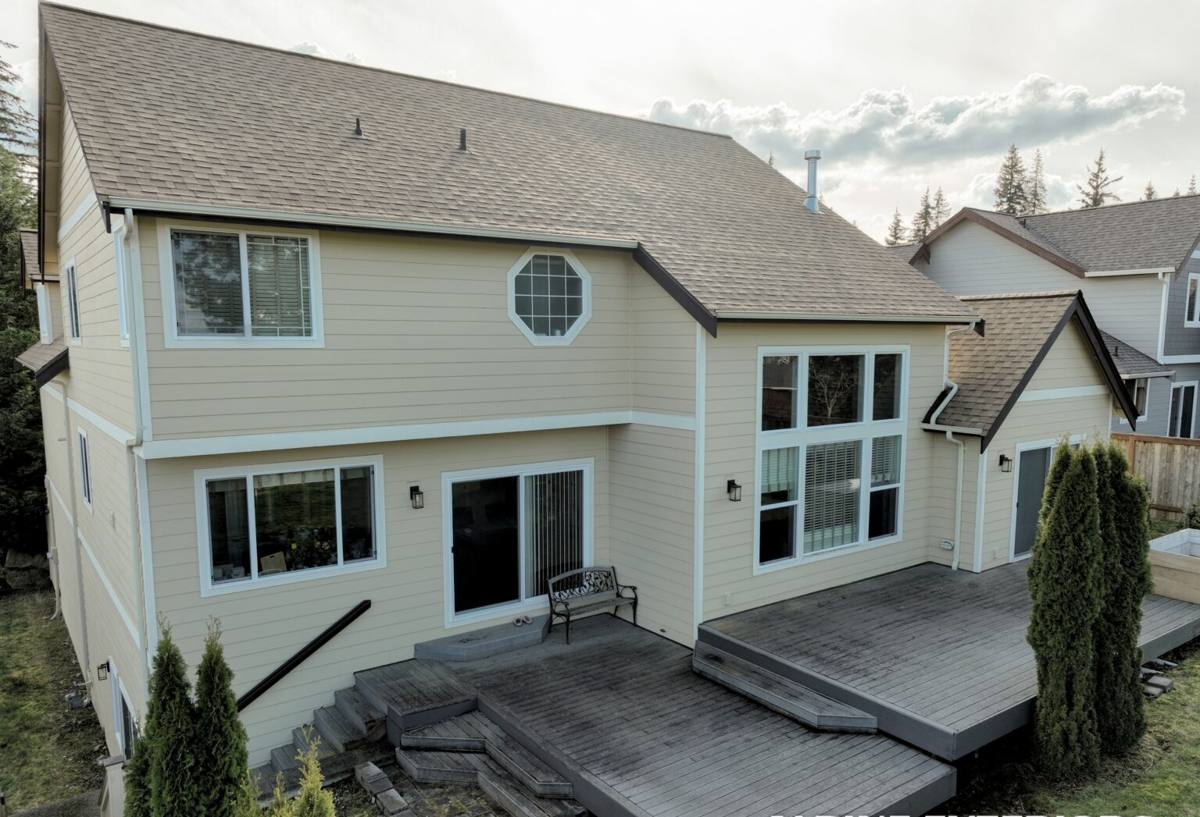
Signs a Bellingham Deck Needs Replacement, Not Just Repair
Not every worn deck needs a full teardown. But there's a point where patching boards is just delaying a bigger, more expensive failure — and in a wet climate, that point arrives faster than homeowners expect.
- Soft or spongy spots underfoot, especially near the house or at stair landings
- Persistent moss or algae staining that comes back within weeks of cleaning
- Gaps opening up between boards, or boards cupping and no longer sitting flat
- Rust streaks below fastener heads, which usually means the fasteners are failing before the wood is
- Any softness or discoloration at the ledger board — where the deck attaches to the house
- Railings that flex or wobble when leaned on
- A deck more than 20-25 years old that has never had the substructure inspected
The ledger board item deserves its own callout. It's the single most common point of hidden rot on decks in this region, because it sits right where the deck meets the house siding — exactly where wind-driven rain gets forced against the building envelope. A deck can look fine on the surface and still have a compromised ledger connection underneath.
Repair vs. Replace, in Practical Terms
If the framing and ledger are sound and only the surface boards are worn, resurfacing can make sense. If there's rot in the joists, ledger, or posts, or if the deck was built without proper flashing to begin with, replacement is the honest recommendation — patching over a compromised structure just hides the problem for another season or two.
What a Correct Deck Replacement Involves
A deck is really two projects stacked together: a structure that has to be sound and dry-detailed, and a surface that has to hold up to foot traffic and weather. Getting the surface material right doesn't matter much if the structure underneath was never properly protected from moisture.
Ledger Board and Flashing
This is where most deck failures in wet, coastal climates start. A correct replacement means removing the old ledger connection entirely, inspecting and repairing any rot in the house rim joist behind it, and installing proper flashing — typically a metal drip cap over the ledger with a self-adhered waterproof membrane behind it — before the ledger ever goes back up. Skipping this step, or reusing old flashing, is the single biggest shortcut that leads to a repeat failure in five to ten years instead of twenty-five.
Framing and Fasteners
Joists, beams, and posts should be pressure-treated or naturally rot-resistant lumber rated for ground or weather exposure, sized correctly for the span, and set on footings that meet Whatcom County frost depth and load requirements. Fasteners matter more here than in a dry climate — we use fasteners rated to match the treated lumber's chemical makeup, since the wrong metal combination corrodes fast in a wet, salt-influenced environment.
Drainage and Airflow
Standing water and stagnant air under a deck are what feed moss, mildew, and rot. A correct rebuild grades the ground underneath away from the house, keeps skirting or landscaping from blocking airflow, and spaces boards to let water shed through rather than pool on top.
Choosing a Decking Material for This Climate
There's no single "best" decking material — there's a best fit for a given budget, maintenance appetite, and exposure. In a climate with this much rain and moss pressure, the tradeoffs shift compared to a drier region.
| Material | How It Handles Local Conditions | Maintenance | Typical Lifespan |
|---|---|---|---|
| Pressure-treated wood | Affordable, but absorbs moisture readily and is the most moss-prone surface without regular cleaning | Annual cleaning, periodic stain/seal | 10-15 years |
| Cedar | Naturally rot-resistant and handsome, but still needs sealing to resist the moisture load here | Sealing every 2-3 years | 15-20 years |
| Composite decking | Resists rot and doesn't need staining; some early-generation boards were more moss-prone before cap-stock technology improved | Periodic washing | 25-30 years |
| PVC/capped polymer | Fully sealed surface, best moisture and moss resistance of the common options | Occasional washing | 25-30+ years |
We don't push one material as universally "right." Wood costs less up front and some homeowners simply like the look and feel of real lumber enough to accept the extra upkeep. Composite and PVC cost more initially but save on the recurring sanding, staining, and moss treatment that wood demands in a climate this wet. We'll walk through the real maintenance commitment of each option honestly, rather than steering you toward whatever's easiest for us to install.
Our Deck Replacement Process
- On-site assessment — we inspect the existing deck, ledger connection, and substructure to confirm whether replacement or repair is the right call
- Design and material selection — sizing, layout, railing style, and decking material chosen against your budget and maintenance preference
- Permitting — we handle the Whatcom County or City of Bellingham permit application where required
- Demolition — full removal of the old deck surface and structure down to sound framing or bare ground
- Structural rebuild — footings, posts, beams, joists, and a properly flashed ledger connection
- Decking and railing installation — surface material and code-compliant railing system installed
- Final inspection and walkthrough — county inspection where applicable, plus our own walkthrough with you before we call the job done
Permits, Codes, and Local Inspections
Most deck replacements in and around Bellingham require a building permit, particularly when the structure is being rebuilt rather than just resurfaced, or when the deck is elevated above a certain height. Requirements can differ depending on whether the property falls under City of Bellingham or unincorporated Whatcom County jurisdiction, and railing height, guard spacing, and stair geometry all have specific code requirements that inspectors check. We pull the permit, schedule the inspections, and build to the code that applies to your specific property, so you're not the one tracking down which jurisdiction's rules apply.
Keeping a New Deck Ahead of Moss and Moisture
A well-built deck still needs some seasonal attention in this climate — the goal is to make that attention minimal, not eliminate it entirely.
- Sweep debris off the deck regularly, especially fallen leaves and needles that trap moisture against the surface
- Clean visible moss or algae growth before it spreads, using a method appropriate to your decking material
- Keep gutters and downspouts clear so roof runoff isn't draining directly onto or under the deck
- Trim back vegetation that shades the deck and slows drying time
- Check railings and stair connections once a year for any looseness
- Re-seal wood or cedar decking on the schedule recommended for that material — don't wait until it's visibly gray and dry
Why Hire a Crew That Already Works in Bellingham
Deck failures here aren't random — they follow patterns tied to this specific stretch of coastline and this specific weather cycle. A crew that works this area regularly has already seen where ledger flashing typically fails first, which decking materials actually hold up against the local moss load versus which ones just claim to, and what the local permitting process actually expects on inspection day. That local pattern recognition is the difference between a deck that gets rebuilt once and one that needs the same repair again in under a decade.
We're not guessing at how Whatcom County weather treats a deck over time — it's the environment we build in every week. That shows up in the details: the flashing details at the ledger, the fastener choices, the grading underneath, and a material recommendation based on how it actually performs here rather than a manufacturer's brochure.
If your deck is showing its age, or you're not sure whether it needs a full rebuild or just some attention, we're happy to take a look and give you a straight answer. Reach out for a free, no-pressure estimate using the form below — there's no obligation, just an honest assessment of what your deck needs.