 Blaine
 Semiahmoo Sits Right Where Weather and Siding Collide
Semiahmoo is one of the more exposed pockets of Blaine. Homes here sit close to open water, which means they take on salt-laden air, steady onshore wind, and driving rain more directly than a house set back a few miles inland. That combination is hard on exterior materials in ways that aren't always obvious until years in, when trim starts to swell, paint starts to chalk early, or siding panels start to cup at the edges.
Whatcom County's marine climate already means a long wet season and short, mild summers. Add the salt air and wind exposure that come with a waterfront setting like Semiahmoo, and you get a faster clock on anything that isn't genuinely built for it. Moss and algae growth gets an early start in fall and doesn't really let up until late spring, wind-driven rain finds gaps that a calmer site would never expose, and salt residue accelerates corrosion on fasteners and hardware that aren't rated for it. Siding decisions that would be low-stakes somewhere drier become long-term maintenance decisions here.
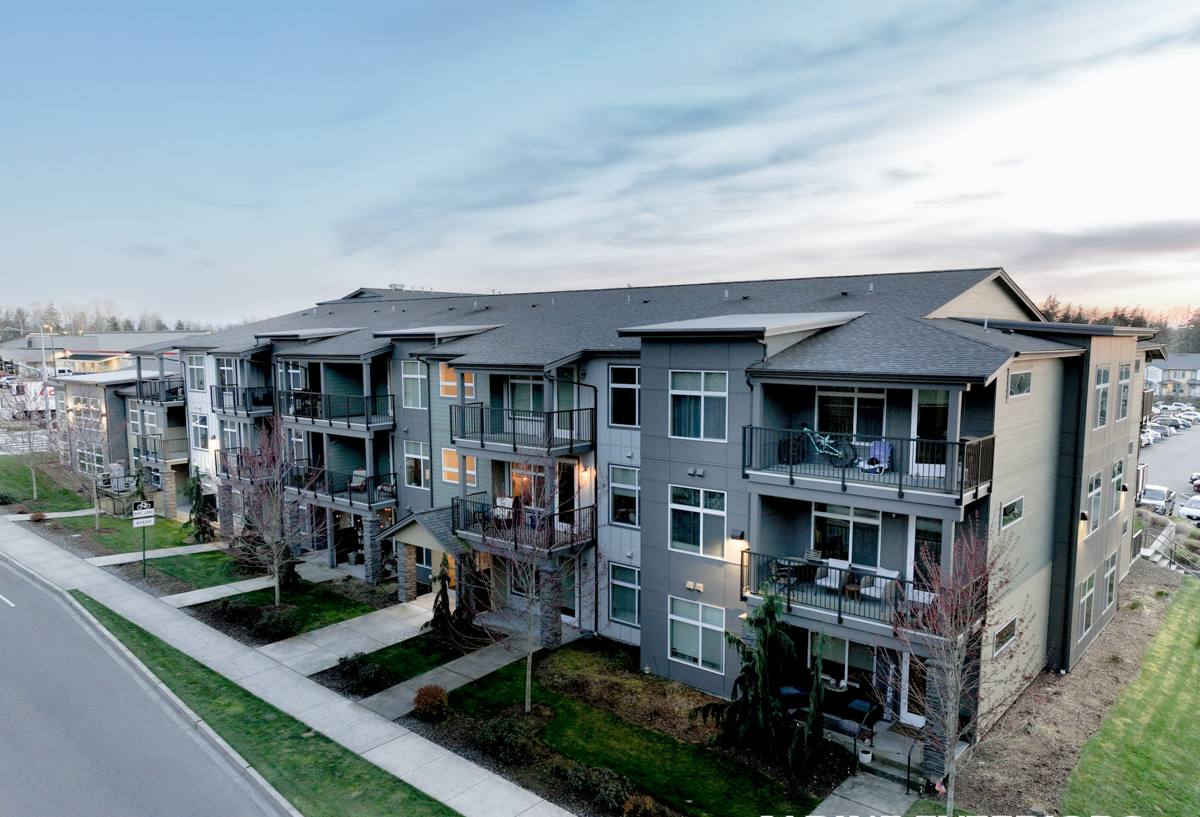
What Siding Actually Needs to Do on a Semiahmoo Home
Before talking about products, it helps to be specific about the job the siding is doing. On a home in this location, siding has to manage four things at once, continuously, for decades:
- Shed wind-driven rain — not just vertical rainfall, but water pushed sideways and upward under laps and around openings during storms off the water
- Resist moisture absorption — so the material itself doesn't swell, soften, or hold water against the wall assembly
- Tolerate salt exposure — on the siding surface, the fasteners, and any trim or flashing details
- Stay dimensionally stable through wet-dry cycling — expanding and contracting repeatedly without cracking, warping, or losing its paint bond
Wood-based products struggle with the second and fourth points in particular. Vinyl handles moisture fine but is dimensionally unstable in temperature swings and its color and rigidity fade with UV and salt exposure over time. This is the exact set of trade-offs that led us to standardize on one product category and stop installing the others.
Why We Only Install James Hardie Fiber Cement
We install James Hardie fiber cement siding exclusively — not vinyl, not LP SmartSide, not primed cedar or spruce, not other fiber cement brands like Cemplank or Allura. That's a deliberate standard, not a sales pitch, and it's worth explaining why in a place like Semiahmoo specifically.
Fiber cement is cement, sand, and cellulose fiber formed under pressure. It doesn't absorb water the way wood does, it doesn't expand and contract with humidity the way vinyl does, and it's non-combustible — a real advantage in a region that also sees wildfire smoke and periodic fire-weather warnings in late summer. James Hardie is the manufacturer we've found builds this into a genuinely engineered system, not just a board: their HZ5 product line is formulated specifically for wetter, harsher climates like the Pacific Northwest, with moisture and impact performance matched to the region rather than a one-size-fits-all national spec.
ColorPlus Factory Finish vs. Field-Painted Siding
One detail that matters more in a salt-air setting than people expect: how the color gets onto the siding. James Hardie's ColorPlus finish is baked on at the factory in a controlled environment, which gives it a stronger, more consistent bond than paint applied on-site after installation. On a normal inland lot that's a nice-to-have. On a home taking direct salt spray and wind, it's the difference between a finish that holds its color and sheen for years and one that starts chalking and fading within a couple of seasons. Field-painted siding — whether fiber cement, wood, or primed board — is only as good as the paint job and the weather conditions it was applied under, and it will need repainting on a cycle that ColorPlus is designed to outlast.
HardiePlank, HardiePanel, or HardieShingle
Not every Semiahmoo home wants the same look, and Hardie's product lines cover the common styles found in the area:
| Product | Look | Best fit |
|---|---|---|
| HardiePlank lap siding | Traditional horizontal lap, smooth or cedar-textured | Most single-family homes; the most common choice in this area |
| HardiePanel vertical siding | Board-and-batten or smooth vertical panels | Accent walls, gables, or a more modern elevation |
| HardieShingle | Staggered or straight-edge shingle profile | Coastal or craftsman-style homes wanting a shingle look without cedar's maintenance |
We'll walk through which line fits your home's style and exposure during the estimate rather than defaulting to one option.
What a Correct Installation Actually Involves
Fiber cement siding is only as good as the assembly behind it. Most of the failures we get called out to inspect on other homes aren't the siding material failing — they're installation shortcuts that let water get where it shouldn't.
Weather-Resistive Barrier and Flashing
Every correct install starts with a continuous weather-resistive barrier behind the siding, with flashing integrated at every window, door, and penetration so water is directed out and down, never trapped against the sheathing. In a location that takes wind-driven rain from an open exposure, this layer is doing more work than the siding itself — the siding sheds the bulk of the water, but the barrier and flashing handle what gets past it.
Fastening, Clearances, and Sealant
James Hardie publishes specific fastening patterns, minimum clearances from grade, decks, and roof lines, and gapping requirements at butt joints and trim. Skipping these doesn't show up as a problem on day one — it shows up two or three years later as staining, soft spots, or paint failure at the joints. In salt air, we also pay attention to fastener material: corrosion-resistant fasteners rated for coastal exposure cost more and take longer to source, but they're not optional this close to the water.
Signs Your Current Siding Is Losing the Fight
Because Semiahmoo's exposure accelerates wear, it's worth knowing what early trouble looks like before it becomes a bigger repair:
- Persistent moss or algae streaking on north- and west-facing walls that comes back within weeks of cleaning
- Paint that's chalking, peeling, or fading noticeably faster on the water-facing side of the house than the sheltered side
- Soft or spongy spots at the bottom edge of siding boards, especially near grade or under windows
- Visible cupping, warping, or gaps opening up at butt joints and corners
- Rust streaking below fasteners or trim hardware
Any one of these on its own might just need attention. Several together usually means the underlying material or the original installation isn't holding up to the site conditions.
Our Process, Start to Finish
The work follows the same sequence on every Semiahmoo job:
- On-site assessment — we look at current siding condition, exposure direction, existing moisture damage, and trim/window details before quoting anything
- Product and color selection — choosing the right Hardie line, profile, and ColorPlus color for the home's style and exposure
- Tear-off and sheathing check — removing old siding and inspecting the sheathing underneath for rot or damage before it's covered up again
- Weather barrier and flashing installation — the step that determines how the wall performs for the next 30 years, done to Hardie's published details
- Siding installation — fastened, gapped, and sealed to manufacturer spec, with attention to coastal-rated hardware
- Final walkthrough — checking trim, caulking, and finish details with you before we call it done
Cost Factors for a Semiahmoo Project
Every home is different, but the same handful of factors drive most of the cost variation we see on siding jobs in this area:
| Factor | Why it matters |
|---|---|
| Extent of tear-off needed | Removing failing wood or vinyl siding and repairing sheathing underneath adds labor before new siding even starts |
| Home size and wall complexity | Cutouts, multiple gables, and dormers take more time per square foot than a simple rectangular elevation |
| Product line and profile | Lap, panel, and shingle profiles differ in material and labor cost |
| Trim and accent work | Window trim, corner boards, and fascia detailing add scope beyond the field siding |
| Site access | Waterfront lots with limited staging space or steep grades can add setup and material-handling time |
We give a written, itemized estimate after seeing the home in person — not a phone quote — so you know exactly what's driving the number.
Why It Matters That We Already Work Semiahmoo
Siding crews that mostly work drier, inland areas can underbuild for a site like this — standard fastener specs, standard clearances, standard flashing details, applied without adjusting for salt air and wind-driven rain. That's not a material failure, it's a mismatch between the install and the environment it has to survive. Working this shoreline regularly means we already account for exposure direction, corrosion-resistant hardware, and the flashing details that matter most on a home taking weather straight off the water, rather than treating every job in Whatcom County the same way.
Maintenance That Actually Fits This Location
Correctly installed Hardie siding is low-maintenance, not no-maintenance. In a Semiahmoo setting, a short seasonal routine keeps it performing:
- Rinse salt residue and grime off exterior walls once or twice a year, especially water-facing elevations
- Keep gutters clear so water isn't overflowing down the siding face during heavy rain
- Trim back vegetation and clear debris that traps moisture against the wall, a common driver of moss growth
- Check caulking at trim joints and penetrations annually and re-seal if it's cracked or pulling away
- Address any soft spots, staining, or fastener rust promptly rather than waiting for a full season
If you're weighing a siding replacement or repair on a Semiahmoo home, we're glad to take a look and give you a straight, no-pressure estimate — use the form below to get started.