 Blaine
 Custer's Climate Is Harder on Siding Than It Looks
Custer sits inland just enough from Semiahmoo Bay and the Strait of Georgia that homeowners sometimes assume they're spared the worst of the coastal weather. In practice, this pocket of Whatcom County gets the same marine air, the same wind-driven rain off the water, and the same long gray stretch from fall through spring that keeps every north-facing wall damp for weeks at a time. Add in the tree cover common to the area and you get shade, still air, and moisture sitting against exterior walls longer than it would in a drier, more open part of the state.
That combination — salt-tinged air, driving rain, and a moss season that can run six months or more — is exactly the kind of environment that separates siding that performs for decades from siding that starts failing quietly within a few years. Paint chalks and peels faster near salt air. Wood-based products swell, soften, and rot where moisture gets trapped. Moss and algae take hold on any surface that stays damp and shaded, and once established, they hold water against the wall even longer. None of this is unique to Custer, but it's more pronounced here than in a lot of inland Whatcom County neighborhoods, which is why the siding choice and the installation details matter more, not less.
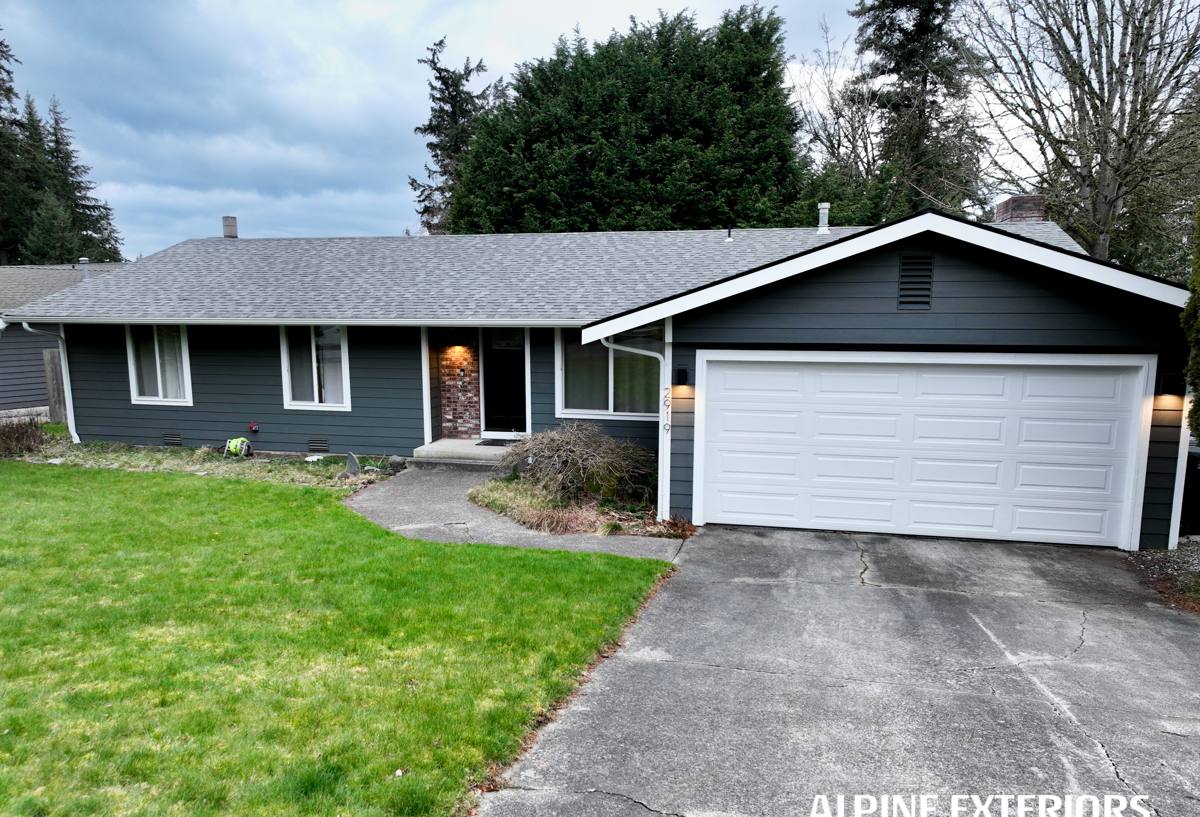
Why We Only Install James Hardie Siding in This Climate
We don't install vinyl, LP SmartSide, Cemplank, Allura, primed spruce, or cedar. That's not a marketing line — it's a standard we settled on after weighing how each of those products actually holds up against exactly the conditions Custer sees every year. Wood and wood-composite sidings depend on an intact paint or coating layer to keep moisture out; once that layer is compromised by driving rain, sun-UV cycling, or a scratch nobody notices, water gets into the substrate and the clock starts on rot. Vinyl doesn't rot, but it expands and contracts with temperature swings, can warp or crack in wind-driven weather, and offers no real fire resistance.
James Hardie fiber cement is non-combustible, doesn't feed insects or rot from moisture the way wood-based products can, and holds its factory-applied ColorPlus finish far longer than field-applied paint on wood siding. Hardie also engineers regional product lines specifically for climate — the HZ5 formulation used in the Pacific Northwest is built to resist moisture and freeze-thaw cycling in exactly this kind of marine environment. For a Custer home taking on salt air and long wet seasons, that engineering difference is the whole reason we stand behind it and won't install something we know performs worse here.
What Salt Air Actually Does
Airborne salt from the Strait accelerates the breakdown of unprotected fasteners, cheap trim, and lower-grade paint systems. It doesn't rust through fiber cement, but it will eat at ungalvanized or poorly coated fasteners and hardware over time — which is why fastener choice and flashing details matter as much as the siding material itself.
What a Correct Installation Involves
Most siding failures we see aren't a product problem — they're an installation problem. Hardie siding installed without a proper drainage plane, with the wrong fastener pattern, or with caulk used as a substitute for flashing will underperform no matter how good the material is. In a climate like Custer's, those shortcuts show up faster because there's more water to test them.
Drainage Plane and Rainscreen
Correct installation starts behind the siding, not at it. A weather-resistant barrier goes over the sheathing, and in high-exposure areas we build in a drainage gap so any moisture that gets behind the siding has somewhere to go instead of sitting against the wall. This detail matters most on walls that take direct, wind-driven rain — which, given Custer's exposure to weather rolling in off the water, is more of the house than people expect.
Fastening and Clearances
James Hardie publishes specific fastener spacing, penetration depth, and clearance requirements — including keeping siding a minimum distance off decks, roofs, and grade so water doesn't wick up into the board. Skipping these clearances is one of the most common corner-cuts we find when we're called out to fix someone else's installation, and it's one of the fastest ways to void the manufacturer's warranty.
Joints, Flashing, and Trim
Every seam, corner, and window or door opening is a potential entry point for water. Correct work means factory-primed cut edges get sealed, joints are flashed rather than just caulked over, and trim is installed to shed water outward instead of channeling it behind the wall. Caulk fails; flashing doesn't. We treat caulk as a finishing detail, not a moisture barrier.
Choosing the Right Hardie Product for a Custer Home
Hardie makes several product lines, and the right one depends on the home's style and exposure, not just personal preference. Here's how the common options compare for a property in this area:
| Product | Typical Use | Why It Fits Custer |
|---|---|---|
| HardiePlank Lap Siding | Most traditional and craftsman-style homes | Widest color and texture range; handles wind-driven rain well when lapped and flashed correctly |
| HardieShingle | Accent gables, Cape Cod or cottage-style homes | Gives a cedar-shake look without the moisture and maintenance issues of real wood shakes |
| HardiePanel | Modern styles, garages, accent walls | Clean vertical lines; works well paired with board-and-batten trim |
| HardieTrim | Corners, fascia, window and door surrounds | Matches the siding's moisture resistance so trim doesn't become the weak point |
On most Custer homes, the right answer is a combination — lap siding on the main walls, trim that matches, and shingle or panel accents where the architecture calls for it. We'll walk through what fits your home during the estimate rather than defaulting to one product for every house.
Our Process, Start to Finish
The work is the same discipline whether it's a full re-side or a single wall repair:
- Assessment — We look at the existing wall assembly, check for hidden moisture damage, and identify exposure areas that need extra attention (north-facing walls, areas under tree cover, low-clearance sections).
- Prep and removal — Old siding comes off, sheathing is inspected and repaired where needed, and the weather barrier is installed correctly rather than patched over damaged material.
- Installation — Hardie siding, trim, and flashing go in to manufacturer spec, with fastening and clearances checked as we go, not just at the end.
- Final inspection — Joints, caulking, and paint touch-up are reviewed before we call the job done.
We don't skip the prep steps to get to the visible work faster. On a home that's going to face another thirty winters of coastal weather, what's behind the siding matters as much as what you see from the street.
Living With Hardie Siding in a Moss-Prone Climate
Fiber cement doesn't rot or feed moss the way wood siding can, but it's not maintenance-free — nothing exposed to Custer's weather is. The good news is that upkeep is straightforward compared to wood or vinyl, and most of it is basic homeowner maintenance rather than specialized work.
- Rinse siding once or twice a year, especially shaded or north-facing walls, to keep moss and algae from getting a foothold
- Trim back vegetation and tree limbs that keep a wall shaded and damp longer than the rest of the house
- Check caulking at trim joints and window surrounds annually — caulk is a wear item and should be refreshed before it fails, not after
- Keep gutters clear so overflow doesn't run directly down a wall section
- Watch for any siding sitting too close to grade, decking, or roofing — trapped moisture there is the most common cause of problems we see
- Repaint or touch up ColorPlus finish only if it's actually needed — the factory finish is designed to outlast field-applied paint by years
Why a Crew That Already Works Custer Matters
Installation specs are written for a national range of conditions, but knowing where the trouble spots are on a specific type of home in a specific microclimate comes from doing the work here repeatedly. A crew that's used to inland or drier-climate installs may not think twice about a clearance detail or a drainage gap that turns out to matter a lot more once wind-driven rain off the Strait is involved. Working in Whatcom County day in and day out means we're not guessing at how a wall assembly should be built for this exposure — we're applying what we already know holds up here.
That local familiarity also shows up in smaller ways: knowing which sides of a house typically need the most attention, recognizing early moss growth before it becomes a moisture problem, and building in the drainage and clearance margin that this climate calls for rather than the bare minimum a warmer, drier region might get away with.
Getting Started
If your Custer home's siding is showing its age, or you're planning ahead of a repaint or repair, we're happy to take a look and give you a straight answer on what it needs — no pressure, no upsell to a product we don't stand behind. Request a free estimate below and we'll walk the property with you.