 Blaine
 Cherry Point Siding Takes a Different Kind of Beating
Cherry Point sits along the Strait of Georgia south of Blaine, and homes out here deal with a combination of stresses that inland Whatcom County properties simply don't see as often. Salt-laden air moves in off the water and settles on exterior surfaces daily. Wind-driven rain hits siding at an angle instead of falling straight down, which pushes moisture into seams, laps, and fastener points that were never designed to handle standing water. And for roughly half the year, shaded and north-facing walls stay damp long enough for moss and algae to take hold and spread.
None of that is dramatic on its own. The problem is what it does over years, not weeks. Salt air accelerates corrosion on fasteners and metal flashing. Driving rain finds the one seam that wasn't sealed quite right and slowly works it wider. Moss holds moisture against the siding surface far longer than open air ever would, which is exactly the condition that rots wood trim, delaminates old fiber cement, and blisters paint. A repair crew that only sees Cherry Point once or twice a year tends to treat these as isolated cosmetic issues. A crew that works the area regularly knows they're usually connected.
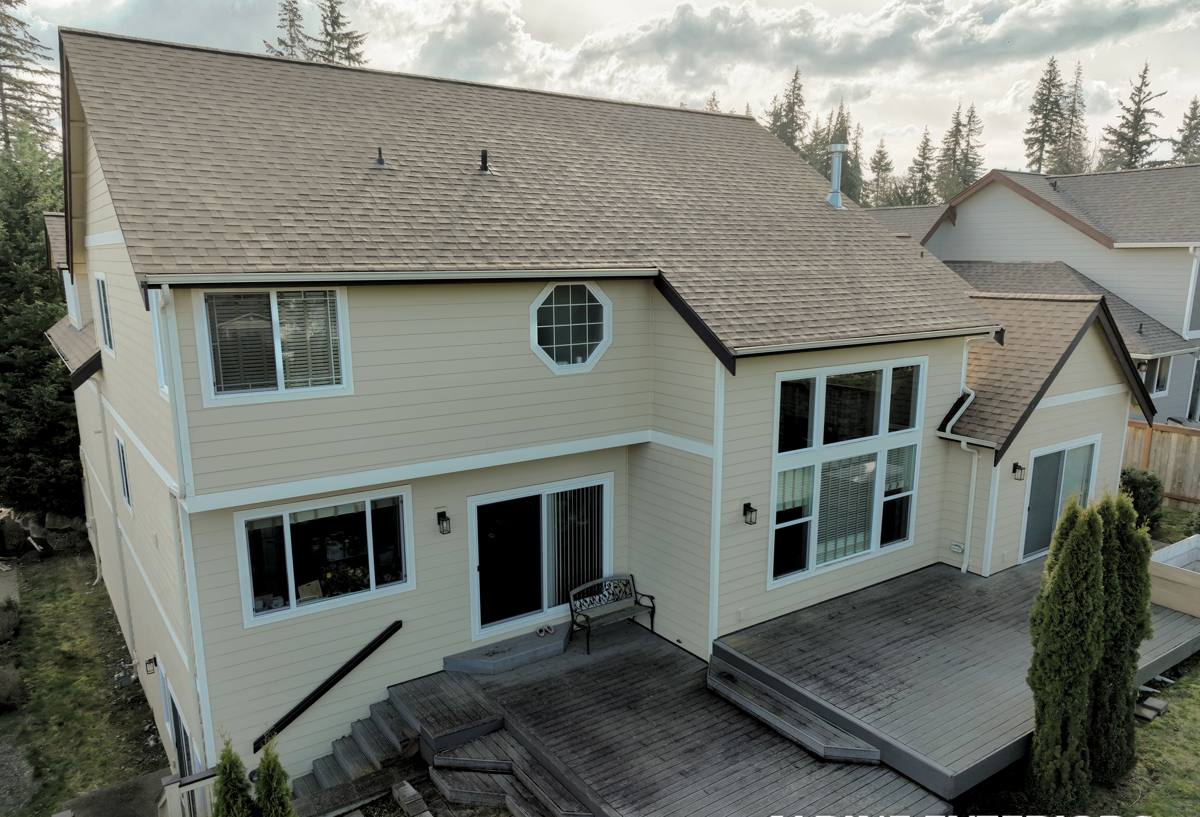
What Actually Causes Siding Damage Out Here
Salt Air and Fastener Corrosion
Coastal salt exposure is hard on anything metal. Nails, screws, and flashing that would last decades in a drier inland location can start corroding noticeably sooner near the water. Once a fastener weakens or a flashing edge rusts through, water gets a path behind the siding — and that's when small problems become expensive ones.
Driving Rain and Wind Direction
Blaine and Cherry Point catch weather systems moving in off the Strait, and wind-driven rain behaves differently than a straight downpour. It pushes water sideways and upward into laps and joints that were only ever built to shed water moving down. Siding installed with tight, correctly sealed laps handles this fine. Siding with gaps, under-lapped joints, or failed caulk does not.
Moss and Prolonged Moisture
Shaded walls, tree-lined lots, and the region's long wet season all favor moss and algae growth. Once moss establishes itself on a wall, it holds moisture against the surface almost continuously, even between rain events. That constant dampness is what leads to rot in wood-based products and can shorten the life of paint and caulk on any siding type.
Repair or Replace? How We Make That Call
Not every damaged section needs to come off the house. But not every problem should be patched, either. We look at three things before recommending anything: how much of the wall is actually affected, what's happening behind the siding (not just on the surface), and whether the underlying material can still perform once the visible issue is fixed.
| Situation | Usually Repairable | Usually Needs Replacement |
|---|---|---|
| Isolated cracked or split boards | Yes, if sheathing behind is dry | — |
| Localized moss/algae staining | Yes, clean and reseal | — |
| Failed caulk at seams and trim | Yes, standard maintenance repair | — |
| Soft or spongy sheathing found during inspection | — | Yes, water has already gotten in |
| Widespread delamination or swelling (older fiber cement or engineered wood) | — | Yes, product is failing broadly |
| Rot at multiple wall penetrations (vents, hose bibs, light fixtures) | Sometimes, case by case | Often, if damage is repeated across the wall |
The honest answer is that most Cherry Point repair calls are legitimate repairs — a section of damaged board, a corroded fastener line, a few feet of failed caulk at a window. We only recommend full replacement when the inspection actually shows it's warranted, not as a default.
What a Correct Repair Actually Involves
A siding repair that's done right addresses the cause, not just the visible symptom. That means the crew has to actually get behind the siding, not just patch what's showing.
- Remove the damaged section carefully so surrounding boards aren't stressed or cracked
- Check the sheathing and house wrap underneath for soft spots, staining, or mold before closing anything back up
- Inspect and, if needed, replace corroded fasteners and compromised flashing — not just at the damaged spot, but along the same wall plane
- Match replacement material, profile, and reveal so the repair doesn't stand out as a patch
- Re-lap and fasten to the same spacing and pattern as the original installation, not shortcuts
- Reseal seams, trim joints, and penetrations with exterior-grade sealant rated for this climate
- Confirm the repaired section sheds water correctly before calling the job done
Skipping any one of these steps is how a "repaired" wall ends up with the same problem again in two or three years. Most premature repair failures we see in this area trace back to a patch that covered damage instead of correcting the moisture path that caused it.
Why We Only Install James Hardie — And What That Means for Repairs
We install James Hardie fiber cement exclusively. We don't install vinyl, LP SmartSide, Cemplank, Allura, or primed wood siding, and that standard shapes how we handle repair work too. Hardie's engineered fiber cement — including its HZ5 formulation built for harsher, wetter climates — resists moisture absorption, doesn't support rot, and holds up to the freeze-thaw and salt-air cycling that coastal Whatcom County sees. When we repair a Hardie wall, we're matching into a product with a long, well-documented track record and a factory ColorPlus finish that ages predictably.
When we're called to repair a home with vinyl, older wood siding, or a lower-grade engineered product, we'll still do the repair honestly and correctly — that's the job we were hired for. But if the underlying material is failing broadly rather than in one spot, we'll tell you that plainly, and we'll explain why Hardie is what we'd put back on the wall if you ever go the replacement route. That's a professional recommendation based on how these materials perform over time in this specific climate, not a sales pitch.
Our Process for Cherry Point Repair Calls
- On-site inspection. We look at the damaged area and the surrounding wall, not just the spot you called about — moisture problems rarely stay contained to one board.
- Honest diagnosis. We tell you what's actually happening behind the siding where possible, and what we won't know until we open it up.
- Written scope and estimate. You get a clear explanation of what's being repaired, why, and what it involves — no vague line items.
- The repair itself. Matched materials, correct fastening and flashing, and sealing done to hold up against wind-driven rain, not just look fine on a dry day.
- Final check. We confirm the repair sheds water correctly and blends with the surrounding siding before we consider the job finished.
Why Local Cherry Point Experience Actually Matters
A crew that regularly works Blaine and the Cherry Point shoreline has already seen how this specific stretch of coastline treats siding — which wall orientations take the worst of the wind-driven rain, how fast moss reestablishes on shaded north walls, and where salt air tends to attack fasteners first. That's not something you get from a general contractor who occasionally drives up from further south. It shows up in small decisions: which seams get extra attention, which fastener types hold up best out here, and when a "small patch job" is actually the first sign of a bigger moisture problem working its way through the wall.
It also means we're not guessing at your specific conditions. Whatcom County's coastal microclimates vary meaningfully between a sheltered inland lot and an exposed waterfront property, and Cherry Point tends toward the exposed end of that range. A repair plan built for a drier, more sheltered site won't necessarily hold up here.
Simple Maintenance That Extends Siding Life Between Repairs
Most of what keeps siding healthy on the coast is basic upkeep, done consistently, rather than anything complicated.
- Rinse siding annually to remove salt residue, especially on walls facing the water
- Keep gutters clear so overflow doesn't run down and pool against siding seams
- Trim back vegetation that shades walls and keeps them damp longer than necessary
- Address moss growth early — a light cleaning is far cheaper than repairing rot it eventually causes
- Walk the exterior once or twice a year and look for cracked caulk, loose boards, or discoloration near penetrations
- Don't ignore small cracks or gaps — they're easy to seal now and expensive to fix once water's gotten behind them
Get an Honest Look at Your Siding
If you're noticing damage, staining, or soft spots on your Cherry Point home's siding, it's worth having someone look at it before the next wet season makes the problem worse. We'll give you a straightforward, no-pressure assessment of what's actually going on and what it would take to fix it right — use the form below to request a free estimate.