 Blaine
 Storm Damage Roof Repair for Grandview
Grandview homes sit close enough to the water that the roof overhead is doing more work than most homeowners realize. Between salt-laden air rolling off the coast, wind-driven rain that finds its way under anything loose, and a moss season that never really ends, a roof in this part of Blaine takes a different kind of beating than one thirty miles inland. Storm damage here rarely announces itself with a dramatic hole in the roof deck. More often it shows up as a lifted shingle tab, a soft spot near a flashing, or a slow stain on a ceiling that started weeks after the wind actually blew.
This page covers what storm damage repair actually involves for a Grandview roof, what our process looks like from first call to final walk-through, and why it matters to work with a crew that already understands how Whatcom County weather behaves on a roofline — not one learning it on your dime.
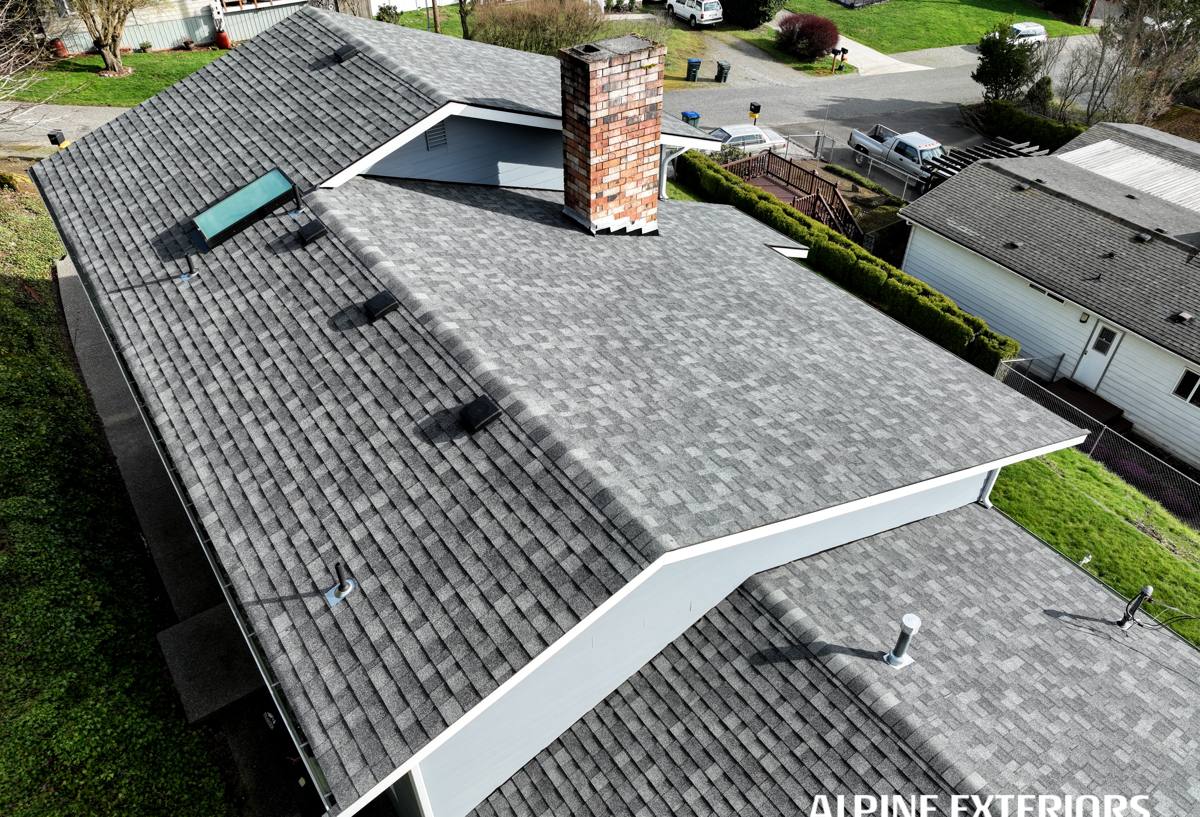
What Grandview's Weather Actually Does to a Roof
Salt Air and Corrosion
Proximity to Semiahmoo Bay and the Strait of Georgia means the air carries salt, even on calm days. Salt accelerates corrosion on exposed metal — nail heads, flashing, gutter fasteners, and the edges of metal roofing panels. A fastener that would last decades in a dry inland climate can start rusting and losing grip years sooner here. Once a fastener corrodes, the material it's holding down loosens, and that's exactly where wind gets a foothold.
Driving Rain and Wind-Driven Water
Storms coming off the water don't just drop rain straight down — wind pushes it sideways, up under shingle laps, and into any gap that a calm-weather roof would never notice. This is why a roof can look intact from the ground after a storm and still be actively leaking. The damage isn't a missing shingle; it's water finding a path that only opens up under wind pressure.
Moss Season
Whatcom County's damp, mild winters and shaded lots common around Grandview keep moss growing for a long stretch of the year. Moss holds moisture against the roof surface, lifts shingle edges as it grows, and adds weight in thick mats. On its own it's a maintenance issue. Combined with wind and rain, it becomes the reason a minor storm turns into a real leak — the moss has already loosened the seal, and the storm just finishes the job.
What Counts as Storm Damage (And What Doesn't)
Insurance and honest assessment both depend on drawing this line correctly. Not everything that goes wrong with a roof after a storm was actually caused by the storm.
| Likely Storm Damage | Likely Wear-and-Tear |
|---|---|
| Shingles creased or torn from wind uplift | Shingles curling or granule loss from age/UV |
| Flashing bent or pulled loose by wind | Flashing corroded from years of salt exposure |
| Sudden leak appearing right after a named storm | Slow-developing stain with no storm tied to it |
| Debris impact dents or punctures | Soft decking from long-term moss moisture |
| Gutter torn off by wind load | Gutter sagging from years of debris weight |
The distinction matters because it affects whether a repair is a straightforward fix-and-move-on job or something an insurance claim should cover. We'll tell you honestly which category your damage falls into — we don't inflate a maintenance issue into a "storm claim" to pad a job, and we don't wave off real storm damage as normal wear either.
Signs of Storm Damage Worth Checking
Most storm damage in this area is found, not seen. A walk around the exterior and a look in the attic after any significant wind event is worth the ten minutes it takes.
- Shingle pieces or granules in gutters, downspout splash areas, or along the foundation line
- Lifted or missing shingle tabs, especially on the side of the roof the wind hit directly
- Bent, loose, or missing flashing around chimneys, vents, and skylights
- New water stains on ceilings or upper walls, even faint ones
- Damp insulation or a musty smell in the attic
- Gutters pulled away from the fascia, or downspouts disconnected
- Visible daylight through the roof deck from inside the attic
- Moss mats that appear disturbed, torn, or shifted after wind
If you see any of these, the priority is stopping active water intrusion before it spreads to decking, insulation, or drywall — that's a bigger repair than the roof damage itself if it sits unaddressed.
Our Storm Damage Repair Process
Storm repair isn't one job — it's a sequence, and skipping a step is usually where things go wrong later.
- Inspection. We check the full roof system, not just the obvious damage — decking, flashing, ventilation, and the areas around the visible problem, since wind damage often extends past what's easy to spot from the ground.
- Documentation. Photos and notes on the damage, dated and organized, which matters whether or not you end up filing an insurance claim.
- Emergency mitigation. If there's active or likely water intrusion, we get a tarp or temporary cover in place the same visit. This step alone prevents most of the expensive secondary damage.
- Repair plan. A clear scope — what's being repaired, what materials match your existing roof, and an honest read on whether this is a patch or points toward a larger repair.
- The repair itself. Matching shingles or flashing where possible, correcting the underlying cause (not just covering the symptom), and rechecking fastener and seal integrity in the surrounding area, not only the exact damaged spot.
- Cleanup and debris removal. Old material, nails, and moss debris cleared from the roof and gutters.
- Follow-up. A check-in after the next significant rain to confirm the repair is holding, particularly for driving-rain conditions that don't always show a problem immediately.
Repair vs. Replacement: How We Decide
Storm damage doesn't always mean a full new roof, and it doesn't always mean a five-minute patch either. The right call depends on a few factors.
| Factor | Points Toward Repair | Points Toward Replacement |
|---|---|---|
| Extent of damage | Isolated to one section or slope | Spread across multiple slopes |
| Roof age | Roof is under 10-12 years old | Roof is near or past expected service life |
| Decking condition | Deck is dry and sound underneath | Deck is soft, delaminated, or water-stained |
| Shingle match | Matching shingles are still available | Discontinued product, visible patch mismatch |
| Underlying moss/moisture history | First real damage event | Repeated moss and leak issues over years |
We'll walk through where your roof lands on this table and explain the reasoning — the goal is the right-sized repair, not the biggest invoice.
Working with Insurance After a Storm
Most homeowner policies cover sudden storm damage — wind, impact, sometimes wind-driven rain — but rarely cover damage from long-term neglect, like a roof that failed because moss and salt corrosion had already compromised it for years. That's part of why accurate documentation matters. We provide photos and a written scope you can hand to an adjuster, and we're available to walk the roof with an adjuster if that's useful. We don't handle the claim for you or promise a specific settlement — that's between you and your insurer — but we make sure the physical facts of the damage are documented clearly and honestly.
Why a Crew That Knows Grandview Matters
A roofer unfamiliar with this stretch of Whatcom County can misdiagnose damage that looks unusual if you haven't seen it before — mistaking salt corrosion for simple age, or missing how far wind-driven rain has traveled under shingles because the entry point isn't where the water ends up. Working storm repairs in and around Blaine and Grandview regularly means recognizing these patterns quickly: which slopes take the worst of the prevailing wind, where moss builds fastest given the shade and moisture on a given lot, and which flashing details tend to fail first in salt air. That familiarity shortens the time between "something's wrong" and "here's exactly what happened and what it takes to fix it."
Maintenance That Reduces Future Storm Risk
A roof that's already in good condition handles a storm far better than one carrying unaddressed moss or loose flashing into the wind. A few habits make a real difference in this climate:
- Clean gutters at least twice a year — clogged gutters back water up under the roof edge during heavy rain
- Address moss growth before it forms thick mats, rather than after
- Have flashing around chimneys, vents, and skylights checked periodically for corrosion, not just after a storm
- Trim back tree limbs that overhang the roof, which reduces both impact risk and shade-driven moss growth
- Get a post-storm walk-around after any significant wind event, even without visible interior signs
None of this prevents every storm problem, but it removes the weak points that turn an average storm into a real repair bill.
Get an Honest Look at Your Roof
If a recent storm has you wondering about your roof, or you'd rather get ahead of the next one, we're glad to come take a look. The estimate is free, there's no pressure to move forward, and you'll get a straight answer about what's actually going on — use the form below to get started.