 Blaine
 Why Decking in Birch Bay Takes a Different Approach
Birch Bay sits right on the water, and that changes what a deck has to survive. Salt-laden air moves inland off the bay and settles on every exposed surface, driving rain comes in sideways off Whatcom County's winter storms, and a long, damp moss season sets in every fall and doesn't let go until late spring. A deck built with the same assumptions you'd use in a drier inland climate will show it within a few years — fading unevenly, holding moisture where boards meet framing, and growing moss and algae in the shaded, low-airflow spots that never fully dry out.
Composite decking earns its keep in this environment because it doesn't absorb water the way wood does, doesn't need annual staining, and resists the freeze-thaw and wet-dry cycling that splits and cups traditional lumber. But composite isn't magic — it still needs to be installed with this specific climate in mind. Framing, spacing, fastening, and drainage decisions matter as much as the decking material itself, maybe more.
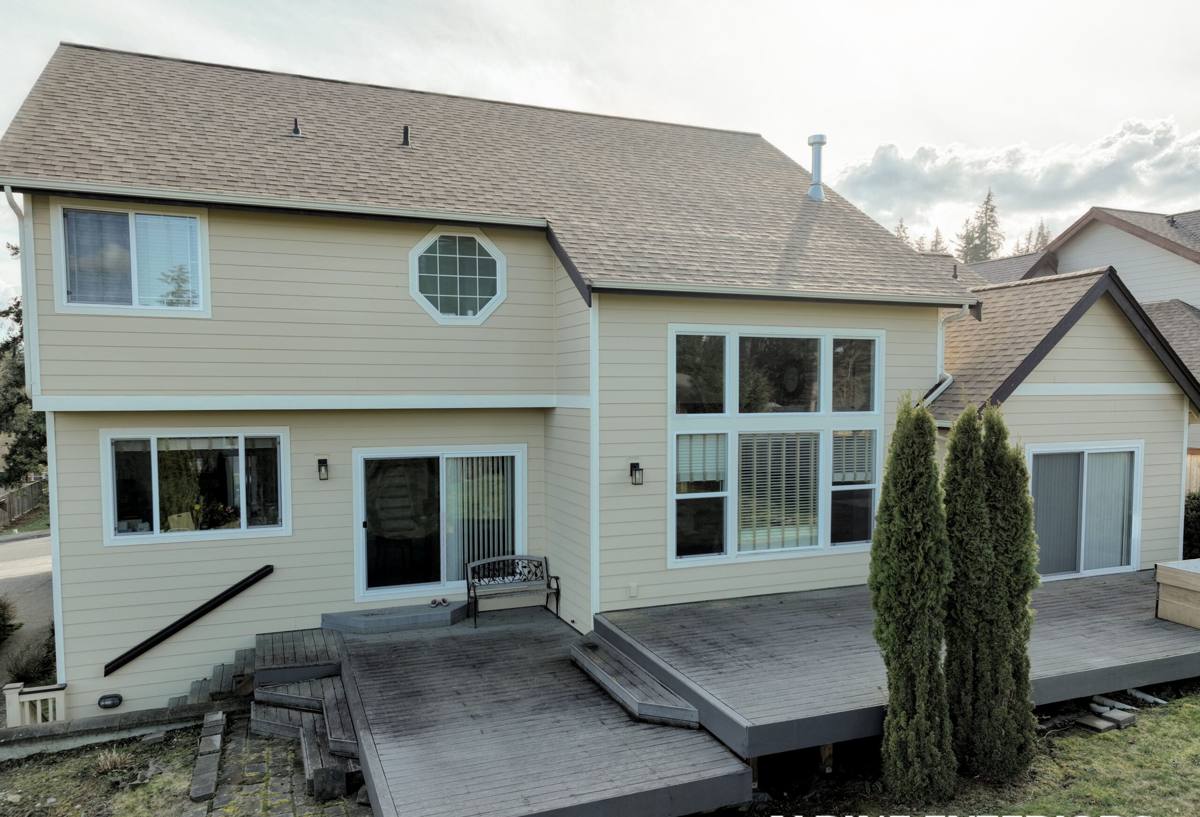
What Salt Air, Rain, and Moss Actually Do to a Deck
Salt Air
Airborne salt is corrosive to hardware. Screws, joist hangers, and structural fasteners that aren't rated for coastal exposure can start corroding well before the decking above them shows any wear. Once a fastener weakens, the board it's holding starts moving, and movement is what causes composite boards to crack around screw heads or pull loose from clips.
Driving Rain
Wind-driven rain doesn't just fall on a deck, it gets pushed underneath it, into end grain, and into any gap where two boards meet. Composite decking sheds surface water well, but the substructure underneath — joists, beams, ledger boards — still needs to be protected and able to drain and dry between storms. A deck that traps water under the boards will develop problems in the framing long before the decking itself fails.
Moss Season
Whatcom County's wet season can run from October through May. Anywhere a deck stays shaded, doesn't get direct sun, or has poor airflow underneath becomes a place moss and algae take hold. On wood, that means soft, slippery, decaying boards. On composite, it's mostly cosmetic and cleanable, but board spacing and gap width still determine how fast a surface dries out after a rain, which determines how much moss growth you're dealing with come spring.
What a Correct Composite Deck Build Includes
A composite deck that's actually built for this area isn't just "composite boards on a wood frame." The details below are what separate a deck that looks good for two seasons from one that holds up for twenty years.
- Coastal-rated fasteners: stainless steel or coated hardware rated for marine/coastal exposure, not standard exterior-grade screws that will corrode faster this close to the bay.
- Proper joist protection: joist tape or an equivalent moisture barrier over the framing so rain that gets under the boards doesn't sit against bare wood.
- Correct board spacing: gap widths set to manufacturer spec so water sheds and air moves underneath, which is what keeps moss from taking hold between boards.
- Ventilated substructure: enough clearance and airflow under the deck that the frame can actually dry out between rain events instead of staying damp all winter.
- Hidden fastening systems where appropriate: clip-based fastening reduces the number of exposed screw penetrations, which means fewer points where water and salt can work their way in over time.
- Flashing at the house connection: a properly flashed ledger board so the point where the deck meets the house doesn't become a slow leak path into the structure.
Comparing Materials for a Bayfront Property
| Material | How it handles salt air & rain | Moss/algae behavior | Ongoing maintenance |
|---|---|---|---|
| Pressure-treated wood | Absorbs moisture, prone to warping and fastener corrosion over time near the water | Holds moisture, moss and mildew take hold readily | Annual cleaning, periodic staining/sealing |
| Cedar | Naturally rot-resistant but still absorbs water and greys/weathers quickly in salt air | Moderate — better than treated pine but still needs upkeep | Regular sealing to hold color and resist moisture |
| Composite decking | Doesn't absorb water into the board itself; performs consistently in salt/rain exposure when framing is done right | Low — surface doesn't hold moisture the way wood does, cleans off easily | Periodic washing, no staining or sealing required |
The material comparison only tells part of the story. Two composite decks can perform very differently depending on whether the framing, fastening, and drainage underneath were done for this climate or just done to a generic spec.
A Note on Product Choice
We install composite decking systems with solid warranty backing and a track record in wet coastal climates, and we're upfront about trade-offs when a homeowner is choosing between product lines. Lower-tier composite boards can be more sensitive to installation errors — tight spacing, inadequate ventilation, or the wrong fastener can shorten their service life fast in an environment like Birch Bay's. We'd rather walk you through what a given product actually needs to hold up here than sell you on a price point that doesn't account for the climate.
Our Process for a Birch Bay Deck Project
- On-site assessment: we look at sun exposure, prevailing wind and rain direction, drainage around the existing structure, and how close the deck sits to the water.
- Framing evaluation: if you're replacing an existing deck, we check the condition of the substructure before anything new goes on top of it — no point installing new boards over compromised framing.
- Material and layout plan: board direction, spacing, and fastening method are chosen based on the site conditions we found, not a one-size layout.
- Installation: coastal-rated hardware, joist protection, and correct ventilation clearance go in as standard practice, not upsells.
- Final walkthrough: we go over basic care — what routine cleaning looks like and what to watch for seasonally — so you know what normal wear looks like versus something that needs a call.
Why Local Experience with Birch Bay Conditions Matters
A contractor who mostly builds decks inland, away from the water, isn't necessarily thinking about coastal fastener corrosion, wind-driven rain intrusion, or moss cycles the same way a crew that regularly works Birch Bay and the rest of the Blaine area does. It's not about a different skill set — it's about which problems you've already seen and planned for before they show up on a new project.
Whatcom County's coastal microclimates aren't uniform even within a few miles. A property with more direct exposure to the bay's wind and salt spray needs different attention than one set back and sheltered by trees. Crews who work this specific stretch of coastline regularly get a feel for which builds need extra ventilation, tighter fastener specs, or different board orientation, without having to guess.
Maintenance: What Birch Bay Homeowners Should Actually Expect
Composite decking is low-maintenance, not no-maintenance. Here's a realistic checklist for keeping a composite deck performing well through Whatcom County's wet season:
- Rinse or sweep debris off the deck surface regularly, especially in fall when leaves and organic matter collect and hold moisture against the boards.
- Wash the deck surface a couple of times a year with a mild soap and water (or manufacturer-recommended cleaner) to keep salt residue and early moss/algae from building up.
- Check that gaps between boards stay clear of debris so water keeps draining and air keeps moving underneath.
- Inspect under the deck occasionally for standing water or blocked drainage paths, particularly after a heavy storm.
- Confirm railing and stair fasteners are still tight — hardware near the water can loosen faster than it would inland.
Cost Factors to Expect
Every deck project is different, but a few factors consistently drive cost on Birch Bay projects specifically:
| Factor | Why it affects cost here |
|---|---|
| Framing condition | Older decks near the water often need more substructure repair or replacement due to moisture exposure |
| Fastener grade | Coastal-rated hardware costs more than standard exterior fasteners but is worth it for longevity |
| Site access | Waterfront lots and steeper bluff properties can add complexity to material delivery and staging |
| Board tier chosen | Higher-tier composite lines cost more upfront but generally offer stronger warranties and better fade/stain resistance |
| Railing and structural add-ons | Code-required railings, stairs, and any structural upgrades add to the base decking cost |
We don't quote a project without seeing the site — condition of the existing structure and access alone can shift the numbers significantly. What we can promise is a straightforward, itemized estimate with no surprise change orders for things we should have caught up front.
Let's Take a Look at Your Deck
If you're in Birch Bay and thinking about a new composite deck or replacing one that hasn't held up to the salt air and rain, we're glad to come take a look. There's no pressure and no obligation — just a straightforward assessment of what your property needs and an honest estimate. Use the form below to get started.