 Blaine
 Why Birch Point Roofs Take More Punishment Than Roofs Inland
Birch Point sits close enough to the water that the roof over your head deals with a different set of stresses than a roof a few miles inland in Whatcom County. Salt-laden air corrodes fasteners and flashing faster than dry air does. Wind-driven rain off the Strait doesn't just fall straight down — it gets pushed sideways under shingle edges and around penetrations where a roof built for a calmer climate would never get tested. And the long, wet, shaded stretches of the year here give moss and algae months to establish themselves before a sunny week ever dries things out.
None of that means asphalt shingles are the wrong choice for Birch Point — they're still the most practical, cost-effective roofing material for most homes in this area. It means the installation details matter more here than they would somewhere drier. A roof that's "good enough" in a low-humidity climate can fail early on this stretch of coastline if it's missing the underlayment, ventilation, or flashing work that coastal Whatcom County actually requires.
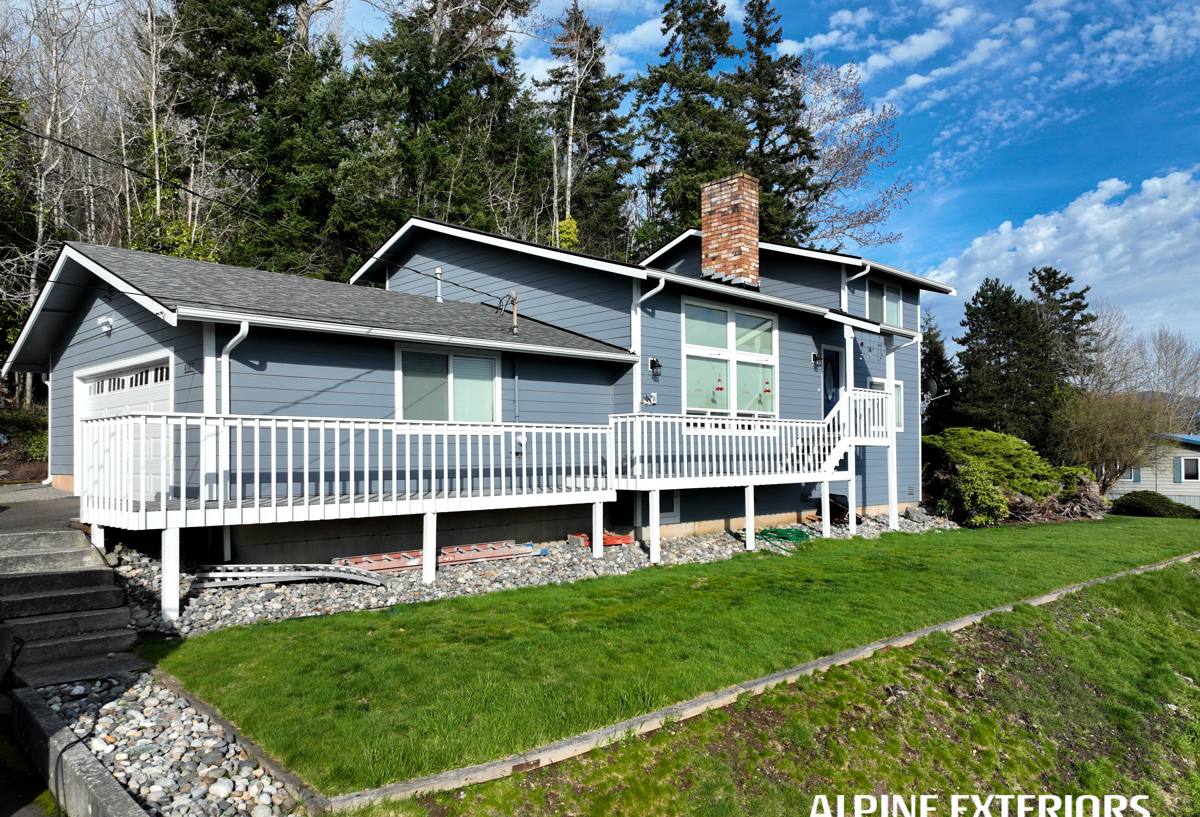
What a Correctly Installed Shingle Roof Looks Like Here
A roof that's going to hold up on the water side of Blaine needs a few things done right that aren't optional extras — they're the baseline for this environment.
Underlayment and Water Management
Wind-driven rain finds its way under shingle tabs more often here than in sheltered locations. A synthetic underlayment rated for high wind exposure, installed with proper overlap, is the difference between rain that stays on top of the roof and rain that gets underneath it. Along eaves and in valleys — the two spots where water concentrates and backs up — we install self-adhering ice-and-water membrane, not because Birch Point gets heavy ice, but because that membrane also seals around fastener penetrations and resists wind-driven intrusion at the roof's most vulnerable edges.
Ventilation
Moisture that gets trapped in an attic condenses, feeds rot in the sheathing, and shortens the life of the shingles from underneath — often before any problem is visible from the ground. Balanced intake at the soffits and exhaust at the ridge keeps air moving through the attic space so that humidity from the marine air outside, and from daily living inside, doesn't sit and soak into wood framing. A shingle roof with poor ventilation will underperform its warranty life even if the shingles themselves are installed perfectly.
Flashing and Transitions
Chimneys, skylights, sidewalls, and any place a roof plane meets a wall or a penetration is where roof leaks actually start — almost never in the open field of shingles. Salt air accelerates corrosion in cheap or thin flashing metal faster than most homeowners expect. We use flashing material and fastener types suited to a coastal environment and detail every transition so wind-driven rain can't work its way in sideways.
Moss, Algae, and Salt Air: The Three Things That Wear Roofs Out Fastest Here
Ask any longtime Blaine or Birch Point homeowner what actually kills a roof early, and it's rarely one dramatic storm — it's the slow, steady wear from these three things.
Moss takes hold in the shaded, north-facing, and tree-covered sections of a roof first. Its roots work under shingle edges and lift them slightly, which is exactly what wind-driven rain needs to get underneath the shingle. Left long enough, moss holds moisture against the roof deck almost permanently.
Algae shows up as dark streaking, usually starting near the ridge and running down the slope. It's cosmetic at first, but heavy algae growth traps moisture against the shingle surface and can shorten the shingle's effective life.
Salt air works on anything metal — nails, flashing, drip edge, gutter fasteners. A fastener that corrodes and loosens is a fastener that no longer holds a shingle down against wind, which matters a lot during a winter storm off the water.
None of these are reasons to avoid asphalt shingles. They're reasons to install algae-resistant shingles where appropriate, use corrosion-resistant fasteners and flashing, and build in the ventilation and drainage that keep moss and algae from getting the standing moisture they need to spread.
Signs a Birch Point Roof Needs Attention
Most shingle roof failures give warning signs well before there's an active leak inside the house. Worth checking for, especially after a stretch of winter storms:
- Granules collecting in gutters or at the base of downspouts — a sign shingles are wearing thin
- Shingle edges that look curled, lifted, or cupped, especially on north-facing or shaded slopes
- Visible moss growth, even if it looks minor — it spreads faster than most people expect
- Dark streaking running down from the ridge — early algae growth
- Rust staining around flashing, vents, or fasteners
- Daylight visible through the roof deck from inside the attic
- Soft or spongy spots when walking the roof, which usually mean the decking underneath has taken on moisture
- Interior ceiling stains, even faint ones, after a heavy rain event
Any one of these on its own might not mean an urgent problem. Several at once, or moss that's been left untreated for a couple of seasons, usually means it's time for a closer look before the next round of driving rain finds a way in.
What Actually Drives the Cost of a Shingle Roof Project
Every roof is priced on its own specifics, but the same handful of factors move the number up or down on almost every job we quote in this area.
| Factor | Why It Matters |
|---|---|
| Roof size and number of planes | More square footage and more valleys, hips, and transitions mean more material and more labor-intensive detail work |
| Existing layers and tear-off | Removing old shingles down to the deck costs more up front but lets us inspect and repair the sheathing underneath — something you can't do over an existing layer |
| Deck condition | Rotted or soft sheathing found during tear-off needs to be replaced before new shingles go down; this is common on older roofs with a history of moss or trapped moisture |
| Ventilation upgrades | Adding or correcting intake and exhaust ventilation is inexpensive during a re-roof and far more disruptive to add later |
| Roof pitch and access | Steeper roofs and roofs with limited ground access around the home take longer and require more safety setup |
| Shingle class and warranty tier | Standard three-tab, architectural, and premium algae-resistant lines carry different material costs and different warranty lengths |
| Flashing and disposal | New flashing at all penetrations and proper disposal of tear-off debris are part of a complete job, not optional add-ons |
We give a straight number after actually seeing the roof, not a guess over the phone — deck condition especially can't be judged accurately from the ground or from photos.
Our Process, From Estimate to Cleanup
- On-site inspection. We walk the roof, check the attic for ventilation and moisture issues, and look closely at flashing, valleys, and any moss or algae growth.
- Written estimate. A clear scope of work and price, including tear-off, deck repair contingencies, underlayment, flashing, and shingle selection — no vague allowances.
- Tear-off and deck inspection. Old roofing comes off down to the sheathing so we can see and fix what's actually underneath, not guess at it.
- Underlayment and ice-and-water membrane. Installed at eaves, valleys, and any high-exposure area before a single shingle goes down.
- Ventilation correction. Intake and exhaust balanced properly so the new roof isn't fighting trapped moisture from day one.
- Shingle installation and flashing. Shingles installed to manufacturer spec with corrosion-resistant fasteners, and new flashing at every chimney, vent, skylight, and wall transition.
- Site cleanup and magnetic sweep. Debris and stray nails cleared from the yard and driveway before we call the job done.
- Final walkthrough. We go over the finished roof with you so you know what was done and what to expect from it going forward.
Why Hiring a Crew That Already Works Birch Point Matters
A roofing crew that only occasionally works this stretch of coastline tends to build the same roof they'd build anywhere — standard underlayment, standard ventilation, no particular attention to salt-air corrosion or moss-prone shading patterns. A crew that works Birch Point and the rest of the Blaine area regularly already knows which slopes on this kind of terrain hold moss the longest, which fastener and flashing materials actually hold up against the salt air coming off the water, and how much wind-driven rain a roof here really needs to be built to shed.
That local familiarity shows up less in any single dramatic feature and more in a dozen small decisions made correctly throughout the job — the kind of decisions that determine whether a roof is still performing well in fifteen years or showing problems in five.
Keeping a New Roof Performing After Installation
A well-installed shingle roof in this climate still benefits from some basic upkeep. Clearing gutters and downspouts before the fall rains keeps water moving off the roof instead of backing up under the eaves. Treating moss early, before it establishes and lifts shingle edges, is far cheaper than dealing with the moisture damage it can cause if ignored for a couple of seasons. And a periodic look at flashing points — chimneys, vents, skylights — catches corrosion or sealant failure while it's a small fix instead of an interior repair.
None of this requires a maintenance contract or constant attention. It's the kind of occasional check that, in a salt-air coastal environment, pays for itself many times over compared to finding out about a problem from a ceiling stain.
If you're seeing moss, granule loss, or aging shingles on a Birch Point roof, we're glad to take a look and give you a straight, no-pressure estimate — just fill out the form below.