 Blaine
 Decking on Birch Point Isn't the Same Job as Decking Inland
Birch Point sits close enough to the water that every deck built here is fighting a different battle than a deck built ten miles inland in Whatcom County. Salt-laden air off the bay works into fasteners, hinges, and end grain year-round. Driving rain off the Strait doesn't just fall straight down — it drives sideways under rail caps and into board gaps. And the long, damp shoulder seasons that define this stretch of the Blaine coastline mean moss and algae get a running start on any surface that doesn't drain and dry quickly. A deck spec'd for a dry inland lot, or copied from a generic buying guide, tends to show its weaknesses here within a few seasons — not because the material failed outright, but because it was never installed with this specific exposure in mind.
This page is about one job, done right, for one kind of property: composite decking for Birch Point homes. Not a general decking overview, and not a sales pitch for one brand over another — just what actually matters when you're building a deck that has to survive salt air, sideways rain, and a moss season that doesn't really end.
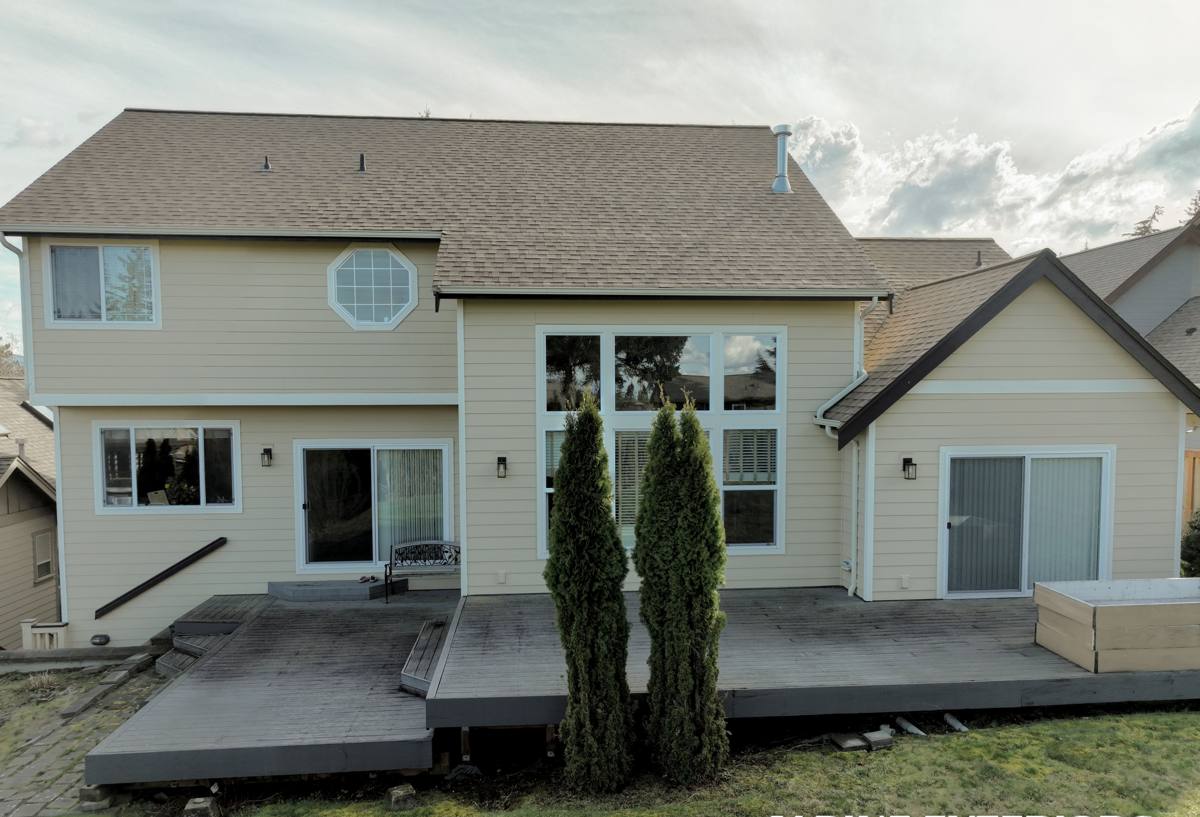
What Salt Air, Rain, and Moss Actually Do to a Deck
It helps to be specific about the failure modes, because they're not all the same problem wearing different clothes.
Salt Air
Airborne salt is corrosive to raw or poorly coated metal. Screws, joist hangers, post bases, and railing hardware that would last decades in a drier inland yard can start showing rust streaks and weakening well ahead of schedule near the water. It's slow and easy to ignore until a fastener actually fails.
Driving Rain
Wind off the water pushes rain at an angle, which means water gets forced into places a flat-on rainstorm never reaches: under fascia boards, behind rim joists, into the gap between decking and house siding at the ledger connection. If flashing and gapping weren't detailed for that, water finds its way into the framing rather than off of it.
Moss and Algae
Moss doesn't need much — shade, moisture, and a surface it can grip. Composite boards resist rot, but a poorly ventilated deck with tight drainage gaps and low airflow underneath will still grow a slick green film on the surface and moss in the gaps between boards, the same as any other surface exposed to this climate. That's a maintenance and slip-hazard issue even on a material that can't rot.
Composite Decking Options and How They Stack Up Here
"Composite decking" covers a range of products, and they don't all behave the same way in a wet, salty climate. Broadly, homeowners choose between traditional wood-plastic composite, fully capped composite, and PVC (cellular polymer) decking. Each has real trade-offs — none of them are a bad product, but each fits differently into a Birch Point property.
| Decking Type | Moisture Behavior | Maintenance | Best Fit |
|---|---|---|---|
| Wood-plastic composite (uncapped or partially capped) | Some moisture absorption at cut ends and edges if not sealed | Occasional cleaning; cut ends need attention | Budget-conscious projects away from direct water exposure |
| Fully capped composite | Shell resists moisture intrusion; core still needs correct end-cutting practices | Low; periodic wash-down | Most Birch Point homes — good balance of cost and durability |
| PVC / cellular polymer | No wood content to absorb moisture; handles wet, salt-air exposure very well | Lowest; wipes clean easily | Waterfront-facing decks, high-exposure rail areas |
| Pressure-treated wood | Absorbs moisture readily; needs regular sealing | Highest; annual inspection and treatment | Homeowners who specifically want a wood deck and accept the upkeep |
We don't push one product line as a blanket answer. What we push is matching the product to the exposure: a covered deck tucked against the house doesn't need the same spec as an open deck facing the water. Where a deck sits — full sun, full rain exposure, tucked under overhangs — changes which composite category makes sense.
What a Correct Composite Deck Installation Actually Involves
Composite boards get most of the attention, but the substructure and details underneath them are what actually determine whether a deck holds up to this climate.
Framing and Ledger Connection
The ledger board — where the deck ties into the house — is the single most common point of hidden water intrusion on any deck, and it's a bigger risk here given how much sideways rain the coastline gets. Correct flashing at the ledger, with proper lap order and a gap for airflow behind the board, keeps driving rain from tracking into the house rim joist.
Fasteners and Hardware
Given the salt air, we don't cut corners on hardware. Stainless steel or coated fasteners rated for coastal exposure, corrosion-resistant joist hangers, and post bases suited to wet ground contact all cost a bit more up front and save the deck from early hardware failure later.
Drainage and Airflow Underneath
A deck built tight to the ground with no ventilation traps moisture underneath, which speeds up moss growth on the surface and creates a damp environment the framing has to sit in year-round. Correct joist spacing, ground clearance, and where needed, a proper under-deck drainage system keep air moving and water leaving instead of pooling.
Board Gapping and Fastening
Composite boards need the manufacturer-specified gap for expansion and drainage — too tight and water sits between boards feeding moss; too loose and it looks sloppy and catches debris. Hidden fastener systems, correctly spaced, keep the surface clean and reduce the gap points where grime and moss get a foothold.
Our Process, Start to Finish
- Site visit and assessment — we look at sun exposure, wind direction, drainage slope, and how close the deck sits to the water before recommending a product.
- Honest product recommendation — we walk through the real trade-offs between composite categories for your specific spot, not a one-size answer.
- Written estimate — clear scope, material spec, and timeline before any work starts.
- Structural and flashing work first — framing, ledger flashing, and hardware go in correctly before a single deck board is placed.
- Decking installation — proper gapping, fastening, and edge detailing to manufacturer spec.
- Final walkthrough — we go over basic care and answer questions before we consider the job done.
Maintaining a Composite Deck in This Climate
Composite decking is genuinely lower-maintenance than wood, but "low-maintenance" doesn't mean "no maintenance" — especially with a moss season this long. A few habits go a long way:
- Sweep debris out of board gaps regularly so organic material doesn't sit and feed moss growth
- Rinse the deck surface periodically, especially after pollen season and after long wet stretches
- Check railing hardware and fasteners once a year for early signs of corrosion
- Keep nearby vegetation trimmed back so the deck gets sun and airflow rather than constant shade
- Clear gutters and downspouts near the deck so runoff isn't dumping extra water onto the surface
- Address any slick, mossy patches with a deck-safe cleaner rather than a pressure washer on high settings, which can damage the cap surface
What Affects the Cost of a Birch Point Composite Deck
| Factor | Why It Matters Here |
|---|---|
| Decking category (WPC vs. capped vs. PVC) | Higher-exposure, water-facing decks often justify the more moisture-resistant category |
| Substructure condition | Existing framing exposed to years of salt air and rain may need repair or replacement before new decking goes on |
| Fastener and hardware spec | Coastal-rated stainless hardware costs more than standard-grade but avoids early corrosion |
| Railing system | Composite or metal rail systems rated for wet, salty exposure vary widely in price |
| Site access and drainage work | Sloped or poorly draining lots near the water may need extra grading or drainage detailing |
We don't quote decks off a square-footage rule of thumb pulled from a national average — every Birch Point lot has its own exposure, drainage, and access considerations that change the real number. That's what the on-site estimate is for.
Why Hiring a Crew That Already Works This Coastline Matters
A contractor who mostly builds decks in drier, inland parts of Whatcom County isn't necessarily wrong about decking in general — they're just less likely to have hard-won habits around flashing details, fastener grade, and drainage spacing that this specific stretch of coastline demands. We work on homes along this part of the Blaine coastline regularly, which means we're not guessing at what salt air and driving rain do to a deck over five or ten years — we've seen it, and we build around it from the start rather than fixing it after the fact.
If you're planning a new composite deck or replacing an aging one on your Birch Point property, we're glad to come take a look and give you a straight, no-pressure estimate — what your site actually needs, what it'll cost, and why. Use the form below to get started.