 Blaine
 Board & Batten in a Salt-Air, High-Rainfall Corner of Whatcom County
Blaine Harbor sits where the Strait of Georgia meets Semiahmoo Bay, and that location shapes what a siding job needs to survive. Homes here take on salt-laden air off the water, long stretches of driving rain pushed in by marine weather systems, and a moss and algae season that can run most of the year in shaded, damp spots. Board & batten siding — with its bold vertical lines and deep shadow reveals — is a popular look for waterfront and near-waterfront homes in this part of Whatcom County, but the material and the installation details matter more here than they would somewhere drier and further inland.
This page covers what board & batten siding actually needs to hold up in Blaine Harbor, what a correct installation looks like, and why we install it only in James Hardie fiber cement rather than wood, vinyl, or engineered wood alternatives.
What Blaine Harbor's Climate Actually Does to Siding
Salt Air
Airborne salt from the Strait settles on exterior surfaces and accelerates corrosion of exposed metal fasteners, flashing, and trim. It also breaks down paint and coatings faster than they'd wear inland, which is a real factor when you're choosing between a factory-applied finish and a field-painted one.
Driving Rain
Storms moving through this stretch of the Strait often bring rain at an angle, not straight down. That matters for a vertical siding profile like board & batten, where the seams between boards and battens are the most vulnerable points on the wall. Wind-driven rain finds gaps that vertical rain never would, and it forces water sideways behind the cladding if the wall assembly isn't built to shed it.
A Long Moss Season
North-facing walls, tree-shaded lots, and homes tucked close to the water hold moisture longer between dry spells. That moisture, combined with mild temperatures for much of the year, is exactly what moss and algae need to establish on siding, especially in the horizontal battens and reveal lines of a board & batten wall where water and debris can collect.
Why Board & Batten Suits This Neighborhood
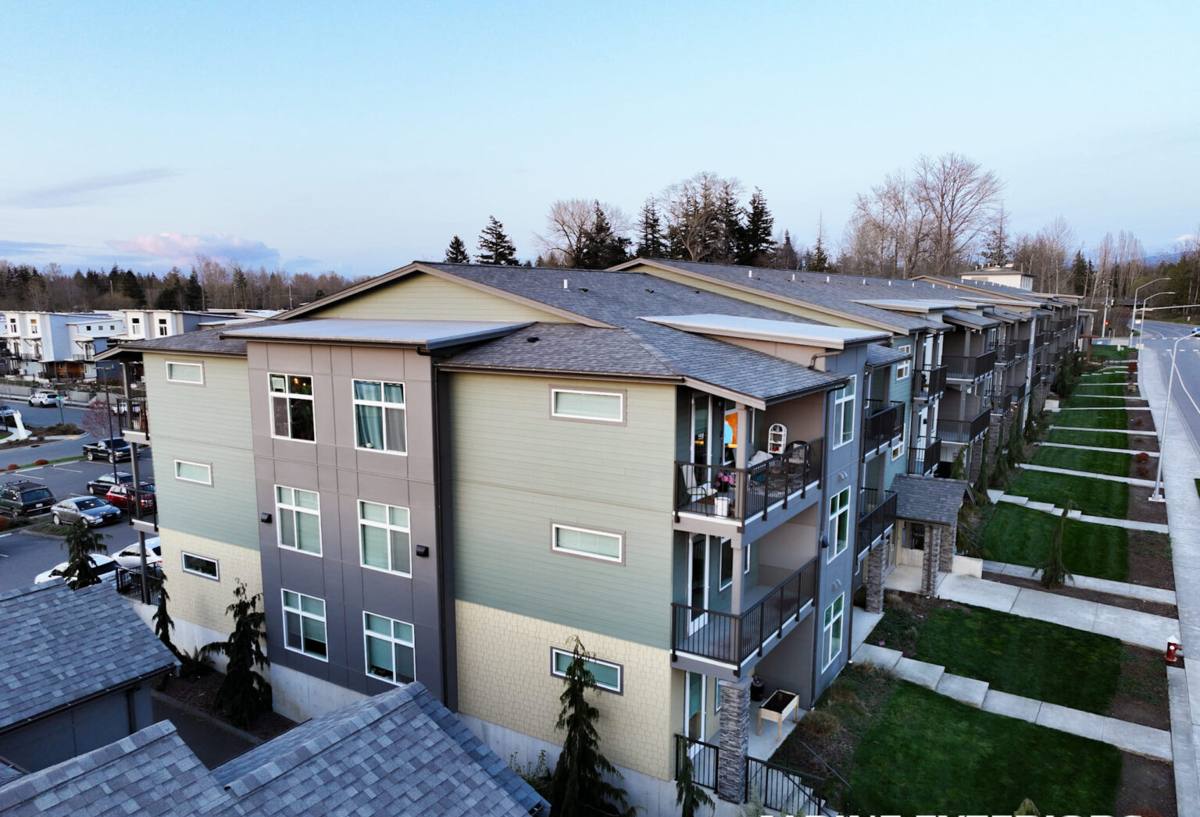
Board & batten reads as a Pacific Northwest coastal style — it shows up on cabins, farmhouses, and newer waterfront builds throughout Blaine and the surrounding harbor communities. The vertical lines and deep shadow lines give a home real texture, and the profile pairs well with the mix of traditional and modern homes you'll find near the water. Beyond the look, the vertical drainage path of a well-built board & batten wall can actually help shed the driving rain common here, provided the assembly behind it is built correctly — which is the part that gets skipped more often than it should be.
What a Correct Board & Batten Installation Involves
Board & batten is often treated as a simple pattern — wide boards, narrow battens over the seams — but the assembly behind the visible siding is what determines whether it lasts on a home exposed to salt air and wind-driven rain.
- A drainage plane (weather-resistive barrier) installed and lapped correctly, with all penetrations sealed
- A rainscreen gap — vertical furring strips behind the siding — so any water that gets past the battens can drain and the wall can dry instead of trapping moisture against the sheathing
- Flashing at every horizontal transition: window and door heads, water tables, roof-to-wall intersections, and the base of the wall
- Corrosion-resistant fasteners, sized and spaced to the manufacturer's specification — not general framing nails
- Battens fastened to align with the framing or furring beneath, not just decoratively face-nailed into the field board
- Factory-primed or factory-finished board edges, since a cut or field-primed edge is where fiber cement is most vulnerable to moisture uptake
Skip the rainscreen gap or get the flashing sequence wrong at a window head, and a board & batten wall in a place like Blaine Harbor will trap water instead of shedding it — regardless of what material the boards themselves are made from.
Why We Install James Hardie and Not the Alternatives
We get asked why we don't offer board & batten in cedar, primed spruce, vinyl, or engineered wood products like LP SmartSide. Each of those has real strengths, but none of them holds up to Blaine Harbor's combination of salt air, driving rain, and sustained moisture the way James Hardie fiber cement does.
| Material | Behavior in Salt Air & Sustained Moisture | Why It's Not What We Install |
|---|---|---|
| Cedar | Naturally rot-resistant when new, but absorbs moisture over repeated wet cycles | Needs ongoing refinishing and vigilant caulk maintenance to keep performing near the water |
| Primed spruce/wood composite | Vulnerable at cut edges and fastener holes once the factory primer is compromised | Moisture intrusion at seams is a known failure point in wet coastal climates |
| Vinyl board & batten | Doesn't absorb water, but expands/contracts with temperature swings and can distort | Thin material shows waviness under strong low-angle coastal light; limited long-term color stability |
| Engineered wood (LP SmartSide) | Treated to resist moisture, but the wood substrate remains sensitive to sustained wet exposure at cut edges and panel joints | We've standardized on a non-wood substrate for anything facing marine moisture year-round |
| James Hardie fiber cement | Non-combustible, dimensionally stable, engineered HZ product lines for this climate | What we install — see below |
James Hardie's fiber cement is cement, sand, and cellulose fiber — it doesn't rot, it doesn't feed moss the way porous wood surfaces can, and it holds its shape through the temperature and moisture swings that come with living on the water. The ColorPlus factory finish is baked on under controlled conditions, which matters directly for salt air: a factory finish resists fading and chalking better than a field-applied coat, and it comes backed by its own finish warranty separate from the product warranty. Hardie's HZ5 product line is engineered specifically for the kind of climate zone Blaine sits in — freeze-thaw cycling combined with high moisture exposure — which is a meaningful distinction from a general-purpose siding product.
Moss, Algae, and Long-Term Maintenance
No siding material is immune to moss and algae growth in a climate this wet — anything can host organic growth if it stays damp long enough. What differs is how the material responds to cleaning and how much the growth actually damages the substrate underneath. Fiber cement doesn't swell, soften, or rot from surface moss the way wood-based products can if growth is left too long. That means routine gentle washing keeps a Hardie board & batten wall looking right without the material itself degrading in the meantime — an important difference on a north-facing or shaded wall in Blaine Harbor, where moss pressure is higher than it is a few miles inland.
Our Process for Blaine Harbor Homes
We work board & batten jobs in Blaine and the surrounding Whatcom County waterfront regularly enough to know the details that matter here specifically:
- Site walk and wall assessment — checking existing sheathing condition, moisture history, and how exposed each elevation is to wind-driven rain off the water
- Drainage plane and rainscreen plan — laid out before a single board goes up, since retrofitting drainage after the fact isn't possible
- Flashing detail at every penetration — window heads, roof intersections, and the water table get the same attention whether they're visible from the street or not
- Board & batten installation to Hardie's fastening and spacing spec — including batten alignment over structural framing or furring, not just cosmetic placement
- Final inspection walk-through — reviewing seams, caulking, and trim details before we call the job done
What Board & Batten Costs and What Drives the Price
Board & batten typically runs somewhat higher than lap siding on the same wall because of the extra material (battens on top of the field boards) and the additional labor to align and fasten them correctly. Broad cost drivers on a Blaine Harbor job:
| Factor | Why It Affects Price |
|---|---|
| Existing wall condition | Rotted sheathing or water damage found during tear-off adds repair scope before new siding can go on |
| Wall complexity | Dormers, bump-outs, and multiple roof-to-wall intersections mean more flashing detail and more labor hours |
| Exposure | Elevations facing the water or prevailing wind may warrant extra attention to flashing and rainscreen detailing |
| Trim and reveal choices | Batten spacing, corner treatment, and trim profile all affect material takeoff |
| Color and finish | ColorPlus factory finishes vary by color; some premium colors carry a modest upcharge |
We give a firm, itemized quote after seeing the actual wall condition — not a rough number over the phone — because on a coastal property the difference between a straightforward re-side and one with hidden moisture damage can be significant.
A Checklist Before You Hire for Board & Batten Near the Water
- Ask specifically whether a rainscreen gap is included, not assumed
- Ask how flashing will be detailed at window heads and roof intersections
- Ask what fastener material will be used and whether it's rated for coastal/marine exposure
- Ask whether board edges and cuts will be factory-primed/sealed or field-treated
- Get the manufacturer's product and finish warranty terms in writing, not just a verbal summary
- Ask if the crew has worked other homes in Blaine or similar Whatcom County waterfront areas
If you're weighing board & batten for a home in Blaine Harbor, we're happy to walk the property, look at your specific exposure and wall condition, and put together a straightforward, no-pressure estimate — just fill out the form below to get started.