 Blaine
 Why Blaine Harbor Siding Wears Differently
Blaine Harbor sits right where the weather comes off the water. Homes here take a steady diet of salt-laden air, wind-driven rain that hits walls sideways instead of straight down, and a moss season that runs long even by Whatcom County standards. None of that is dramatic on any single day. It's the accumulation that causes problems — siding that would hold up fine forty miles inland starts showing stress at the harbor years earlier.
Salt air is corrosive to exposed fasteners and metal trim, and it accelerates the breakdown of caulk and sealants at joints and seams. Driving rain finds any gap in the water management system and pushes moisture where it doesn't belong, especially around window and door trim, corner boards, and butt joints between siding courses. And moss — which thrives in the shaded, damp, north-facing walls common in this area — holds moisture against the siding surface far longer than open, sun-exposed walls ever see.
When we get called out to Blaine Harbor for a repair, it's rarely one big failure. It's usually a handful of small, related issues that started at a seam or a fastener and spread from there.
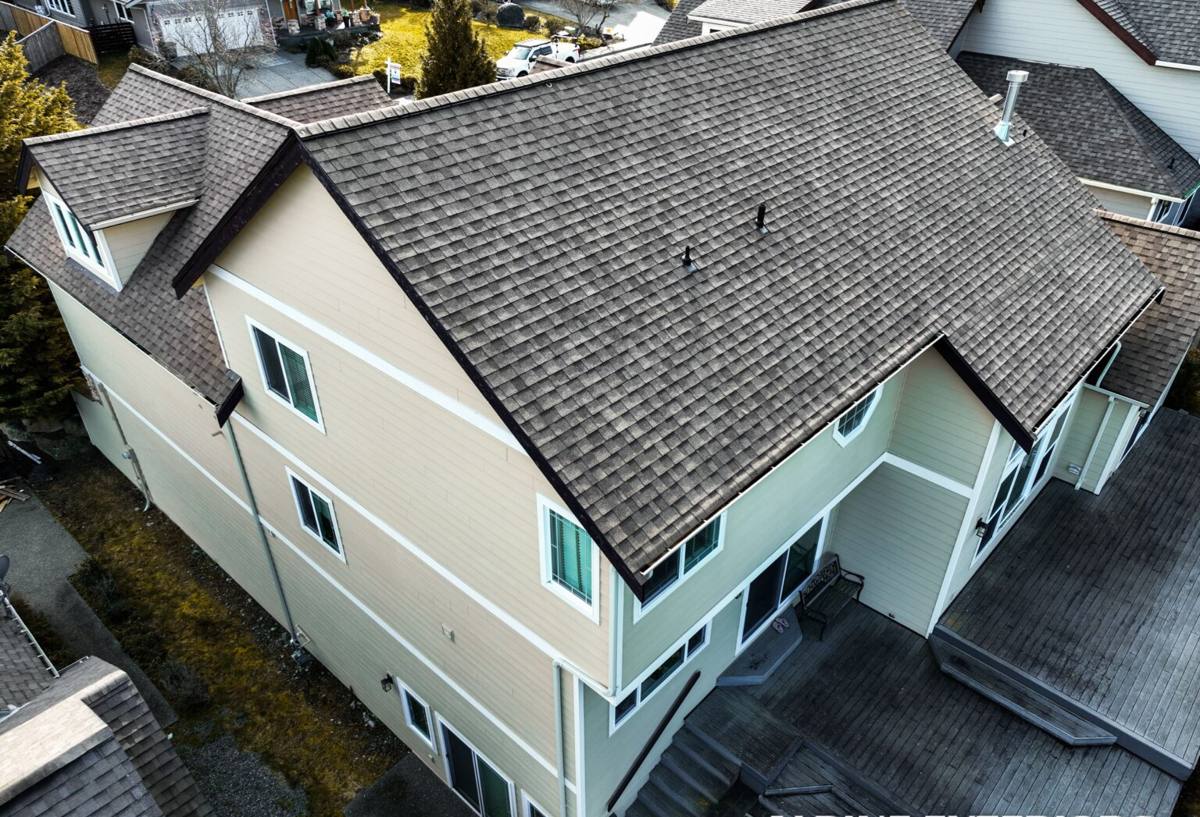
Signs Your Siding Actually Needs Repair
Not every mark on your siding means a repair job. Some things are cosmetic. Others are early warnings you don't want to ignore for another wet season. Here's how we sort the two.
Worth a closer look
- Soft or spongy spots when you press on the siding, especially near the bottom courses or under windows
- Visible gaps opening up at butt joints, corner boards, or where siding meets trim
- Paint that's bubbling, peeling, or failing in a localized area rather than uniformly across the wall
- Streaking or dark staining that keeps coming back after cleaning, particularly on shaded or north-facing walls
- Cracked or missing caulk at penetrations — hose bibs, light fixtures, vents, dryer exhausts
- Rust bleeding from fastener heads or trim, common near the water
- Moss or algae growth that's thick enough to hold visible moisture against the wall
Usually cosmetic, not urgent
Surface fading, light green film that wipes off easily, and minor color mismatch from sun exposure on one elevation are all normal aging. They're worth monitoring, not worth tearing into the wall for.
What a Correct Repair Actually Involves
A siding repair that's done right isn't just "replace the bad board and caulk the edges." That approach patches the symptom and leaves the cause in place — which, in a location like Blaine Harbor, means you'll be back out here again in a season or two. A correct repair addresses three layers.
1. Find the actual water path
Damaged siding is usually a downstream symptom. Before we replace anything, we trace where water is actually getting behind the cladding — a failed kickout flashing, a gap in the house wrap, caulk that's pulled away at a window head, or a butt joint that was never properly lapped or sealed to begin with. Replacing the visible damage without fixing the entry point means the same failure comes back.
2. Check what's underneath
Once siding is pulled, we look at the water-resistive barrier (house wrap or building paper), the sheathing, and any framing that's been exposed to moisture. If there's soft or rotted sheathing, that gets addressed before anything new goes back on — no amount of new siding fixes a wet wall behind it.
3. Rebuild the water management, not just the surface
Flashing gets corrected or added where it was missing. House wrap gets repaired and properly lapped. Then the siding goes back with the right fastener pattern, correct clearances, and sealant only where sealant belongs — not as a substitute for flashing, which is a common shortcut that fails within a few years near the water.
Common Failure Points We See in This Area
| Location | What typically goes wrong | Why it's worse near the harbor |
|---|---|---|
| Butt joints between siding courses | Caulk fails, gap opens, water tracks behind | Salt air degrades sealant faster; driving rain pushes water sideways into any gap |
| Window and door trim | Caulk pulls away at corners and heads | Wind-driven rain concentrates at openings; UV and salt both accelerate sealant breakdown |
| North-facing and shaded walls | Moss and algae buildup holds moisture on the surface | Longer damp season, less sun exposure to dry the wall between rains |
| Bottom courses near grade | Splash-back and standing moisture cause rot | Combined with salt exposure, metal fasteners and trim corrode faster here too |
| Corner boards | Miters open up, exposing end grain or cut edges | End grain and unsealed cuts absorb moisture fastest — a known weak point on any material |
Repair or Replace: How to Decide
This is the honest conversation every homeowner deserves before money changes hands. We don't push replacement when a repair will hold, and we don't recommend patching a wall that's failing systemically.
| Factor | Repair usually makes sense | Replacement usually makes sense |
|---|---|---|
| Extent of damage | Isolated to one or two areas | Showing up in multiple locations across the house |
| Siding material | Original material is sound and still available/matchable | Material is discontinued, degraded, or was a lower-grade product to start with |
| Sheathing condition | Dry, structurally sound where exposed | Soft, rotted, or water-stained over a wide area |
| Age of siding | Well within expected service life | Near or past the end of its realistic lifespan |
| Underlying cause | A single, identifiable, fixable defect | A systemic issue — bad original installation, wrong material for this exposure |
If your home is currently sided in something other than fiber cement — vinyl, older LP SmartSide, primed spruce, or cedar — and you're facing repeated repairs in the same spots, that's usually a sign the material itself is struggling with this exposure, not that the repairs were done poorly. That's a conversation worth having honestly rather than just patching again.
Where James Hardie Fits Into a Repair
We install James Hardie fiber cement exclusively — we don't carry vinyl, LP SmartSide, Cemplank, Allura, primed spruce, or cedar as options. That matters for repair work in two ways.
Repairing existing Hardie siding
If your home already has James Hardie siding, damaged sections can typically be cut out and replaced with matching product, then finished to match the existing ColorPlus factory finish or field-painted to blend, depending on the age of the installation and how well a color match can be achieved. Fiber cement doesn't rot, and it isn't a food source for moss the way wood-based products are, so a correct repair on Hardie siding tends to actually stay fixed.
When repair reveals a bigger material problem
Sometimes what looks like a simple repair on non-Hardie siding turns into a conversation about the material itself. If we open up a wall and find that the original product — engineered wood, primed spruce, older vinyl — has systemic moisture issues from years of harbor exposure, we'll tell you that plainly rather than keep re-patching. In those cases, a full or partial re-side in James Hardie is often the more honest long-term answer: it's non-combustible, engineered for wet climates in its HZ product lines, and backed by a strong transferable warranty. We'll never talk you into replacement you don't need, but we also won't pretend a failing material is going to hold if the underlying issue is the product, not the workmanship.
Our Repair Process
- On-site inspection of the damaged area and a check of the surrounding wall for related issues
- Assessment of what's behind the siding once access is possible — sheathing, house wrap, flashing
- Honest recommendation: targeted repair, larger section replacement, or full re-side, with the reasoning explained
- Correction of the underlying water management issue, not just replacement of the visible damage
- Matching material and finish as closely as the original allows
- Final check of caulking, flashing, and clearances before we call the job done
Why Hiring Locally Matters for Blaine Harbor
Siding repair in a coastal, moss-prone microclimate isn't the same job as siding repair twenty miles inland. A crew that already works Blaine Harbor and the surrounding Whatcom County waterfront knows which elevations take the worst of the driving rain, where moss builds up fastest, and which older installation habits tend to fail first in this exposure. That's not something you learn from a manual — it's something you learn from being out on these specific walls, in this specific weather, repeatedly. It shows up in where we look first, what we flag as a bigger issue versus a quick fix, and how we detail the repair so it actually holds through the next wet season instead of just looking fixed.
Get an Honest Look at Your Siding
If your Blaine Harbor home has siding damage — whether it's an obvious soft spot, a recurring stain, or just siding that's due for an honest once-over after a few wet seasons — we'll come take a look, tell you what we actually find, and give you a straightforward recommendation. No pressure, no upsell. Reach out for a free estimate and we'll get you a clear answer on what your siding needs.