 Blaine
 Why Everson Homes Need Siding Built for This Climate
Everson sits inland from Blaine along the Nooksack River, but it still lives inside the same weather system that soaks all of Whatcom County: long wet winters, a marine air layer that carries salt and moisture well past the immediate coastline, and a moss season that can run eight months or more on north-facing walls and anything shaded by trees. Homes here don't fail because of one big storm. They fail slowly, from siding that absorbs water it was never designed to shed, holds moisture against the sheathing, and gives moss and mildew a foothold that spreads year after year.
Fiber cement siding was engineered for exactly this kind of exposure. It's not a cosmetic upgrade — it's a material change. Where wood-based and composite sidings can swell, delaminate, or feed fungal growth when they stay damp, cement-based siding is dimensionally stable and doesn't rot. That matters more in Everson than it does in a drier climate, because the drying window between rain events here is short, especially from November through April.
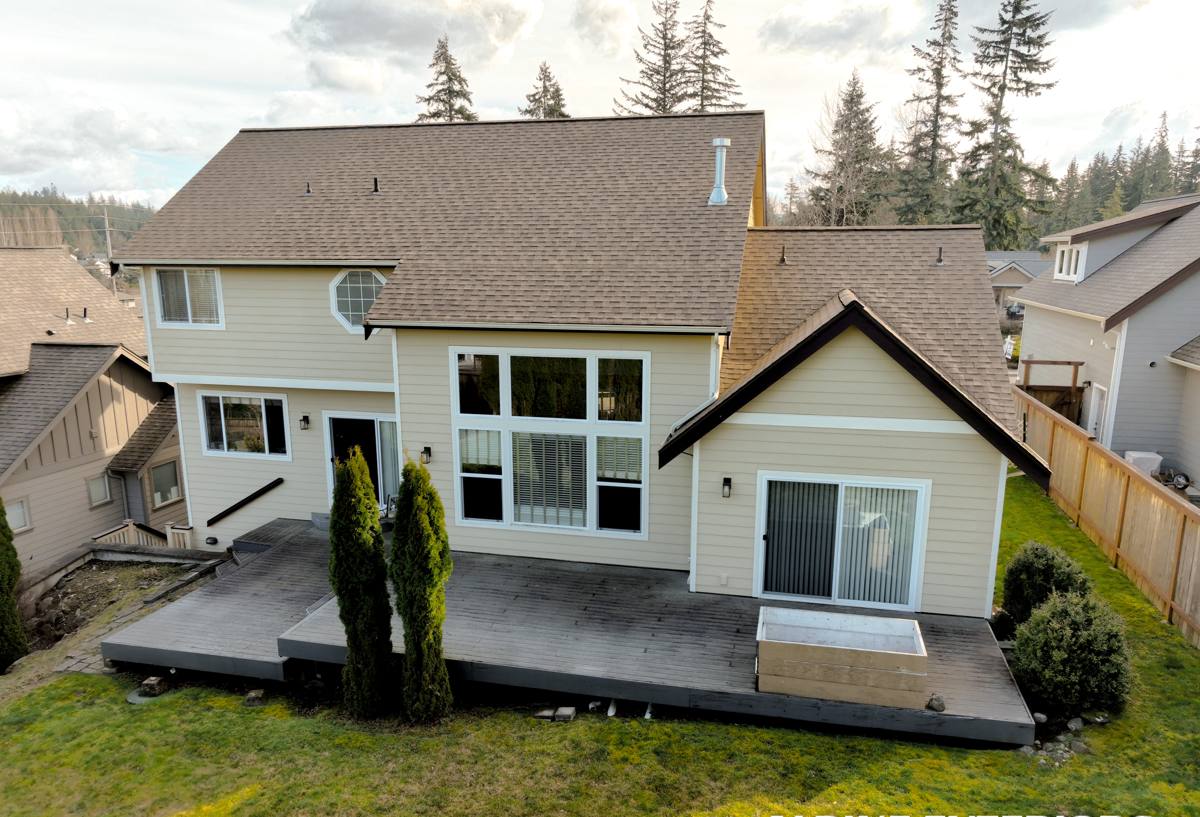
What "Correct" Fiber Cement Installation Actually Involves
Fiber cement siding is only as good as its installation. A huge share of the siding problems we get called out to inspect in Whatcom County aren't material failures — they're installation shortcuts that let water get behind a product that was otherwise doing its job. Getting it right on an Everson home means:
- Correct water-resistive barrier and flashing — a weather-resistant barrier behind the siding, properly lapped, with flashing at every window, door, and horizontal trim transition so water sheds outward instead of tracking behind the panel.
- Rainscreen or proper furring where called for — a small air gap behind the siding lets any moisture that does get past the cladding dry out instead of sitting against the wall, which matters on shaded elevations that stay damp longest.
- Manufacturer-spec fastening — correct nail type, spacing, and penetration depth. Over-driven or under-driven fasteners are one of the most common defects we find on redone jobs, and they void warranty coverage.
- Proper clearance at grade and roofline — siding held up off decks, patios, and soil, and gapped correctly at roof-to-wall intersections, so it isn't sitting in standing water or catching runoff.
- Factory-finished panels installed without exposed cut edges — cut ends sealed per spec, since an unsealed cut edge is where moisture intrusion typically starts.
None of this is exotic. It's discipline — following the manufacturer's installation manual instead of treating siding like a generic wrap-and-nail job.
Why This Matters More in Everson Than in a Dry Climate
A poorly flashed window on a home in a low-humidity region might go a decade before anyone notices a problem. In Everson's climate, the same mistake can show water staining or soft sheathing in a fraction of that time, because the wall assembly rarely gets a long enough dry stretch to recover between rain events. Correct installation isn't a nice-to-have here — it's the difference between siding that lasts its full rated life and siding that creates a hidden moisture problem behind a good-looking exterior.
Moss, Mildew, and Salt Air: The Three Local Stresses
| Stress | What It Does to Siding | How Fiber Cement Handles It |
|---|---|---|
| Moss season (fall–spring) | Holds moisture against the surface, can work into seams and behind trim on porous materials | Non-porous cement composition doesn't feed moss the way wood fiber does; factory finish sheds spores more easily |
| Driving rain | Pushes water sideways under laps and around penetrations if flashing is weak | Rigid, stable panel holds its lap geometry over time — doesn't cup, bow, or open gaps the way some composites can |
| Salt-influenced marine air | Accelerates corrosion of fasteners and coating breakdown on lower-grade paints | Factory-baked finish resists UV and moisture-driven fading; paired with corrosion-resistant fastening per spec |
Why We Only Install James Hardie Fiber Cement
We don't install every siding product on the market, and that's a deliberate call, not a limitation of what we're capable of doing. We install James Hardie exclusively because it's the fiber cement system we trust to perform consistently over the long haul — engineered climate-specific HZ formulations, a factory-applied ColorPlus finish that's cured under controlled conditions rather than field-painted, and a warranty structure that's transferable and backed by a manufacturer with decades of track record in wet climates like ours.
We get asked sometimes why we won't install LP SmartSide, vinyl, or lower-cost cement-based alternatives. The honest answer is trade-offs: engineered wood products still have wood fiber at their core and depend heavily on perfect installation and maintenance to keep moisture out over decades. Vinyl can look fine for years but doesn't offer the same rigidity, fire performance, or long-term color stability, and it tends to show its age faster in a climate that alternates between hard rain and UV exposure. Other fiber cement brands may be reasonable products, but we've standardized on one system so we can install it the same correct way every time, stand behind the workmanship with confidence, and give homeowners a single, well-documented warranty path instead of piecing together coverage across different manufacturers.
Our Process for an Everson Fiber Cement Project
- On-site assessment — we look at the existing siding and sheathing condition, note any moisture damage, check flashing at windows and rooflines, and assess sun/shade exposure per elevation since that drives moss risk.
- Scope and product selection — plank width, texture (smooth or cedar-shake style), and color are chosen based on the home's style and the elevation-specific exposure we found during assessment.
- Tear-off and sheathing check — old siding comes off, and we inspect sheathing underneath for rot or soft spots before anything new goes up. This is often where hidden problems from a prior installation surface.
- Weather barrier and rainscreen installation — done to spec before a single piece of siding is hung.
- Fiber cement installation — installed per James Hardie's fastening and clearance requirements, with flashing detailed at every penetration.
- Final walkthrough — we go over caulking, trim, and touch-up paint at cut edges with the homeowner before calling the job done.
What Local Experience Actually Changes
A crew that regularly works Whatcom County jobs isn't guessing at rainscreen details or flashing sequencing — they've seen what happens when those steps get skipped on homes in this exact climate. That shows up in small decisions: which elevations get extra attention because they stay shaded and damp longest, how tight the trim details need to be around window heads to shed driving rain, and where moss is most likely to establish if the finish and installation aren't handled right. It also means faster, more accurate estimates, because the climate variables aren't a hypothetical — they're the same conditions on every job in the area.
Signs Your Current Siding Is Losing the Fight
- Persistent moss or dark streaking that comes back within a season of cleaning
- Soft or spongy spots when you press on the siding, especially near the bottom courses or under windows
- Visible cupping, bowing, or gaps opening up at the laps
- Paint that's peeling or bubbling rather than just fading evenly
- Interior signs — musty smell, staining, or soft drywall near exterior walls — that suggest moisture has already gotten behind the cladding
Any one of these is worth a look before it becomes a sheathing repair instead of a siding replacement.
Cost Factors for Everson Fiber Cement Projects
| Factor | Why It Affects Price |
|---|---|
| Existing wall condition | Rot or soft sheathing found during tear-off adds repair scope before new siding can go on |
| Home size and elevation complexity | More corners, gables, and trim details mean more cutting, flashing, and labor time |
| Plank style and texture | Smooth, shake-style, and board-and-batten profiles vary in material and install time |
| Access and site conditions | Steep grades, tight lot lines, or landscaping can affect staging and labor |
| Trim and accessory scope | Fascia, soffit, and trim replacement alongside siding changes total project cost |
We give homeowners a written, itemized estimate after the on-site assessment rather than a ballpark over the phone — the wall condition underneath the old siding is too big a variable to price accurately without seeing it.
Get a Straight Answer for Your Home
If you're weighing a siding replacement in Everson or elsewhere near Blaine, we're happy to come take a look, tell you honestly what condition your current siding and sheathing are in, and walk you through what a correct James Hardie installation would involve for your specific home. There's no cost and no pressure to move forward — use the form below to request a free estimate.