 Blaine
 Why Nooksack Homes Need Siding Built for This Specific Climate
Nooksack sits close enough to the water and the Nooksack River corridor that homes here deal with a combination most siding products were never designed for: salt-laden air moving off the Strait, long stretches of driving rain through fall and winter, and a growing season for moss and algae that can run eight or nine months out of the year. None of these things alone is unusual for Western Washington. Together, on the same wall, year after year, they wear out the wrong siding fast.
Salt air is corrosive to exposed metal fasteners and trim, and it accelerates the breakdown of coatings that aren't formulated to resist it. Driving rain — rain that comes in sideways during a Whatcom County windstorm rather than falling straight down — finds every gap, seam, and under-caulked joint on a wall. And moss doesn't just sit on a roof; it colonizes anything organic or porous enough to hold moisture, which includes wood siding, primed wood trim, and even some fiber cement installations if the water-management details were skipped.
Whatcom County's marine climate means walls rarely get a long dry stretch to fully shed moisture the way siding in a drier region does. That's the real design problem: it's not one bad storm, it's siding that's damp more often than it's dry, for months at a time.
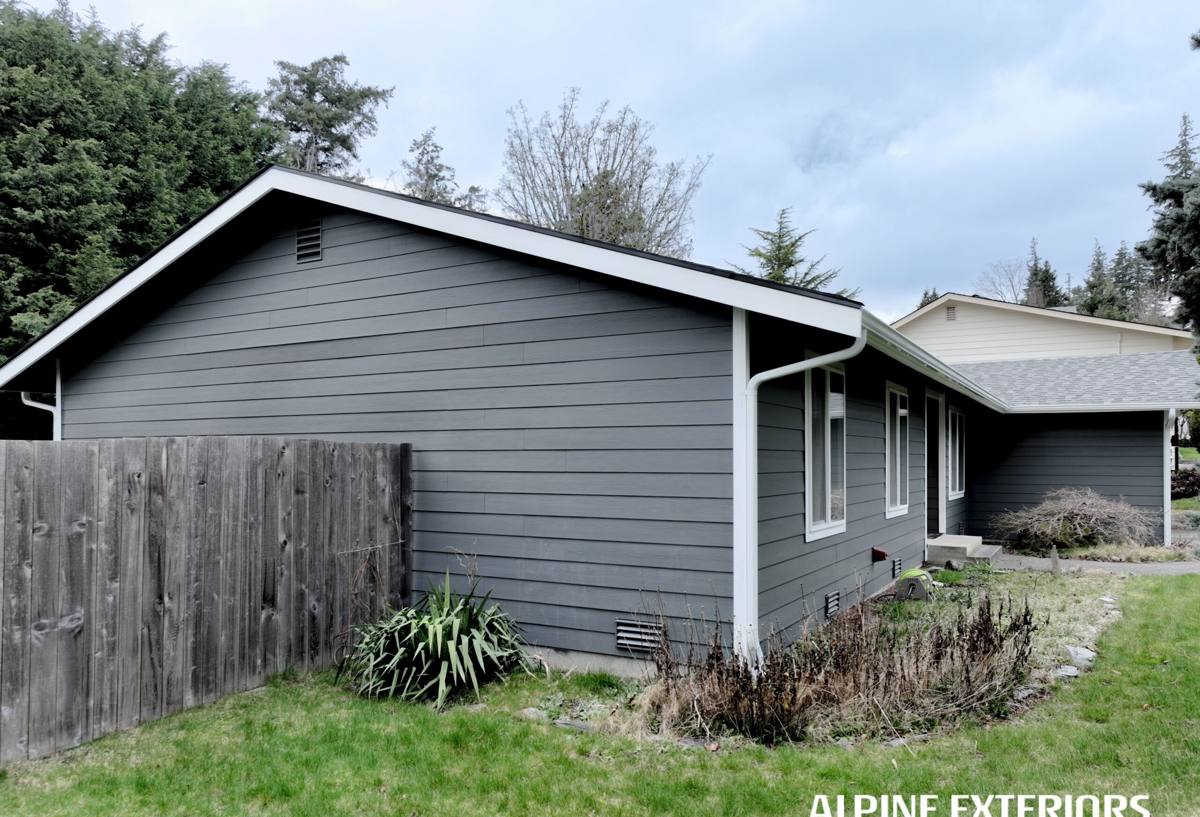
What "Correct" Fiber Cement Siding Actually Means Here
Fiber cement itself doesn't rot, doesn't feed moss the way wood does, and doesn't corrode. But the material only performs as well as the installation behind it. In a climate like this, a handful of details separate siding that lasts decades from siding that causes problems in five or six years:
Clearances and Drainage
Siding needs a gap above roof lines, decks, and grade — manufacturer minimums exist for a reason, and in a wet climate we don't treat them as suggestions. Where siding meets a roof, deck, or patio without a proper gap, water and debris collect against the bottom edge and it stays wet long after the rain stops.
Fastening
Corrosion-resistant fasteners, driven correctly — not overdriven, not underdriven — matter more here than in a dry inland climate. Overdriven fasteners crack the board's outer shell and create an entry point for water; underdriven fasteners leave the board loose and prone to movement that eventually telegraphs through the joints.
Joints, Caulking, and Flashing
Butt joints, window and door penetrations, and any place two materials meet are where driving rain gets tested the hardest. Correct flashing, properly lapped house wrap, and the right sealant at the right joints keep water out of the wall assembly instead of just off the surface.
Factory-Applied Finish
ColorPlus factory finish is baked on and backed by its own finish warranty, which matters in salt air and high-moss environments specifically because it holds up to repeated wet-dry cycling and UV exposure better than field-applied paint, and it doesn't need repainting on the same schedule wood trim does.
Why We Only Install James Hardie
We standardized on James Hardie fiber cement because it's engineered in climate-specific HZ (HardieZone) formulations, and the Pacific Northwest falls under the wetter HZ5 profile the product line is built to handle. That's not marketing — it means the board itself is formulated for a climate where moisture exposure is the norm, not the exception, which is exactly the situation in Nooksack.
Hardie fiber cement is non-combustible, holds paint and factory finish well over time, and comes with a transferable limited warranty that matters to homeowners who may sell in the next decade. We don't install LP SmartSide, vinyl, Cemplank, Allura, primed spruce, or cedar — not because those products have no merit anywhere, but because in a coastal Whatcom County climate we don't want to put our name behind a material or finish system that asks for more maintenance, tolerates moisture less predictably, or comes with a thinner warranty than what Hardie offers.
Our Process for a Nooksack Fiber Cement Job
- Walk and assess: we look at the existing siding, moisture staining, moss growth patterns, trim condition, and any problem areas — deck ledgers, roof-to-wall intersections, window returns — before we quote anything.
- Tear-off and sheathing check: once old siding is off, we inspect the sheathing underneath. Hidden rot or soft spots get addressed before anything new goes up; covering a wet wall with new siding just hides the problem.
- House wrap and flashing: a properly lapped weather-resistive barrier and correct flashing at every penetration, done before the first board goes on.
- Installation to spec: Hardie boards fastened and gapped per manufacturer specification, with attention to the clearances that matter most in a wet climate.
- Trim, caulking, and final detailing: joints sealed correctly, not just caulked over gaps that shouldn't be there in the first place.
- Walkthrough and cleanup: we go over the finished job with the homeowner and clear the site.
Cost Factors for a Fiber Cement Siding Job
| Factor | Why It Moves the Price |
|---|---|
| Tear-off complexity | Multiple layers of old siding or extensive rot repair adds labor before install even starts |
| Home size and wall complexity | More corners, gables, and trim details mean more cuts and labor hours |
| Siding profile | Lap siding, shingle-style panels, and board-and-batten each have different material and labor costs |
| Trim scope | Full trim replacement versus reusing sound existing trim changes both material and time |
| Access and site conditions | Steep grades, tight setbacks, or limited equipment access common on some Nooksack lots can add time |
Every quote we give is based on an actual walkthrough of the home, not a square-footage guess over the phone. We'll give you a straight number with the reasoning behind it.
Why a Crew That Already Works Nooksack Matters
A siding job done right in a dry climate can still fail in a coastal one if the crew doesn't build in the extra margin this environment demands. A crew that regularly works Blaine and the surrounding Whatcom County coastline already knows which details can't be shortcut here — the clearance at grade, the flashing at deck ledgers, the joint sealing that has to hold up to sideways rain instead of just vertical rain. That's not something you pick up from a manual; it's something you learn from seeing what fails in this specific climate and building the fix into every job from the start.
It also means faster response if something needs a look after the job is done — a local crew isn't driving in from two counties away for a warranty check or a question about how the siding is holding up after its first full wet season.
Maintenance That Actually Matters in a Moss-Prone, Salt-Air Environment
Fiber cement is low-maintenance compared to wood, but "low-maintenance" isn't "no-maintenance" in this climate. A short list of things worth doing:
- Rinse siding once or twice a year, especially north- and shade-facing walls where moss and algae take hold first
- Keep gutters clear so overflow doesn't run down the wall face and stay wet longer than it should
- Trim back vegetation and tree cover that keeps a wall section shaded and damp
- Check caulking at joints and trim every couple of years and re-seal anything that's cracked or pulled away
- Watch for any staining or soft spots near grade, decks, or roof intersections and have them looked at early
None of this is heavy work, but skipping it in a climate this wet is how small issues turn into bigger ones.
Signs Your Current Siding Isn't Keeping Up
If you're not sure whether your home's siding is due for replacement, a few things worth watching for: moss or algae that comes back within weeks of cleaning, visible warping or soft boards, paint that's peeling or bubbling rather than just fading, staining that tracks down from a specific joint or corner, or trim that's gone soft to the touch. Any one of these in a Nooksack home usually traces back to water getting past the siding rather than the siding itself simply aging out.
Get a Straight Answer on Your Home
If you're dealing with moss that won't stay off your siding, trim that's starting to go soft, or you're just planning ahead for a home in a demanding coastal climate, we're happy to take a look. We'll walk the exterior, tell you honestly what we see, and put together a free, no-pressure estimate — no scare tactics, no upsell on products we don't believe in for this climate.