 Blaine
 Metal Roofing Built for Nooksack's Climate, Not Just Installed in It
Nooksack sits close enough to the Strait of Georgia and the Salish Sea that salt-laden air is a real factor in how a roof ages here, even a few miles inland. Add Whatcom County's long, wet winters, driving rain off the water, and a moss season that can stretch from October through May, and you have a climate that is genuinely hard on roofing materials. A metal roof that's specified and installed correctly can handle all of that for decades. One that's installed generically, using details that work fine in a drier climate, will show problems within a few years — usually starting at the fasteners, the flashing, or the areas where moss and organic debris collect.
We install and repair metal roofing for homes in and around Nooksack specifically because it's one of the better long-term answers to this weather. But "metal roof" isn't a single product, and not every installation crew details it the same way. This page covers what actually matters for a metal roof on a Nooksack home: the panel and fastener choices that hold up to salt air, the underlayment and flashing details that keep driving rain out, how moss season affects maintenance, and what our process looks like from estimate to finished roof.
What Salt Air and Driving Rain Actually Do to a Roof
Salt air doesn't need to come from oceanfront property to matter. Airborne salt travels with prevailing winds and settles on exposed metal, where it accelerates corrosion at any point the protective coating is thin, scratched, or absent — cut edges, exposed fastener heads, and factory finish that's been compromised during shipping or installation. On a standard asphalt shingle roof, salt exposure shows up as faster granule loss and shorter service life. On a metal roof, it shows up as rust bleed at fastener heads and panel edges if the wrong hardware or coating was used.
Driving rain is a separate problem. Storms coming off the water in this part of Whatcom County often push rain sideways rather than straight down, which means water gets tested at every seam, lap, and penetration on the roof — not just the open field of the panels. A roof that would shed water fine in a calm, vertical rain can leak under wind-driven conditions if the laps, flashing, and underlayment weren't detailed for it. This is one of the main reasons generic installations fail here: the panels themselves are rated for the weather, but the details around them weren't built for wind-driven moisture.
Where This Shows Up First
- Fastener heads and cut panel edges — the most common starting point for corrosion in salt-exposed areas
- Valleys and roof-to-wall transitions — where wind-driven rain concentrates and standard laps can be overwhelmed
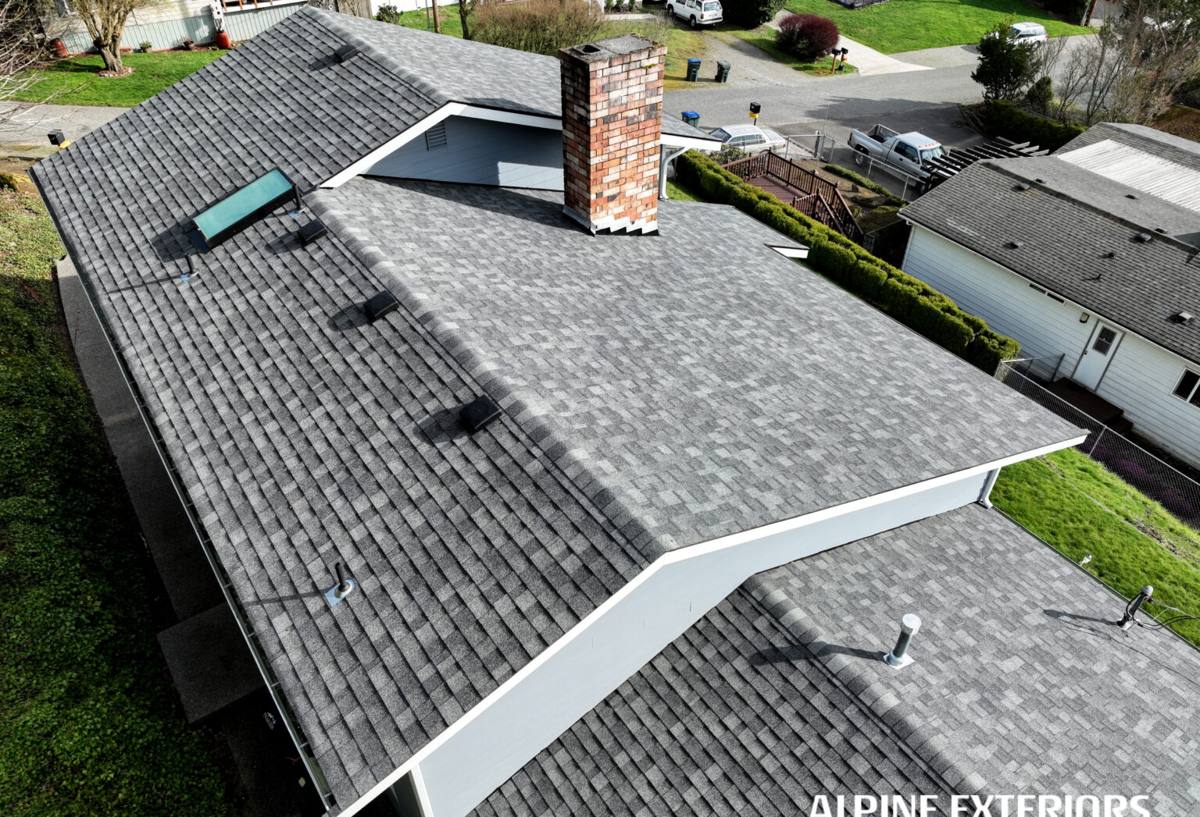
- Around chimneys, vents, and skylights — any penetration is a potential entry point if flashed incorrectly
- North-facing and shaded slopes — where moss and moisture sit longest between dry spells
Panel Materials and Fastening: What Holds Up Near the Water
Not all metal roofing is equally suited to a salt-air environment. The coating system and fastener hardware matter as much as the base metal. We choose materials and detailing based on how exposed a given home is, not a one-size-fits-all spec.
| Option | How It Performs Locally | Where It Makes Sense |
|---|---|---|
| Standing seam (concealed fastener) | No exposed fastener heads on the field of the roof, which removes the most common corrosion starting point; strong performance against wind-driven rain | Homes with higher salt exposure or steady wind off the water |
| Exposed-fastener panel | Lower upfront cost, but relies on gasketed fasteners that need to be correctly torqued and, eventually, checked for wear | More sheltered lots, secondary structures, budget-driven projects |
| Stainless or coated fasteners | Resists corrosion far longer than standard galvanized hardware in salt air | Any metal roof within a few miles of open water or exposed to prevailing coastal wind |
| Standard galvanized fasteners | Cost less but are the first thing to show rust staining in this environment | Not something we recommend for this area regardless of panel type |
We don't push one panel system on every home. A well-sheltered lot a few miles from Nooksack's more exposed areas doesn't need the same spec as a home catching wind straight off the water. What we won't do is use hardware or coatings that are a poor match for local salt exposure just to save a few dollars up front — that trade-off shows up as visible rust streaking and premature fastener failure well before the panels themselves are due for replacement.
Underlayment and Flashing: The Part You Don't See
Most metal roof failures aren't failures of the metal — they're failures of what's underneath and around it. A correct installation includes a high-temperature synthetic or self-adhered underlayment rated for the panel type, ice-and-water protection at eaves, valleys, and other vulnerable areas, and flashing details sized for wind-driven rain rather than a bare-minimum lap.
Details We Treat as Non-Negotiable
- Ice-and-water shield at eaves, valleys, and around all penetrations, not just where code requires it
- Closure strips and proper end-lap sealant at panel seams, sized for the panel profile in use
- Step and counter-flashing at walls and chimneys — never caulk used as a substitute for proper metal flashing
- Continuous or properly balanced intake and exhaust ventilation, so moisture doesn't get trapped under the deck
- Fastener patterns and torque set to manufacturer spec — over-driven or under-driven screws are a leading cause of early leaks
These details cost more in labor than a bare-minimum install, and they're also invisible once the roof is finished — which is exactly why some installers skip them. It's the reason we walk homeowners through what's happening at each stage rather than just showing up with panels and a crew.
Moss Season and What It Means for a Metal Roof
Whatcom County's moss season is long, and Nooksack's tree cover and moisture levels make it a real factor for most roofs in the area. Metal roofing handles moss far better than shingles — there's no granule surface for spores to root into, and a smooth, properly pitched metal roof sheds debris more readily. But metal isn't immune. Moss and organic debris can still build up in valleys, at panel laps, behind chimneys, and anywhere water sits or airflow is blocked, and trapped moisture against any roofing material eventually causes problems.
The maintenance difference is significant, though. A metal roof generally needs periodic debris clearing rather than the moss treatments and granule-loss monitoring a shingle roof demands. We factor moss and debris behavior into panel profile and slope recommendations, and we're upfront that even a metal roof in this area benefits from an occasional check, especially on shaded, tree-covered lots.
Our Installation Process
We walk every project through the same sequence, adjusted for the home's exposure and existing roof condition:
- On-site assessment — we look at slope, exposure to wind and salt air, existing decking condition, ventilation, and any problem areas from the current roof
- Panel and hardware selection — matched to the home's actual exposure, not a default spec
- Tear-off and deck inspection — any soft or water-damaged decking gets replaced before anything goes back on, since metal panels won't hide a bad deck the way shingles sometimes can
- Underlayment and flashing installation — ice-and-water shield, synthetic underlayment, and all flashing details completed before panels go on
- Panel installation — set to manufacturer fastening spec, with attention to laps, closures, and penetration flashing as we go
- Final walkthrough — we review the finished roof with the homeowner, including what routine maintenance looks like going forward
Repair, Recoat, or Replace: How We Make the Call
Not every metal roof issue means starting over. We look at whether the problem is isolated (a failed fastener, a flashing detail that was never done correctly, a single damaged panel) or systemic (widespread coating failure, corrosion at multiple points, or a roof that was installed with the wrong hardware for this environment from the start).
| Situation | Typical Approach |
|---|---|
| Isolated fastener corrosion or a leak at one flashing detail | Targeted repair — replace hardware, correct the flashing detail |
| Coating wear or chalking on an otherwise sound roof | Evaluate for a rated recoat system rather than full replacement |
| Widespread rust at fasteners and panel edges, or a roof installed with mismatched hardware | Full replacement usually makes more sense than chasing repeated repairs |
| Roof nearing the end of its coating warranty with new leak activity | Case-by-case — depends on deck condition and how the original installation was detailed |
We'll always tell a homeowner honestly when a repair is the right call instead of pushing a full replacement. Metal roofing is a real investment, and our standard is to recommend what the roof actually needs, not the largest project available.
Why Local Experience with This Specific Area Matters
A crew that regularly works in and around Nooksack knows which slopes tend to catch wind-driven rain, which lots hold moss longest, and how salt exposure varies even within a few miles. That knowledge shapes real decisions — panel profile, fastener spec, flashing detail, ventilation design — rather than applying a generic installation and hoping the climate cooperates. It also means we're not guessing at how a roof will perform here; we've seen how this specific combination of salt air, rain, and moss treats roofs that were built for it correctly and ones that weren't.
Questions Worth Asking Any Metal Roofing Contractor Here
- What fastener and hardware type are you using, and is it rated for salt-air exposure?
- What underlayment and ice-and-water protection is included, and where specifically will it go?
- How are valleys, walls, and penetrations flashed — metal detailing or caulk-dependent shortcuts?
- What ventilation is included, and has it been balanced for intake and exhaust?
- What warranty covers the coating versus the installation labor, and who do you call if something goes wrong in year six?
Get an Honest Look at Your Roof
If you're weighing a new metal roof, a replacement of an aging one, or you've got a specific leak or corrosion issue on a home in the Nooksack area, we're happy to take a look and give you a straight answer about what it needs. Use the form below to request a free, no-pressure estimate.