 Blaine
 Siding Installation Built for a Spit Property
Semiahmoo occupies a narrow spit between Semiahmoo Bay and Drayton Harbor at the edge of Blaine, and a siding installation out here has to answer for conditions most Whatcom County homes never face at the same intensity: salt air moving in from more than one direction, driving rain with almost nothing to block it, and a moss season that barely takes a break. This page is specifically about installing siding on a Semiahmoo property — not roofing, not windows, not decks — because the install itself is where most long-term siding problems either get built in or avoided. A siding job that looks fine on the day it's finished can still fail early if the details underneath weren't handled with this specific site in mind.
We install James Hardie fiber cement exclusively, and everything below reflects how we approach the installation process on a property like this — what the substrate needs, how fastening and flashing get handled, and what correct sequencing looks like when the house sits this exposed to open water.
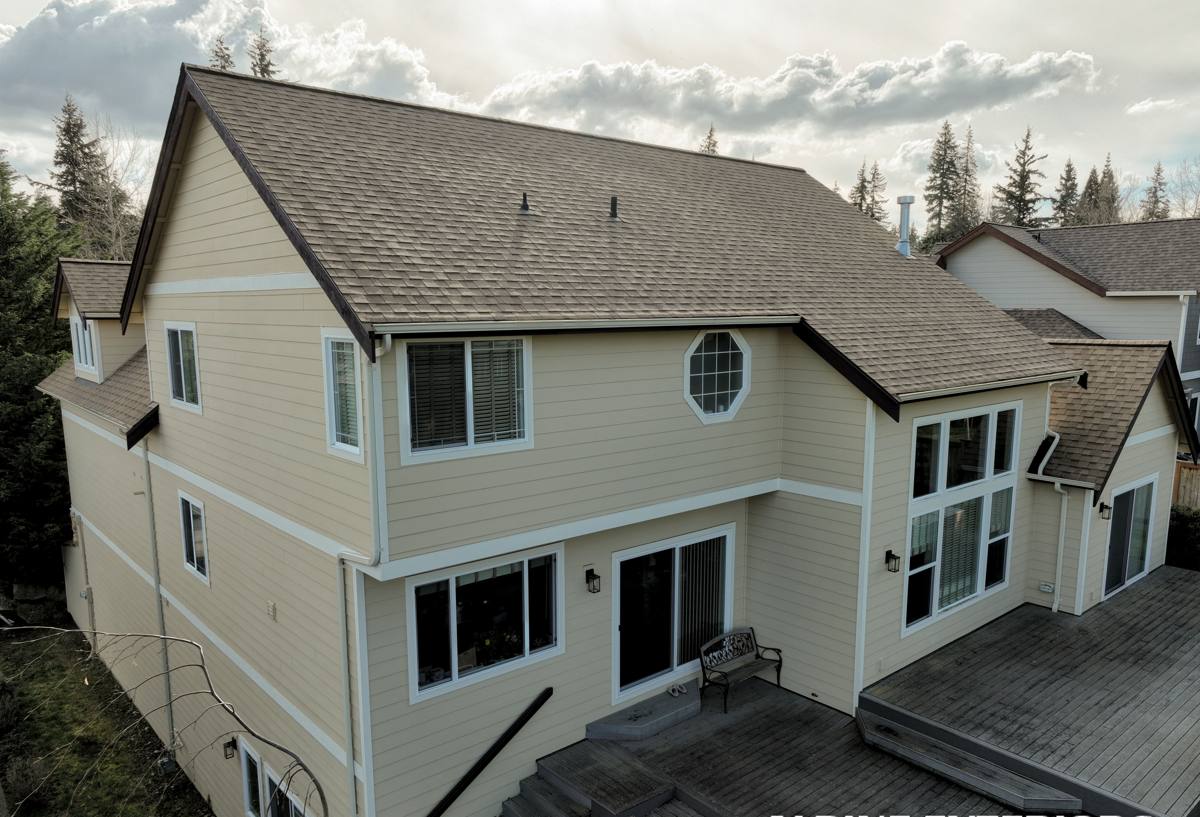
What Semiahmoo's Exposure Demands From an Installation
Salt Air From More Than One Direction
Because the spit has water on multiple sides, a Semiahmoo home doesn't get salt exposure from a single prevailing direction the way many coastal properties do — it comes from more than one angle depending on wind and tide. That changes how we think about fastener selection and flashing hardware during installation, since corrosion-prone materials that might survive on a single-exposure property don't get the same break here. Every metal component that goes into the wall assembly during installation needs to be chosen with that multi-directional salt load in mind, not just the side of the house that faces the water most directly.
Wind-Driven Rain Hitting Walls Sideways
With almost no windbreak on the spit, rain frequently arrives at the wall plane at an angle rather than falling straight down. During installation, that means every horizontal lap, every joint, and every penetration has to be treated as a place water will actively be pushed into, not just a spot where water might pool. It's the difference between installing siding for a climate that gets rain and installing siding for a climate that gets rain forced sideways into seams — the second one demands tighter lap details and more deliberate flashing integration at every transition.
A Moss and Mildew Season That Doesn't Really End
Mild, humid conditions and shaded north-facing walls mean moss and mildew pressure runs most of the year on this stretch of Whatcom County coastline. During installation, that affects decisions like how much drainage gap gets built behind the siding and how walls that don't get much direct sun are detailed differently than south-facing walls on the same house. An installation that treats every wall identically, without accounting for which sides stay damp longest, tends to show moss and staining unevenly within the first few seasons.
Why We Install Only James Hardie Fiber Cement
We used to offer a wider range of siding products. We narrowed to one system after seeing, repeatedly, what actually held up on exposed coastal installs like this one and what didn't — not because of a supplier arrangement.
- Non-combustible core: Fiber cement doesn't feed a fire the way wood-based siding can, which matters for safety and often for insurance underwriting.
- Factory-applied ColorPlus finish: Cured under controlled factory conditions rather than brushed on-site, it holds color and adhesion far longer under sustained salt air and UV than field-applied paint.
- Climate-engineered HZ5 formulation: Built for regions with heavy moisture exposure and freeze-thaw cycling — a fit for waterfront Whatcom County.
- Dimensional stability: Fiber cement resists the swelling, cupping, and warping that engineered wood products can develop after repeated wetting cycles.
- A strong transferable warranty: Backed by Hardie, contingent on installation following their published specifications.
We don't install LP SmartSide, vinyl siding, Cemplank, Allura, primed spruce, or cedar. Each has a legitimate place in the broader market and satisfied customers elsewhere. Our position is specific to this kind of site: on an exposed spit property, we'd rather install and stand behind one system fully than offer something cheaper that quietly shifts maintenance risk onto the homeowner a few years out.
What Correct Installation Actually Involves
Substrate Inspection Before Anything Goes Up
Once old siding comes off, the sheathing underneath gets checked for rot, soft spots, and existing moisture damage before any new material is installed. On a property that's taken years of salt air and wind-driven rain, hidden sheathing damage is common enough that we treat this step as mandatory, not optional. Covering a compromised substrate with new siding just delays a bigger repair.
Weather-Resistive Barrier and Drainage Detailing
Behind the siding, the house wrap and any drainage or rain-screen detailing form the layer that actually keeps a Semiahmoo home dry over time — the siding itself is the first line of defense, not the only one. Given how much coastal siding failure traces back to water getting behind the cladding rather than through it, we treat this layer as carefully as the visible finish work, particularly on walls facing open water.
Fastener and Flashing Selection
Corrosion-resistant fasteners are non-negotiable on a multi-exposure salt-air site like this. The same goes for flashing at every window, door, and roof-to-wall transition — these are the points where a generic installation and a site-specific one diverge most, since a flashing detail that's adequate a few miles inland can fail here under sustained wind-driven rain.
Fastener Spacing and Manufacturer Spec
James Hardie's warranty depends on installation matching their published specifications: correct nail or screw spacing, proper clearance from grade and roofline, and correctly sealed or factory-mitered joints. We install to that spec as a baseline requirement, not an upgrade option, because a Hardie product installed loosely will still develop problems in this climate regardless of the material's own resistance to moisture.
Final Walkthrough
We walk the completed installation with the homeowner, confirm the work matches the estimated scope, and go over maintenance expectations specific to a waterfront property before calling the job finished.
Our Installation Process, Start to Finish
- On-site assessment: We look at existing siding condition, sheathing risk areas, and how exposure varies wall by wall given the property's specific position on the spit.
- Written scope and estimate: A clear, itemized scope before any contract is signed, so there are no surprises about what's included.
- Tear-off and substrate check: Old siding comes off, sheathing gets inspected, and any rot or damage gets addressed before new material goes on.
- Weather barrier and flashing installation: House wrap, flashing, and drainage detailing go in with the site's wind and salt exposure specifically in mind.
- Hardie panel or plank installation to spec: Correct fastener type and spacing, proper clearances, and sealed or mitered joints throughout.
- Final walkthrough: A joint review of the finished work against the original scope, with maintenance guidance specific to a Semiahmoo property.
Comparing Installation Outcomes by Material
| Material | Installation sensitivity in this climate | Typical outcome on an exposed spit property |
|---|---|---|
| James Hardie fiber cement | Performs as engineered when installed to spec; dimensionally stable | 30+ years with correct installation and normal upkeep |
| Vinyl siding | Panel seams and fastening tolerances become entry points under wind-driven rain | Variable; often shorter lifespan in high-wind waterfront settings |
| LP SmartSide / engineered wood | Cut edges and joints are moisture-sensitive if sealing isn't maintained | Depends heavily on ongoing maintenance and installation quality |
| Cedar / primed wood | Absorbs and releases moisture readily; finish needs regular attention | Shorter lifespan without consistent refinishing |
What Drives Cost on a Semiahmoo Installation
Every estimate is specific to the house, but a few factors consistently move the number on properties out here: total square footage and number of stories, how much trim and window/door detail work surrounds the field of siding, sheathing condition once old siding is removed, how many walls face open water versus a more sheltered side, and which Hardie product line and color best fits the home. We walk through these factors during the estimate rather than handing over a flat number with no explanation.
A Homeowner's Checklist Before Hiring for Siding Installation on the Spit
- Ask what material they install and why, and whether it's backed by a written manufacturer warranty
- Confirm current Washington contractor licensing and active liability insurance
- Ask specifically how they detail flashing at windows, doors, and roof-to-wall transitions given wind-driven rain
- Ask what fastener and hardware grade they use for corrosion resistance in a multi-directional salt-air setting
- Get a full written scope of work, including substrate repair contingencies, before signing anything
Why a Crew That Already Works Semiahmoo Matters
A contractor who installs siding regularly on this specific stretch of coastline already knows how salt air, open wind, and prolonged moisture behave differently here than even a few miles inland in Blaine. That familiarity shows up in installation choices that don't appear on a spec sheet — how tightly laps get sealed on the water-facing side, which walls need extra drainage detailing, and which fastener grade is worth the added cost. Those are exactly the decisions that determine whether a siding installation lasts one wet season or several decades on a property this exposed.
If you're planning a siding installation on a Semiahmoo home, we're glad to walk the property with you and give a straightforward read on what it actually needs. Reach out below for a free, no-pressure estimate.