 Blaine
 Siding Repair Built for Birch Bay's Waterfront Exposure
Birch Bay homes take a harder hit from the weather than houses just a few miles inland. The bay sends salt-laden air across every exterior surface, storms push rain sideways into wall assemblies instead of straight down, and shaded or north-facing walls can stay damp long enough to grow moss for most of the year. When siding starts failing here, it's rarely random — it's almost always tied to one of those three things finding a weak point in the wall. Our crew works out of Blaine and handles siding repair calls in Birch Bay regularly, which means we're not guessing at how this climate behaves. We've seen what it does to fasteners, seams, and lower-grade panels over a few wet seasons, and we repair accordingly.
This page is specifically about siding repair — patching, replacing damaged sections, and fixing the moisture or fastener problems that cause siding to fail in the first place. If you're planning a full re-side rather than a repair, that's a different scope of work, but a lot of what's below still applies to why James Hardie fiber cement is what we recommend and install.
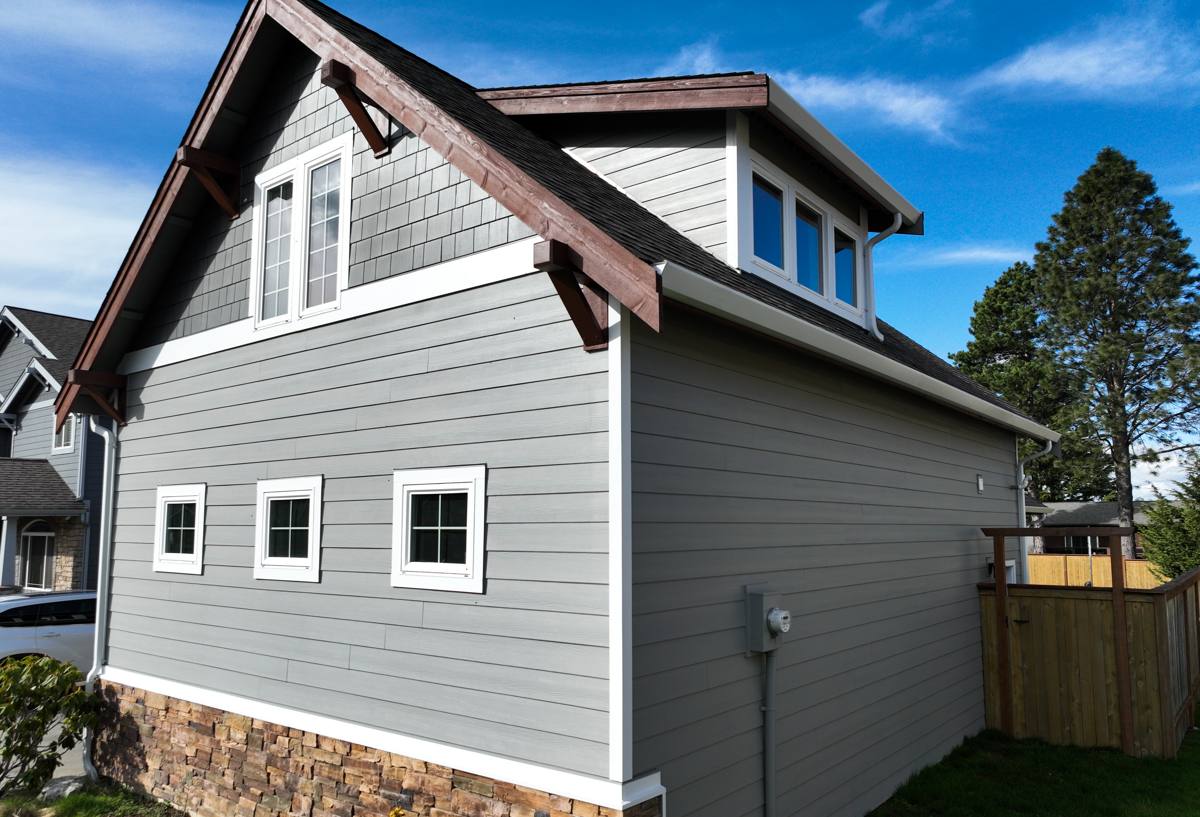
What Causes Siding Damage in Birch Bay Specifically
Salt Air and Fastener Corrosion
Direct exposure to salt-laden air accelerates corrosion on nails, screws, and metal trim faster than it would a few miles from the water. A fastener that's rusted or backed out is a common starting point for siding repair calls — once a fastener fails, the panel around it loses its hold and starts moving, which opens gaps for water.
Wind-Driven Rain Finding Weak Joints
Storms off the water don't just drop rain, they push it sideways into seams, joints, and anywhere flashing wasn't detailed correctly the first time. On siding that was installed without enough attention to those details, this shows up as water staining, soft spots, or panels that have started to separate at the joints. It's one of the most common reasons we get called out for repair rather than simple cosmetic touch-up.
Moss, Mildew, and Trapped Moisture
Birch Bay's long moss season isn't just a roof problem. Shaded siding walls, especially on the north side or anywhere blocked by trees or a neighboring structure, can stay damp long enough for moss and mildew to take hold on the surface and, in worse cases, hold moisture against the substrate underneath. Porous or lower-quality siding materials are more vulnerable to this than dense fiber cement.
Common Repair Scenarios We See
- Cracked or split panels from impact, settling, or age
- Water staining or soft, spongy siding near ground level or under windows
- Rusted, backed-out, or missing fasteners letting panels shift or rattle
- Failed caulk or sealant at joints and trim allowing water intrusion
- Moss or mildew buildup on shaded walls that keeps returning after cleaning
- Damaged flashing at windows, doors, or roof-to-wall transitions causing localized siding failure nearby
- Faded, chalking, or peeling finish on sections that were field-painted rather than factory-finished
What a Correct Siding Repair Actually Involves
A siding repair that's done right isn't just about swapping a damaged board for a new one. The real work is figuring out why that section failed in the first place, because replacing a panel without addressing the underlying cause just buys a few more years before the same spot fails again.
Diagnosis Before Anything Gets Replaced
We start by pulling back or removing the damaged section to look at what's underneath — the house wrap, flashing, and framing behind the siding. If there's evidence of moisture intrusion, we trace it back to its source rather than just patching the visible damage. On a waterfront property like this, that often means checking nearby flashing, caulk joints, and drainage detailing, not just the panel that's obviously cracked or stained.
Matching Material and Finish
Replacement sections need to match the existing siding in profile, exposure, and color as closely as possible. With James Hardie's factory-applied ColorPlus finish, matching an existing color is far more reliable than trying to match field-applied paint on an older or weathered product, since the factory finish is a consistent, documented color rather than a mixed batch that may have shifted with age and UV exposure.
Fastening and Flashing Done to Spec
Any repair we do gets fastened and flashed to the manufacturer's published specifications — correct fastener type, spacing, and clearance, with flashing lapped correctly at any joint or transition near the repair. In a climate that pushes rain sideways, a repair that looks fine but skips proper flashing detail will fail again, often faster than the original damage took to develop.
Addressing the Root Cause, Not Just the Symptom
If the underlying cause is a drainage problem, a missing rain-screen gap, or corroded fasteners spreading beyond the damaged section, we address that as part of the repair rather than leaving it for the next call. A patch that ignores the cause is a short-term fix, and on a property exposed to this much salt air and moisture, short-term fixes don't hold up long.
Repair vs. Replacement: How We Help You Decide
Not every siding problem in Birch Bay calls for a full re-side, and not every damaged section can be responsibly patched. Part of an honest repair visit is telling you which situation you're actually in.
| Situation | Repair Usually Makes Sense | Replacement Usually Makes Sense |
|---|---|---|
| Damage is isolated to a few panels or one wall section | Yes | Not necessary |
| Moisture intrusion is widespread behind multiple walls | Rarely enough on its own | Yes |
| Existing siding is an aging or discontinued product | Matching material may not be available | Often the more practical route |
| Fastener corrosion is limited to one area | Yes | Not necessary |
| Underlying sheathing or framing shows rot | Only if damage is very limited | Yes |
When repair is the right call, we do the repair. We're not going to push a full re-side on a homeowner who needs a section replaced and a drainage detail corrected. When the damage points to a bigger underlying problem, we'll say so plainly and explain why, rather than patching over something that's going to come back.
Why We Repair with James Hardie Fiber Cement
We install and repair with James Hardie fiber cement exclusively. We don't work with LP SmartSide, vinyl siding, Cemplank, Allura, primed spruce, or cedar. That's not a brand preference — it's a standard we settled on after years of repair and tear-off work in exactly this kind of coastal, wet climate.
- Non-combustible core: Fiber cement doesn't feed a fire the way wood-based siding products can.
- Factory-applied ColorPlus finish: Baked on under controlled conditions, it holds color and resists chalking far longer than field-applied paint, and it makes repair-section color matching far more reliable.
- Climate-engineered HZ product lines: Hardie's HZ5 formulation is built for regions with heavy moisture exposure and freeze-thaw cycling, which fits Birch Bay's waterfront conditions.
- Dimensional stability: Fiber cement doesn't swell, warp, or cup with repeated wetting the way some engineered wood products can, so repairs stay tight instead of opening back up.
- Strong transferable warranty: Provided installation follows Hardie's spec, the product carries a warranty that holds up as one of the more robust in the industry.
Other products have a place in the market, and homeowners elsewhere are satisfied with them. But when we're the ones doing the repair — standing behind the work with our name on it — we'd rather work with one system we trust fully in this climate than patch a product we know is more likely to bring us back out in a year or two.
What Happens When Existing Siding Isn't Hardie
A lot of the repair calls we get in Birch Bay are on homes with vinyl, engineered wood, or older wood siding that's showing exactly the kind of wear this climate causes. We can repair most materials in a limited, targeted way — replacing a damaged section with a close match where that's realistic. But if a homeowner is dealing with recurring failures across multiple areas, that's usually the point where we'll have an honest conversation about whether continued patch repairs make sense or whether it's time to talk about re-siding with a product built for this exposure.
Why a Local Blaine Crew Matters for Repair Work
Siding repair is detail work, and the details that matter change depending on exposure. A crew that works Birch Bay regularly already knows which walls tend to hold moisture, how far wind-driven rain typically pushes on a waterfront lot, and which fastener grades hold up out here versus a few miles inland. That familiarity shows up in small decisions during a repair — how far past the damaged area to check for hidden moisture, how much flashing to add at a repaired joint, which sealant actually holds in salt air — and those small decisions are what determine whether a repair lasts five years or fifteen.
A Checklist for Hiring a Siding Repair Contractor in Birch Bay
- Ask what they found when they inspected behind the damaged siding, not just what they plan to replace on the surface
- Confirm current Washington contractor licensing and active liability insurance
- Ask specifically how they'll match color and profile to your existing siding
- Get a clear, written scope describing exactly what will be repaired, replaced, and reflashed
- Ask whether they can explain the likely root cause of the damage, not just offer to cover it up
Our Siding Repair Process
We start with an on-site inspection of the damaged area and the siding around it, since problems in this climate rarely stay isolated to exactly where they're visible. We open up enough of the wall to see what's actually happening behind the surface, then put together a clear, written scope covering what needs to be replaced, what flashing or drainage detailing needs correcting, and what the repair will cost. From there we do the work to manufacturer spec — correct fasteners, correct flashing laps, and a color and profile match that blends with the rest of the house.
If you've got damaged, stained, or aging siding on a Birch Bay property and want an honest read on whether it needs a repair or something more, we're happy to take a look. Reach out below for a free, no-pressure estimate.