 Blaine
 Why Birch Bay Siding Wears Differently Than Inland Homes
Birch Bay sits right where Whatcom County's coastline meets some of the wettest weather in Washington, and that combination is hard on exterior siding. Homes here face a triple load that inland Blaine and Ferndale properties don't deal with in the same way: salt-laden air off the bay, sideways-driving rain that gets pushed straight into wall assemblies, and a moss season that can stretch from October clear through May. Any one of those factors will shorten the life of the wrong siding material. Together, they turn a marginal product choice into a five-to-ten-year regret.
We've replaced siding on enough Birch Bay homes to know the failure patterns aren't random. They show up on the windward walls first, at the lowest courses near grade, around window trim that wasn't flashed correctly, and anywhere moss has been allowed to sit against the wall for a season or two. Understanding why those spots fail is the first step to specifying a replacement that won't repeat the problem.
What Salt Air Actually Does to Siding
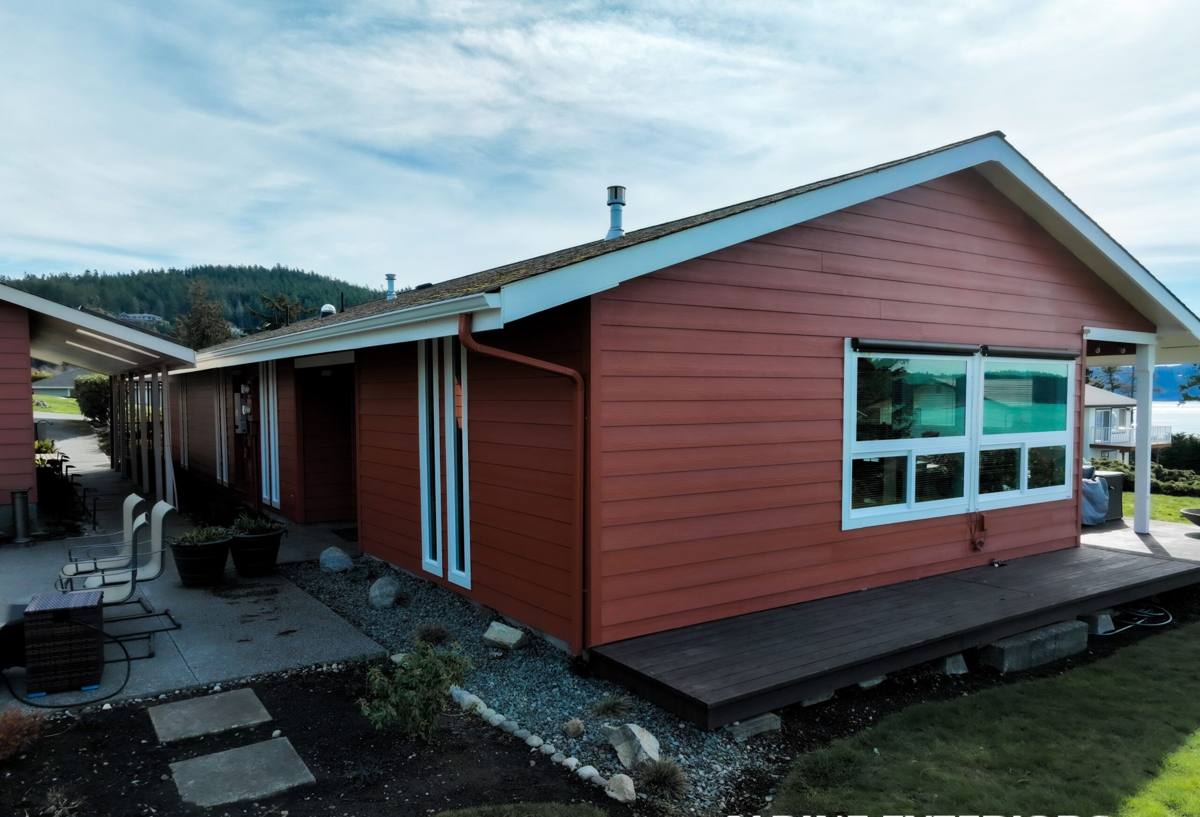
Salt air isn't just "coastal weather" — it's an active corrosive and moisture-holding agent. It accelerates rust on exposed fasteners, breaks down lower-grade paint films faster than inland UV exposure would, and it keeps organic surfaces (wood fiber, cellulose-based composites) slightly damp even on days without rain, because salt is hygroscopic and pulls moisture out of the air. That constant low-grade dampness is exactly the condition mold, mildew, and moss need to establish themselves on a wall surface.
Vinyl siding tolerates salt air reasonably well on the surface, but it expands and contracts more than fiber cement, and in coastal wind exposure the panels can loosen at the nailing hem over time, opening gaps for wind-driven rain to get behind the cladding. Wood-based and primed-spruce products absorb moisture at cut edges and fastener penetrations, and once that moisture is in the substrate, salt air slows the drying-out period, which is when rot gets a foothold.
Driving Rain and Wall Assembly
Birch Bay's exposure to Georgia Strait weather means rain frequently arrives horizontally, not straight down. That matters because a siding system's water-shedding details — the lap overlap, the flashing at windows and trim, the gap at the bottom starter course — have to work under wind pressure, not just gravity. A replacement job that only swaps the surface material without correcting these details will fail in the same places the old siding did, just on a longer timeline.
Moss Season: The Slow Damage Most Homeowners Miss
Whatcom County's moss season is long, and Birch Bay's proximity to the water keeps humidity elevated even on drier days. Moss itself doesn't eat siding material the way rot does, but it holds moisture directly against the wall surface for months at a stretch, and it's the growth medium that lets mildew and algae take hold on painted or coated surfaces. On lower-grade siding, that sustained dampness can:
- Soften and delaminate composite or OSB-based products at seams and edges
- Trap moisture against fastener heads, accelerating corrosion and staining
- Break down paint adhesion, leading to peeling, chalking, or blistering within a few seasons
- Create a freeze-thaw cycle risk on the rare hard-frost mornings, widening any existing cracks
Moss growth on a north-facing or shaded wall is often the first visible sign that a siding system isn't shedding water the way it should — not a cosmetic nuisance to pressure-wash away every spring, but a signal worth reading.
Why We Only Install James Hardie Fiber Cement
We stopped installing vinyl, LP SmartSide, primed spruce, cedar, and other fiber cement brands for Birch Bay-area replacements because we were repeatedly diagnosing the same coastal-climate failures on those products and repairing them years ahead of a normal service life. James Hardie fiber cement is not immune to bad installation, but the material itself is engineered around the conditions this stretch of coastline actually produces:
- Non-combustible composition — cement, sand, and cellulose fiber, with no wood content to rot, delaminate, or feed insects
- HZ5 engineered product line — Hardie's harshest-climate formulation, built for high-moisture, freeze-prone regions like the Pacific Northwest coast
- ColorPlus factory-baked finish — a UV-cured coating applied under controlled conditions, which holds up to salt air and moss-season dampness far better than field-applied paint
- Dimensional stability — fiber cement doesn't expand and contract with humidity swings the way vinyl and wood-based products do, so laps and fastener points stay tight over time
We're not saying every home that had vinyl or LP siding was doomed — plenty of installations hold up for a reasonable service life inland. But on a Birch Bay property facing salt air, wind-driven rain, and months of moss-favorable humidity every year, the margin for error is smaller, and fiber cement gives us more of that margin to work with.
What a Correct Siding Replacement Involves
Replacing siding on a coastal Birch Bay home is not a like-for-like swap. A correct job addresses the wall assembly underneath the cladding, not just the visible surface. Our process typically includes:
- Full tear-off and inspection — removing old siding to expose the sheathing, framing, and any existing water damage or rot before it's covered up again
- Sheathing repair — replacing any compromised OSB or plywood found during tear-off rather than siding over it
- Weather-resistive barrier installation — a correctly lapped house wrap or building paper that drains water down and out, not behind the cladding
- Window and trim flashing — flashing details specifically sized for the wind-driven rain exposure common to bay-facing walls
- Rainscreen or furring strip application where warranted — creating an air gap behind the siding so any moisture that does get past the cladding can drain and dry rather than sit against the wall
- James Hardie panel or lap installation to manufacturer spec — correct fastener type, spacing, and clearance from grade and roofing to keep warranty coverage intact
- Caulking and touch-up at cut edges — sealing factory-cut ends per Hardie's installation guidelines so the ColorPlus finish isn't compromised at seams
Skipping any one of these steps is how a siding replacement ends up needing another replacement in half the expected lifespan. It's also usually invisible from the curb until the problem is already established underneath.
Comparing Siding Options for a Birch Bay Home
| Factor | Vinyl | Wood / Primed Spruce | James Hardie Fiber Cement |
|---|---|---|---|
| Salt air resistance | Fair — surface holds up, seams can loosen | Poor — absorbs moisture at cut edges | Strong — engineered HZ5 line for coastal climates |
| Wind-driven rain tolerance | Moderate — depends on installation detail | Weak — prone to swelling and rot at joints | Strong when installed with proper flashing and clearance |
| Moss/moisture resistance | Good on surface, but traps moisture behind if loose | Poor — moss-favorable dampness accelerates decay | Good — non-organic material, factory finish resists staining |
| Fire resistance | Low — melts/deforms under heat | Low — combustible | Non-combustible |
| Typical service life (installed correctly) | 20-30 years | 10-20 years, climate-dependent | 30-50 years |
Signs a Birch Bay Home Needs Siding Replacement, Not Just Repair
- Soft or spongy spots when pressed, especially near the bottom courses or under windows
- Persistent moss or algae growth that returns within a season of cleaning
- Visible cracking, buckling, or gapping at laps and corners
- Paint that's chalking, peeling, or blistering across multiple wall sections
- Rusty streaking below fastener heads
- Interior signs — musty smell, staining, or soft drywall near exterior walls, which often points to moisture already past the cladding
One or two of these on an isolated section might mean a targeted repair is enough. Several of these across multiple walls, especially the bay-facing or north-shaded sides, usually means the whole system has reached the end of its useful life.
Why Local Experience in Birch Bay Matters
Siding contractors who mostly work inland don't always account for wind-driven rain exposure or the length of the local moss season when they're detailing flashing and rainscreen gaps. A crew that regularly works this specific stretch of Whatcom County coastline has already seen where the old siding failed on similar homes and builds the replacement to correct those exact weak points — not a generic install pulled from a manufacturer's minimum spec sheet. That local pattern recognition is worth as much as the material choice itself.
What to Expect From Our Process
We start with an on-site inspection of the existing siding and, where accessible, a look at the condition underneath at a few test points. From there we walk through what we're seeing, what's driving the damage, and what a correct replacement plan looks like for that specific home — including product line, color, and any wall-assembly corrections needed. We provide a clear, itemized proposal before any work begins, and every installation follows James Hardie's published installation specifications to keep the manufacturer's warranty intact.
If you're seeing moss buildup that won't quit, paint that's failing early, or you just know your siding has been up longer than it should have been, we're happy to take a look. Reach out for a free, no-pressure estimate — the form below gets you started.