 Blaine
 Why Cherry Point Roofs Wear Differently Than Roofs Inland
Cherry Point sits right up against the Salish Sea, and that changes what a roof deals with year to year. Homes just a few miles inland in Whatcom County get a milder version of our weather — houses out here get the full version. Salt-laden air moves off the water and settles on every exposed metal surface: fasteners, flashing, gutters, vents. Add near-constant winter rain, long stretches of overcast humidity, and a moss season that can run eight or nine months, and you have a roofing environment that punishes shortcuts fast.
None of that means metal roofing is a bad fit for Cherry Point — the opposite is usually true. It means the material choice, the coating, the fasteners, and the installation details all have to be picked for this specific exposure, not just pulled off a generic spec sheet. A roof that would hold up fine in eastern Washington or a dry inland suburb can start showing corrosion, streaking, or moss intrusion out here within a few seasons if it wasn't detailed for coastal conditions.
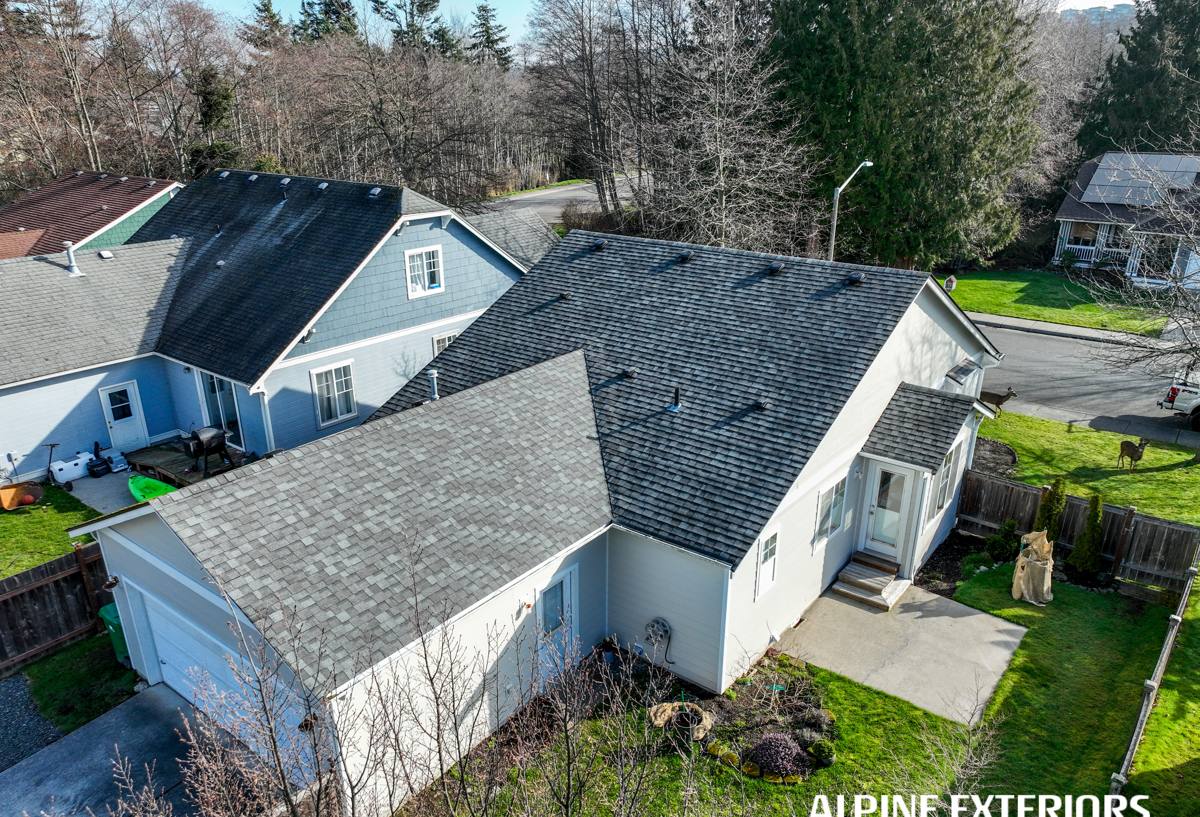
What Salt Air Actually Does to a Roof
Corrosion Starts Small and Spreads
Salt doesn't rust metal on its own — it accelerates the electrochemical reaction that causes rust once moisture is present, which in this climate is most of the year. The failure points we see most often on older or poorly-specified metal roofs near the water aren't the panels themselves. They're the small stuff: exposed fastener heads, cut panel edges that weren't resealed, and dissimilar metals touching each other (steel flashing against aluminum gutters, for example) and setting up galvanic corrosion between them.
Why Panel Finish Matters More Here Than Elsewhere
A bare or lightly coated panel that would be fine 20 miles inland needs a real marine-grade finish here. This is the single biggest variable in how long a Cherry Point metal roof looks good, not just how long it technically keeps water out.
Choosing Metal Panels and Coatings for This Exposure
There isn't one "best" metal roofing product — there's a right answer for a given house, budget, and how close it sits to open water. Here's how the common options stack up for coastal Whatcom County conditions:
| Option | Salt air performance | Trade-offs to know |
|---|---|---|
| Steel with a Kynar/PVDF finish | Strong, if the coating and cut-edge sealing are done right | Coating quality varies a lot between suppliers; cheap coated steel is where most coastal failures start |
| Galvalume steel, standard finish | Decent but not built for close-to-shore exposure | Better suited to homes further from the water; needs regular rinsing here |
| Aluminum panels | Naturally corrosion-resistant, a common choice right on the water | Softer material, dents more easily, costs more up front |
| Exposed-fastener steel panels | Workable, but every fastener is a future maintenance point | Gaskets degrade over time; needs periodic fastener checks we build into maintenance |
| Standing seam (concealed fastener) | Our default recommendation for Cherry Point | Higher install cost, but no exposed fasteners for salt to attack |
For most Cherry Point homes, we steer people toward standing seam in a marine-rated finish, or aluminum where a house sits especially close to the water. It's not about upselling — it's that exposed-fastener systems simply ask more of the homeowner in ongoing maintenance in this specific environment, and we'd rather be upfront about that trade-off before the roof goes on than after.
Moss, Algae, and the Long Wet Season
Metal roofing resists moss far better than shingles or wood, but "resists" isn't "immune." Moss needs organic debris and standing moisture to get started, and Whatcom County's long damp stretches give it plenty of time to try. On a metal roof, moss problems almost always start in the same three places:
- Valleys and low-slope transitions where debris collects and water sits longer
- Areas shaded by overhanging trees, where the roof surface never fully dries
- Poorly lapped seams or panel overlaps where wind-driven rain and debris can wedge in
Correct panel spacing, proper slope at transitions, and keeping valleys clear go a lot further than any after-the-fact treatment. Where a roof has heavy tree cover, we'll sometimes recommend zinc or copper strips near the ridge — rain washing over them releases trace minerals that discourage growth down the slope. It's a long-standing, low-tech approach that works with the climate instead of fighting it every year.
Wind and Driving Rain Off the Water
Open water means fewer windbreaks, and Cherry Point can catch weather that gets softened by the time it reaches homes further inland. Two things matter most for keeping a metal roof watertight under those conditions:
Underlayment
Under the metal, we use a high-quality synthetic or self-adhered underlayment rated for the sustained wet exposure this area gets, with extra attention — and often self-adhered membrane — at eaves, valleys, and any roof-to-wall transition where wind-driven rain tends to find its way in.
Fastening and Panel Engagement
Standing seam panels need to be seamed correctly and fastened per the manufacturer's wind-load spec for our area, not a generic minimum. Clip spacing, panel gauge, and edge detailing at rakes and eaves are where wind uplift failures actually start — not in the field of the roof.
What a Correct Metal Roofing Job Includes
A metal roof is only as good as the details underneath it. On every Cherry Point project, our process covers:
- Full roof deck inspection — soft or rotted decking gets replaced before anything goes down, not covered up
- Ice-and-water or self-adhered membrane at eaves, valleys, and penetrations
- Proper underlayment across the full roof, rated for extended wet exposure
- Correct panel and fastener selection for the home's exposure level to salt air
- Flashing details at chimneys, vents, and wall transitions built to shed water, not rely on sealant alone
- Attic and roof ventilation checked and corrected where needed, since trapped moisture under the metal is its own long-term problem
- Clean edge and seam work so the finish coating isn't compromised at cut points
Sealant has its place, but it's a backup, not the plan. Roofs that lean on caulk to do the flashing's job are the ones that leak a few years down the road — and that's true whether the crew is local or not.
Cost Factors for a Cherry Point Metal Roof
We don't quote a number without seeing the roof, but the honest range depends on a handful of specific factors more than most people expect:
| Factor | Why it moves the price |
|---|---|
| Panel material (steel vs. aluminum) | Aluminum costs more but needs less long-term maintenance this close to the water |
| Standing seam vs. exposed fastener | Concealed-fastener systems cost more installed, less to maintain over time |
| Roof complexity (valleys, dormers, penetrations) | More transitions mean more flashing labor and materials |
| Deck condition underneath the existing roof | Rot or soft sheathing found during tear-off adds repair cost |
| Existing roof removal vs. re-cover | Tear-off costs more but lets us fix underlayment and deck issues properly |
| Coating and warranty tier | Better marine-rated finishes cost more but hold color and resist corrosion longer here |
Broadly, metal roofing costs more up front than asphalt shingles, and the gap widens with standing seam and premium coatings. The trade-off is a roof that's built for decades in this climate rather than needing replacement on a shingle-length timeline — but we'll walk through where your budget makes sense to spend and where it doesn't, without pressure either direction.
Why Local Cherry Point Experience Matters
Roofing crews that don't work this stretch of coastline regularly tend to make the same mistakes: standard-grade coatings that aren't rated for salt exposure, underlayment specs pulled from drier climates, and flashing details that work fine most places but not here. A crew that's actually worked Cherry Point and the surrounding Blaine area knows which corners of a roof take the worst of the wind and salt, how long moss season really runs, and which products hold up versus which ones just look good on a spec sheet in the showroom.
That local knowledge also matters for permitting and code — Whatcom County and the City of Blaine have their own requirements for roofing work, and a crew that pulls permits here regularly knows what inspectors expect the first time, instead of getting sent back for corrections. It's a small thing that saves real time on a project.
Keeping a Metal Roof in Shape Year to Year
Metal roofing is low-maintenance, not no-maintenance — especially this close to open water. A simple annual routine covers most of what actually matters:
- Clear leaves, needles, and debris from valleys and gutters before fall rains set in
- Rinse accumulated salt film off the roof surface where trees or wind patterns trap it
- Walk the roofline (or have it checked) for any lifted flashing or damaged seams after major windstorms
- Trim back tree limbs that keep sections of the roof shaded and slow to dry
- Check exposed fasteners on any exposed-fastener panel sections every couple of years
None of this takes much time, but skipping it is how a 40-plus-year roof turns into a 20-year roof. We're happy to walk any homeowner through what to watch for, whether or not we installed the roof.
If you're weighing metal roofing for a home in Cherry Point or elsewhere around Blaine, we're glad to take a look and give you a straight answer on what your roof actually needs — no pressure, no upsell. Use the form below to request a free estimate.