 Blaine
 Composite Decking in Custer: A Different Climate Problem Than Most Manufacturers Plan For
Custer sits close enough to the water that homes here deal with a specific combination most decking product literature doesn't account for: salt-laced air drifting off Semiahmoo Bay and the Strait, long stretches of driving rain through fall and winter, and a moss season that can run from October well into April. None of those three things alone is unusual for Western Washington. Together, on a deck that sits low, faces the weather, or backs up to trees and damp ground, they compound. Boards that would be fine in a drier inland town start showing streaking, slow drainage, and moss creep within a couple seasons if the install didn't account for it.
We work Custer and the rest of the Blaine area regularly, which matters more with decking than with almost any other exterior project. A composite deck is judged over years, not on install day. The board, the fastening system, the substructure, and the drainage plan all have to be right together, and the right answers for a Custer lot near the water aren't identical to the right answers for a lot a few miles inland in less exposed terrain.
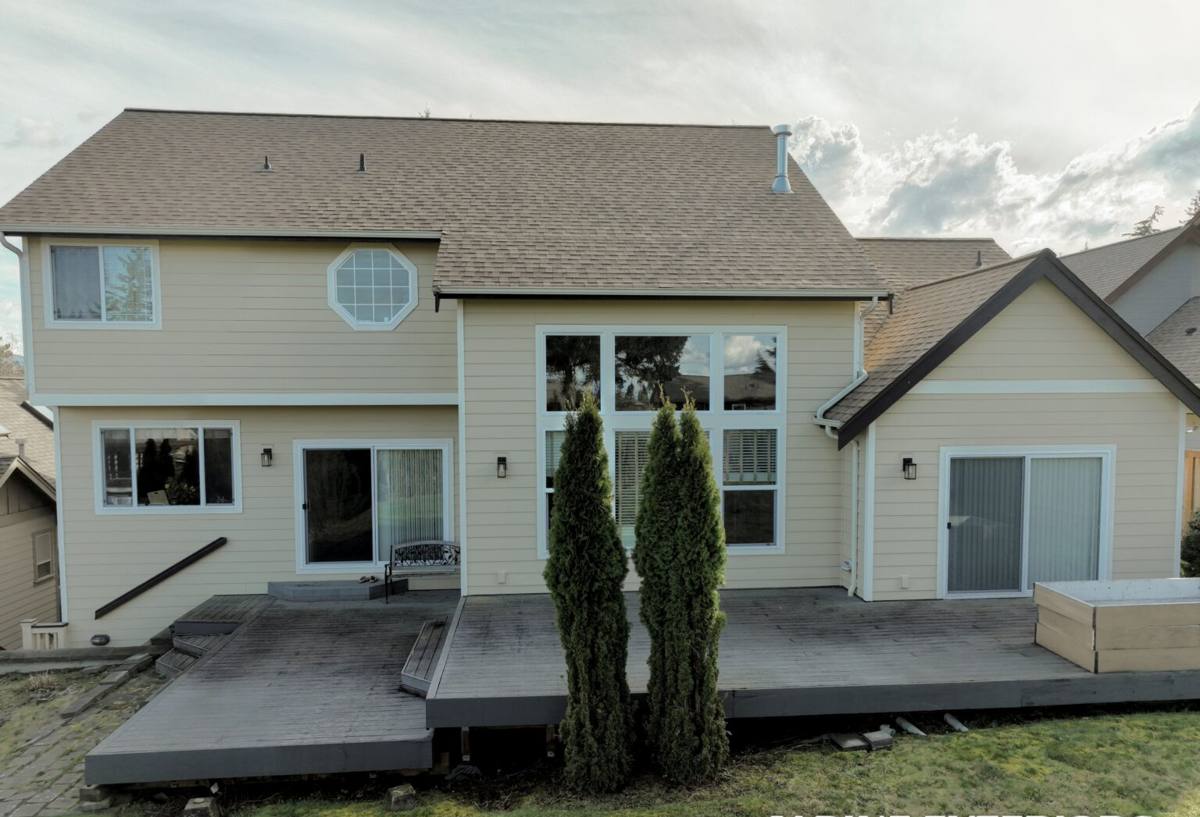
What Whatcom County Weather Actually Does to a Deck
Salt Air
Salt-laden air corrodes exposed metal fasteners and hardware faster than it degrades the composite board itself. Cheap or mismatched fastening hardware is usually the first failure point on a coastal deck — not the decking material. This is why fastener selection and hidden-fastener systems rated for coastal exposure matter more here than in most parts of the county.
Driving Rain
Wind-driven rain doesn't just fall on a deck, it gets pushed sideways into board gaps, ledger connections, and the framing underneath. A deck built with proper gapping and drainage sheds that water. A deck built tight, or without a drainage plane between the boards and the joists, traps it — and trapped moisture is what eventually rots the substructure even when the composite surface still looks fine.
Moss Season
Composite decking doesn't feed moss the way untreated wood does, but moss and algae will still colonize a board surface wherever moisture sits and airflow is poor — shaded areas, low spots, spots near tree cover. A deck built with correct slope, gapping, and joist spacing dries out between storms. One built flat or too tight stays damp long enough for moss to take hold, and once it does, it's a recurring cleaning chore rather than a one-time problem.
What a Correct Composite Deck Install Involves Here
Composite decking is often sold as low-maintenance, and the board itself is. But "low-maintenance" only holds up if the installation underneath it is done right. For Custer conditions specifically, that means:
- Joist spacing matched to the manufacturer's spec for the board profile — grooved boards and hidden-fastener systems often require tighter spacing than standard lumber decking
- Coastal-rated, corrosion-resistant fasteners and clips, not standard-grade hardware
- Proper board gapping calculated for the actual moisture exposure of the site, not a generic gap width
- A ledger connection flashed and sealed to keep water from tracking back into the house rim joist
- Slope built into the substructure so water sheds off the deck instead of pooling
- Joist tape or an equivalent moisture barrier on top of the framing, since composite boards trap the moisture that gets under them longer than wood does
- Adequate under-deck airflow, especially on lower decks close to grade where damp ground air collects
Skip any one of these and the deck can still look right for a year or two. The problems that show up later — soft spots in framing, fastener staining, persistent moss in low spots — almost always trace back to one of these steps being shortcut at install.
Choosing a Board for a Custer Lot
Not every composite line is built the same way, and the differences matter more near the water. Capped composite boards (a wood-plastic core with a protective cap layer) generally hold up better against staining and moisture absorption at the board ends than uncapped composite, which is one reason we lean toward capped products for coastal-exposed sites. Board color also matters more here than people expect — darker boards run hotter and can accelerate expansion/contraction cycling, while very light boards can show salt residue and organic staining more visibly. We'll walk through the realistic trade-offs for your specific site rather than pushing one line across the board.
Composite vs. Pressure-Treated Wood vs. PVC — Honest Trade-offs
| Factor | Composite | Pressure-Treated Wood | Cellular PVC |
|---|---|---|---|
| Upfront cost | Mid-high | Lowest | Highest |
| Maintenance | Periodic wash | Regular staining/sealing | Wash only |
| Moss/algae resistance | Good if installed with airflow | Poor without upkeep | Good |
| Fastener corrosion risk near salt air | Moderate — depends on hardware chosen | Moderate | Moderate |
| Expected lifespan (properly installed) | 25–30+ years | 10–15 years to major repair | 25–30+ years |
| Feel/appearance | Wood-like, consistent | Natural wood grain | Uniform, plastic look |
Wood is the cheapest way onto a deck, but in this climate it's also the most maintenance-hungry — annual or biannual sealing is realistic, not optional, if you want to avoid rot and splintering. PVC holds up extremely well but costs more and some homeowners don't love the look. For most Custer homeowners weighing looks, upkeep, and total cost over 20+ years, composite lands in the middle in a way that works — which is why it's the material we get asked about most out here.
Our Process for a Custer Composite Deck
1. Site Assessment
We look at sun/shade exposure, proximity to the water and prevailing wind direction, existing drainage on the lot, and the condition of any structure the new deck ties into (ledger board, rim joist, foundation). This is where we catch problems — like an already-soft rim joist — before they become part of a new deck's foundation.
2. Substructure Build or Repair
If the existing framing is sound, we build on it after correcting any drainage or flashing issues. If it's not, we replace it — a beautiful composite surface on a compromised substructure just delays the same failure by a few years.
3. Fastening & Drainage Details
This is where coastal exposure gets built in: corrosion-rated hardware, correct gapping, joist protection tape, and ledger flashing sized for driving rain, not just occasional showers.
4. Board Installation
Installed to the manufacturer's spec for the specific product line, including any required expansion gaps at butt joints and picture-framing edges, since composite expands and contracts with temperature more than people expect.
5. Walkthrough
We go over what maintenance actually looks like for your board choice — most composite decks just need an occasional wash, but we'll flag anything site-specific, like a shaded corner that'll need more frequent attention.
Maintenance Reality for a Coastal Deck
Composite decking is genuinely lower maintenance than wood, but "lower" isn't "none," especially this close to the water. A realistic maintenance routine for a Custer deck:
- Rinse or sweep off salt residue and debris a few times a year, more often in winter storm months
- Wash with a composite-safe cleaner once or twice a year to prevent moss and algae buildup, especially in shaded sections
- Keep gutters and downspouts near the deck clear so runoff isn't dumping extra water onto the surface
- Check fastener heads and hidden-clip areas periodically for corrosion or movement, particularly after the first couple winters
- Trim back overhanging vegetation that keeps sections of the deck shaded and damp
Why Hiring a Crew That Already Works Custer Matters
A lot of decking problems we get called to fix aren't material failures — they're installation choices that didn't account for where the house actually sits. A crew that hasn't worked this stretch of Whatcom County might use standard fastener hardware because that's what works fine at their last job forty miles inland, or gap boards to a generic spec instead of one suited to a windward, water-facing lot. We already know what Blaine and Custer conditions do to a deck over five, ten, fifteen years, because we've been back to see it. That's the difference between a deck that's still tight and dry in year ten and one that's already showing soft spots.
Get a Straight Answer for Your Deck
Every lot in Custer is a little different — how exposed it is to wind off the water, how much shade it gets, what the existing structure looks like underneath. We'll take a look, tell you honestly what your site needs, and give you a clear estimate with no pressure to sign anything on the spot. If you're planning a new composite deck or replacing one that's not holding up, reach out below for a free estimate.