 Blaine
 Custer's Climate Is Harder on Siding Than Most Homeowners Realize
Custer sits inland from Semiahmoo Bay and Birch Bay, close enough to the water that salt-laden air still reaches homes on breezy days, and close enough to the Cascade foothills and heavy tree cover that damp, shaded conditions linger for months at a time. Add in Whatcom County's driving rain — the kind that comes in sideways off winter storms rather than falling straight down — and you have a combination that few siding products are built to withstand indefinitely. Salt air accelerates corrosion on fasteners and trim. Driving rain finds every gap in flashing and caulking that a calm-weather installation would never expose. And a long moss season, often stretching from October through May in shaded rural lots, keeps siding surfaces wet far longer than in sunnier parts of the state.
None of this means siding fails quickly in Custer. It means the margin for error is smaller. A siding job that would hold up fine in a dry inland climate can start showing problems here within a few years if the water management details were rushed or the wrong material was used in the wrong place.
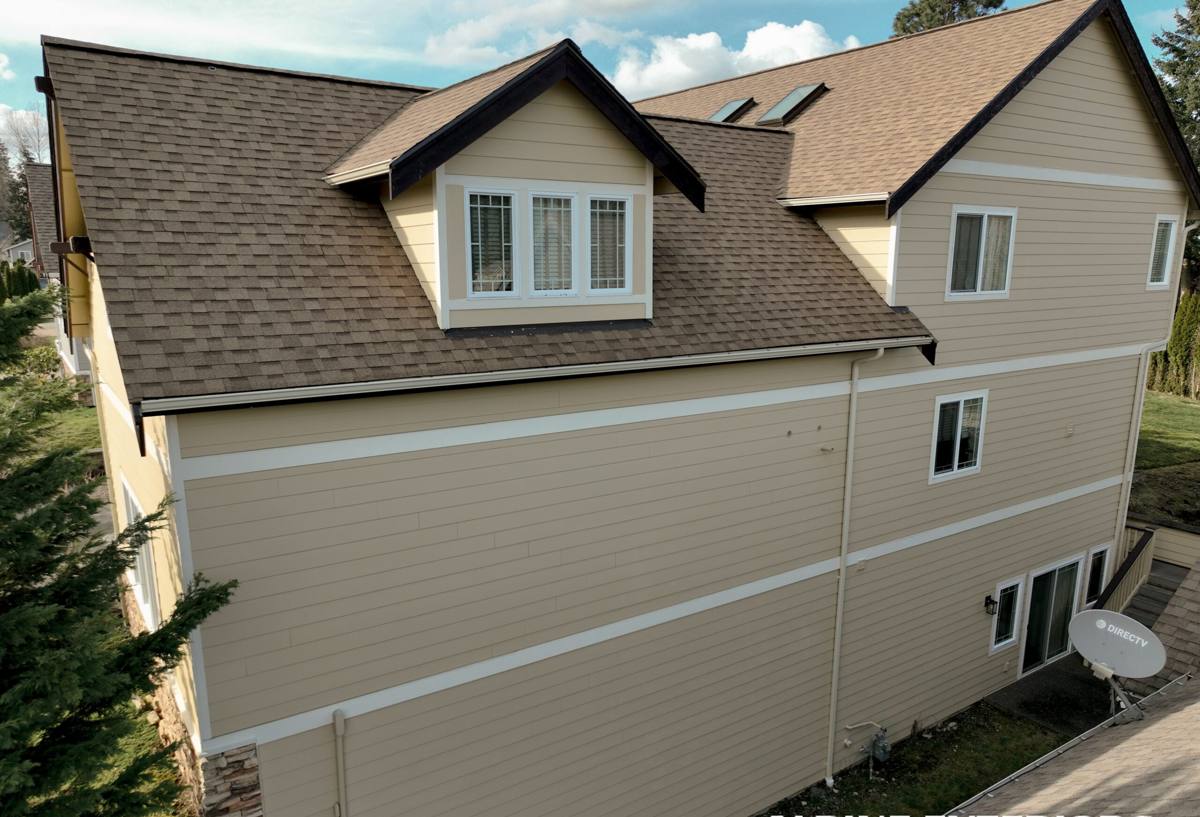
What Custer Homes Actually Need From a Siding System
Before talking about brands or colors, it helps to be clear on what the siding actually has to do. In this part of Whatcom County, siding is doing three jobs at once, not one:
- Shedding driving rain without letting moisture track behind the cladding and into the sheathing
- Resisting the effects of salt-influenced moisture on fasteners, trim, and finish coatings
- Staying dry enough, long enough, that moss, algae, and mildew don't get a permanent foothold on north-facing or tree-shaded walls
A product that only handles one or two of these well isn't a good match for a Custer property, even if it performs fine in a drier climate zone or a more open, sun-exposed lot closer to town.
Why We Install Only James Hardie Fiber Cement
We made the decision years ago to install James Hardie fiber cement siding exclusively — not vinyl, not LP SmartSide, not Cemplank or Allura, not primed spruce or cedar. That's not a marketing position; it's a practical one built around what actually holds up in Pacific Northwest conditions over decades, not just the first few years.
Fiber cement is non-combustible, which matters increasingly to insurers and homeowners alike. It doesn't absorb and swell with moisture the way engineered wood products can if a seam or cut edge gets exposed. Hardie's ColorPlus factory finish is baked on under controlled conditions rather than field-applied, which gives it better adhesion and color retention than most site-painted siding — a real advantage in a climate where paint has to fight moisture almost year-round. And Hardie engineers specific product lines (their HZ5 designation, used throughout our region) for exactly the wet, temperate exposure Whatcom County sees.
We're not going to tell you every other siding material is worthless — vinyl, engineered wood, and cedar all have legitimate uses. But we won't put our name on an installation using a product we don't believe holds up to this specific climate without an outsized maintenance burden falling back on the homeowner. That's why our trucks only carry one brand.
How Materials Compare for a Custer Property
| Material | Salt air / moisture resistance | Moss & mildew resistance | Typical maintenance |
|---|---|---|---|
| James Hardie fiber cement | Strong — non-combustible, dimensionally stable | Good, especially with factory ColorPlus finish | Occasional wash; repaint only if desired, decades out |
| Vinyl siding | Fair — can warp or fade under UV and salt cycling | Fair — seams and laps can trap moisture | Periodic cleaning; panels can crack in cold snaps |
| Engineered wood (LP-type) | Weaker if edges/cuts aren't fully sealed | Weaker — more prone to swelling if moisture intrudes | Regular inspection of seams and caulk lines |
| Cedar / primed spruce | Moderate — natural rot resistance varies by cut | Weaker — organic material feeds moss and mildew | Frequent refinishing, staining, or painting |
What a Correct Installation Actually Involves
The siding material is only part of the equation. Most siding failures we get called out to inspect in this area weren't caused by a bad product — they were caused by installation shortcuts that let water get behind the cladding. A correct job includes:
- A continuous weather-resistive barrier (WRB) installed with proper overlaps, not just stapled on and left
- Flashing at every window, door, and horizontal trim transition — the single most common failure point we see on older Custer homes
- A drainage plane or rainscreen gap behind the siding so any moisture that does get in can drain and dry out instead of sitting against the sheathing
- Correct fastener type, spacing, and depth per Hardie's published installation specifications
- Proper clearance between the bottom of the siding and grade, decks, or roof lines, so splashback and standing water don't sit against the material
- Factory-finished caulk joints and touch-up paint matched to the ColorPlus system, not generic exterior caulk that will fail years before the siding does
Skipping any one of these doesn't usually cause an immediate, visible problem. It shows up two, five, or ten years later as staining, soft trim, or a section of siding that has to be pulled and redone — often at a much higher cost than doing it right the first time.
Our Process on a Custer Job
1. On-Site Assessment
We walk the property, check the condition of the existing siding and sheathing, and look specifically at moisture exposure — how much tree cover shades each wall, which sides face prevailing wind and rain, and whether previous flashing or caulk work has already failed.
2. Tear-Off and Sheathing Check
Old siding comes off and we inspect the sheathing underneath. In a climate this wet, hidden rot behind old siding is common enough that we treat this step as mandatory, not optional — you don't want new siding going over compromised sheathing.
3. Weather Barrier and Flashing
This is where the job is actually won or lost. We install the WRB and flashing system to manage water at every penetration and transition before a single piece of siding goes up.
4. Hardie Installation
Panels or lap siding go up per Hardie's fastening and spacing specifications, with attention to seams, corners, and trim details that keep water moving away from the wall assembly.
5. Finish Work and Cleanup
Caulking, touch-up paint matched to the ColorPlus finish, and a full site cleanup close out the job. We also walk the finished exterior with the homeowner before we consider it done.
Local Considerations for Custer Properties Specifically
Custer's mix of larger, tree-shaded lots and older farmhouse-style homes creates a few conditions worth planning around. Heavily shaded walls — common on lots with mature tree cover — stay damp longer after rain and are the first place moss and mildew take hold, so drainage detailing on those elevations deserves extra attention. Older homes on acreage properties sometimes have siding that was patched or partially replaced over the years, which means transitions between old and new material need careful flashing to avoid creating a weak point. And because many Custer properties sit further from the highway corridor than in-town Blaine addresses, we plan material delivery and crew scheduling with that distance in mind so a job doesn't stall waiting on supplies.
A Simple Pre-Project Checklist for Homeowners
- Note which sides of your house stay damp or shaded longest — these need the most attention during installation
- Check for any soft spots, staining, or bubbling paint on current siding, especially near windows and trim
- Ask any contractor you're considering what flashing and drainage plane details they use, not just what siding brand they sell
- Confirm in writing what siding product and finish system is being installed, including the manufacturer's warranty terms
- Ask how long the crew has been installing in Whatcom County specifically — regional experience matters more than years in business alone
Why a Crew That Already Works in Custer Matters
Siding installed to a national average standard doesn't always hold up to Whatcom County's specific combination of salt air, driving rain, and extended moss season. A crew that regularly works properties in and around Custer has already seen which details matter most here — which wall orientations need extra flashing attention, how tree cover changes drying time, and what a correctly weather-sealed transition looks like in this exact climate. That experience shows up in fewer callbacks and a siding system that's still performing the way it should well beyond the first few winters.
If you're planning a siding project for a Custer home, we're happy to walk the property with you, look at what your specific exposure and tree cover call for, and put together a straightforward, no-pressure estimate using the form below.