 Blaine
 Building New in Semiahmoo? The Windows Have to Match What the Site Throws at Them
Semiahmoo sits out on the water, which is exactly why people build there — and exactly why the windows on a new home need more thought than a standard interior-lot build in most of Whatcom County. Wind off the bay, salt-laden air, and long stretches of driving rain hit a Semiahmoo home differently than a house set back in the trees a few miles inland. On a remodel or replacement job, you're working around what's already there. On new construction, you get one shot to build the window openings, flashing, and water management right from the start — before siding, trim, or drywall cover up the evidence. That's the opportunity, and the risk, of doing windows during a new build.
This page is specifically about new-construction window installation for homes going up in and around Semiahmoo — not replacement windows in an existing house, which is a different scope with different failure points. If you're building here, this is what we look at and why.
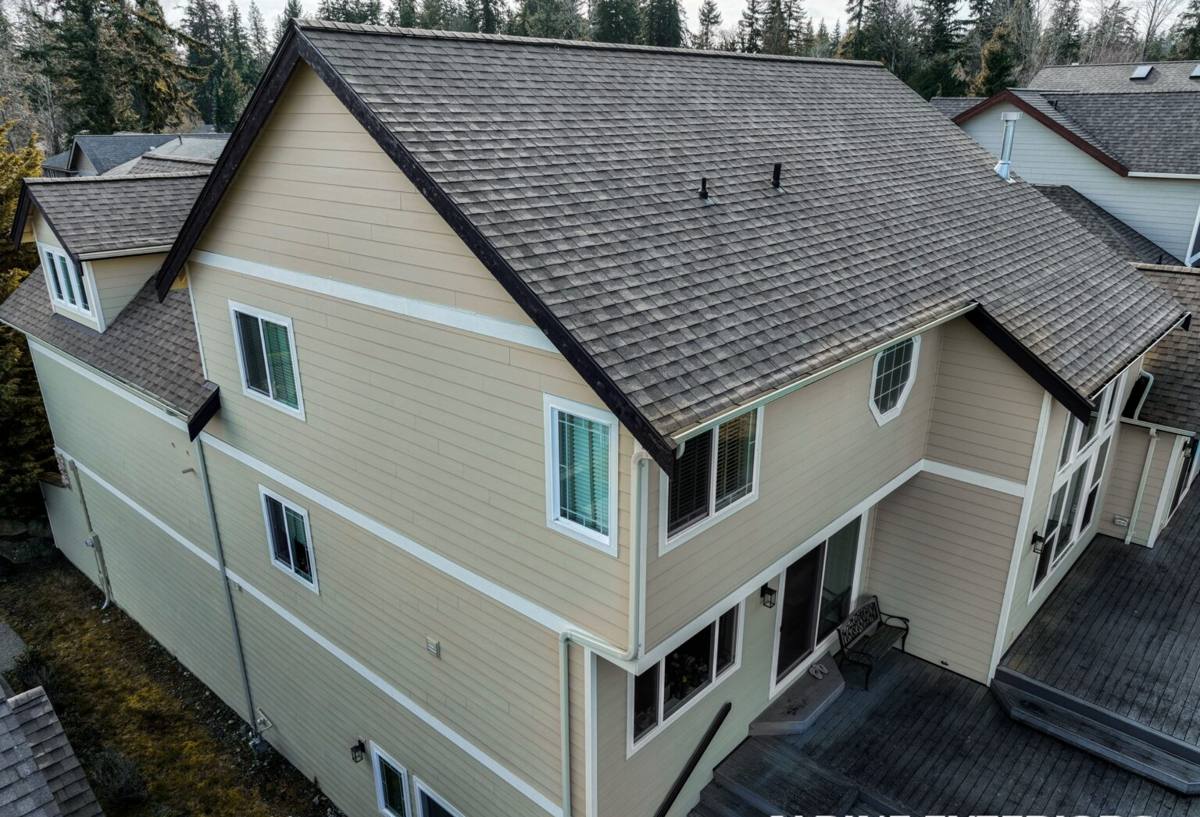
What Semiahmoo's Climate Actually Does to a Window Assembly
Whatcom County's marine west coast climate means moisture is a year-round condition, not a seasonal one. A Semiahmoo build adds three things on top of that baseline:
- Salt air: Proximity to Semiahmoo Bay and Drayton Harbor accelerates corrosion on unprotected fasteners, cheap hardware, and lower-grade cladding. Metal components that would last decades a few miles inland can start showing pitting and staining much sooner right on the water.
- Wind-driven rain: Open water exposure means rain doesn't just fall — it gets pushed sideways into wall assemblies, which puts real pressure on flashing details that a sheltered lot would never test.
- Moss and organic growth season: Long damp stretches let moss and algae get a foothold on north- and shaded-side surfaces, including window sills and trim, if drainage and airflow aren't planned for at install.
None of this means a Semiahmoo home needs exotic materials. It means the window selection and installation details need to assume sustained moisture and airborne salt as normal conditions, not worst-case ones.
Corrosion-Resistant Hardware Isn't Optional Here
Window hardware, hinges, and fasteners that carry a standard residential warranty inland can underperform in a direct-water-exposure setting. On Semiahmoo builds we spec stainless or coated fasteners and hardware rated for coastal or marine exposure, and we flag any window line that only offers standard-grade hardware as an option before it goes into the opening — not after it's caulked in.
New Construction vs. Replacement: Why the Install Sequence Is Different
On a replacement job, the wall is already built, the siding is already on, and the window has to work with what exists. New construction flips that: the window opening, the weather-resistive barrier (WRB), the flashing, and the siding all get built around the window in a specific sequence — and that sequence is what determines whether the assembly sheds water correctly for the next 30-plus years.
Get the sequence wrong on new construction and you don't get a leak next winter — you get a leak in five or ten years, after moisture has already been working its way into the sheathing and framing behind trim that looks fine from the outside. That's the real argument for doing it right the first time on a new build: there's no easy way to inspect it again once the walls are closed up.
Choosing the Right Window for a Semiahmoo Build
Material choice matters more on an exposed coastal lot than it does a few miles inland. Here's how the common options stack up for this specific setting:
| Material | Coastal/salt-air behavior | Maintenance | Typical fit for Semiahmoo |
|---|---|---|---|
| Vinyl | Won't corrode; UV and thermal cycling are the main long-term concerns | Low | Solid, budget-friendly choice for most new builds |
| Fiberglass | Very stable dimensionally, good match for expansion/contraction near water | Low | Strong option where wind exposure and temperature swings are higher |
| Aluminum-clad wood | Clad exterior resists weather but any breach exposes wood beneath — cladding integrity is critical | Moderate | Works if detailing and gutters keep water off the clad surfaces consistently |
| Bare aluminum | Prone to pitting and corrosion in salt air without upgraded finishes | Higher | We steer builds away from this on direct-exposure lots |
Beyond material, the two performance numbers that matter most for a Whatcom County build are U-factor (heat loss) and SHGC, solar heat gain coefficient. Given our overcast, moderate climate, we're generally optimizing for a lower U-factor to hold heat in rather than blocking solar gain — the opposite priority from a hot, sunny climate. Washington's energy code sets minimum performance requirements for new construction, and we confirm the specified windows meet or beat those numbers before they're ordered, not after.
Flashing and Water Management — Where New Construction Is Won or Lost
This is the part of the job that doesn't show up in the finished photos and matters the most. On a Semiahmoo build, wind-driven rain means every flashing lap and every termination point has to assume water will reach it, not just that it might.
The sequence we follow on a new-build rough opening:
- Sill pan flashing installed first, sloped to drain outward, so any water that gets past the window has somewhere to go besides the framing.
- Window set into the opening, checked for level, plumb, and square before a single fastener goes permanent.
- Side and head flashing integrated in proper shingle-lap order with the WRB — each layer overlapping the one below it, never the reverse.
- Head flashing or drip cap detail set to kick water away from the top of the window, not let it run down the face of the wall and pool at the frame.
- Sealant used at the right joints only — over-sealing a window can trap moisture just as badly as under-sealing it lets water in.
Skipping or reordering any of these steps is the single most common cause of hidden water damage in new construction, and it's very hard to catch after the siding goes on. It's also the reason experience on this specific type of lot matters more than experience in general.
Our Process on a Semiahmoo New-Build
We work new-construction windows in from rough opening to final trim, coordinated with your framing and siding schedule:
- Review the window schedule and specs against the site's exposure before anything is ordered — flagging any product or hardware grade that's a poor match for direct water and salt exposure.
- Verify rough openings against manufacturer specs before install day, so there's no last-minute framing scramble.
- Install sill pan flashing, set and shim the window, and integrate flashing with the WRB in the correct lap sequence.
- Check level, plumb, square, and operation (open/close/lock) on every unit before moving to the next.
- Document the flashing details at each opening while the wall is still open — useful for your own records and for any future work on the home.
- Coordinate timing with your siding and trim crews so windows aren't sitting exposed longer than necessary once they're set.
Working With Your Builder or GC
Most of our new-construction window work happens as a sub on someone else's build schedule, and we're used to fitting into that. We show up on the framing timeline the GC sets, flag any rough-opening or spec issues before they become change orders, and communicate directly with the builder on sequencing so window install doesn't become the bottleneck holding up siding or interior work. If you're an owner-builder managing your own trades on a Semiahmoo lot, we can walk you through the sequencing so you know what needs to happen before we show up and what can wait until after.
Code, Egress, and Energy Requirements
New construction in Whatcom County has to meet current Washington State Energy Code performance minimums, and bedroom windows have to meet egress requirements for emergency escape — minimum opening size, sill height, and clear opening dimensions. These aren't areas where "close enough" passes inspection, and getting them wrong after the wall is framed means cutting the opening again. We check egress sizing and energy code compliance against the actual window specs before install, not after the inspector flags it.
Why a Crew That Already Works Semiahmoo Matters
A window installer who mostly works sheltered inland lots in Whatcom County can do a technically fine job and still miss the details that matter on a direct-exposure site — the flashing lap that needs to be more generous because the wind pushes rain sideways here, the hardware grade that needs an upgrade because of the salt air, the drainage detail that keeps moss from taking hold on a shaded sill. None of that is exotic knowledge, but it only comes from having actually installed windows on lots like this one before. That's the difference between a window install that looks right on day one and one that's still performing correctly in fifteen years of Semiahmoo weather.
If you're building on Semiahmoo or elsewhere around Blaine and want the window package looked at before it's ordered, we're happy to walk the plans with you and give you a straightforward, no-pressure estimate — just fill out the form below.