 Blaine
 Why Nooksack Siding Wears Differently Than Siding Inland
Nooksack sits close enough to the Strait of Georgia and Semiahmoo Bay that homes here deal with a combination of stresses that inland Whatcom County houses simply don't see as often: salt-laden air, driving rain that comes in sideways off Puget Sound weather systems, and a moss season that can run eight or nine months out of the year under the tree cover common to this area. None of these factors alone is unusual for Western Washington. Together, on the same wall, over enough winters, they add up to specific and predictable failure patterns in siding — and that's what a repair crew working this area needs to actually understand, not just patch over.
Salt air accelerates corrosion on fasteners, flashing, and any exposed metal trim. Driving rain finds every gap in caulking, every under-lapped joint, and every spot where old paint has failed, and pushes water behind the siding instead of shedding it. Moss and algae hold moisture against the surface long after a storm has passed, which keeps wood-based products wet for days at a time even in a light drizzle. A repair that doesn't account for all three is a repair that fails again within a couple of seasons.
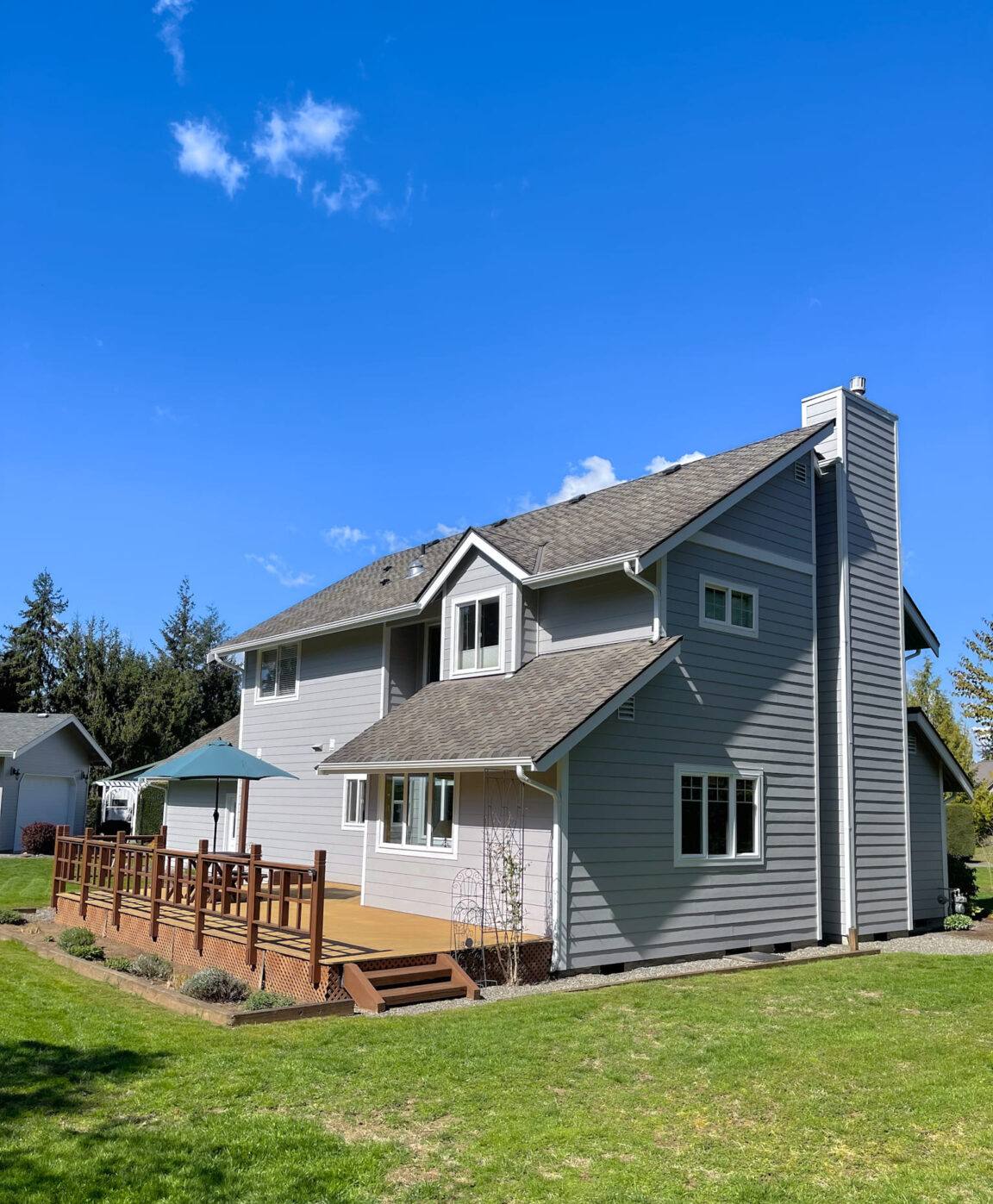
What Typically Goes Wrong on Nooksack Homes
Moisture Intrusion at Joints and Penetrations
The most common repair call we get in this area isn't dramatic — it's water finding its way in at butt joints, around window and door trim, at corner boards, or where siding meets a deck ledger or utility penetration. Once water gets behind the cladding, it doesn't dry out quickly in our climate. That leads to soft sheathing, staining, and eventually siding that's separating from the wall.
Moss and Algae Growth
Whatcom County's tree canopy and persistent damp keep a lot of Nooksack properties in shade for large parts of the day, which is exactly what moss needs to establish. On older wood or engineered-wood siding, moss roots into the surface and holds water against it constantly. On fiber cement, moss stays on the surface and can be washed off without damaging the material underneath — a meaningful long-term difference we'll get into below.
Fastener and Flashing Corrosion
Salt-influenced air corrodes standard fasteners and unprotected metal flashing faster than it would twenty or thirty miles inland. Rust streaks below nail heads or at flashing seams are a visible early warning sign, and they usually mean the fastening system needs to be addressed, not just the visible siding panel.
Paint and Finish Failure
Field-applied paint on siding in this climate has a shorter realistic lifespan than most homeowners expect, especially on south- and west-facing walls that take the brunt of driving rain. When paint fails, the substrate underneath is exposed to exactly the moisture cycle described above, and deterioration speeds up fast.
What a Correct Repair Actually Involves
A siding repair that's done right isn't just about matching the new piece to the old one. It starts with figuring out why the damage happened in the first place, because replacing a panel without fixing the underlying cause just buys a year or two before the same spot fails again.
- Remove the damaged siding and inspect the underlying weather-resistive barrier (house wrap) and sheathing for moisture staining or soft spots
- Confirm flashing at windows, doors, and any wall penetrations is intact, properly lapped, and directing water outward, not behind the cladding
- Check and correct any past installation issues — siding installed too close to grade, missing kick-out flashing, gaps in caulking, or fasteners driven at the wrong depth
- Replace deteriorated sheathing or framing if moisture has already caused rot, rather than covering it back up
- Install replacement siding that matches the existing material's profile and reveal, with proper overlaps and clearances
- Re-seal and re-caulk joints with a product rated for this climate, not a generic all-purpose caulk
- Verify the repaired section sheds water correctly before calling the job finished
Skipping the inspection step is the single biggest reason repairs don't last. A new piece of siding over a wet, rotting wall is a cosmetic fix, not a repair.
Why the Siding Material Matters for Repair Longevity
What the siding is made of has a direct effect on how often you'll be calling a contractor back out. This is worth being honest about, because it's the reason we've standardized on one product for every home we work on.
| Material | Behavior in Salt Air / Rain / Moss | Repair Frequency |
|---|---|---|
| Untreated or primed wood | Absorbs moisture, swells, and rots where paint fails; moss roots into the surface | Frequent, ongoing maintenance |
| Vinyl siding | Doesn't rot, but warps and becomes brittle with UV and temperature swings; seams are a common water entry point | Occasional, but full panel replacement is often the only fix |
| Engineered wood (e.g. LP SmartSide) | Better moisture resistance than raw wood, but edges and cut ends remain vulnerable if not fully sealed and maintained | Moderate, dependent on maintenance discipline |
| James Hardie fiber cement | Non-combustible, doesn't absorb water the way wood-based products do, moss stays on the surface and rinses off | Low, when installed correctly |
We only install James Hardie fiber cement siding, and jobs like this are exactly why. Fiber cement doesn't swell, delaminate, or rot the way wood-based products can when they take on repeated moisture. Hardie's factory-applied ColorPlus finish is also baked on under controlled conditions, which holds up to driving rain and UV exposure far longer than most field-applied paint — meaning fewer repaint cycles and fewer chances for finish failure to expose the substrate underneath.
Repair vs. Replacement: How to Tell Which You Need
Not every damaged section needs a full re-side, and not every homeowner needs to hear "you should replace the whole thing" from a contractor who'd rather sell a bigger job. The honest answer depends on how widespread the damage is and what's causing it.
- Repair is usually the right call when damage is isolated to one or two wall sections, the underlying sheathing tests dry, and the rest of the siding is sound and properly finished.
- Replacement becomes the more honest recommendation when moisture damage shows up in multiple unrelated areas, when the siding material itself (not just the installation) is the source of the problem, or when repeated past repairs haven't solved a recurring leak.
- A mixed approach — repairing sound sections while replacing the material on chronically wet elevations — is sometimes the most cost-effective path, particularly on homes with heavy shade or exposure on one side only.
How Our Process Works for Nooksack Repairs
We start with an on-site inspection, not a phone estimate, because siding damage in this climate is rarely as simple as it looks from the driveway. We check moisture levels at the affected area and surrounding sections, look at flashing and drainage details, and identify whether the cause is installation-related, material-related, or just age and exposure catching up with the wall.
From there we give a straight recommendation — repair, partial replacement, or full re-side — along with what we found and why. If repair is the right call, we match materials as closely as reasonably possible and address the underlying cause, not just the visible symptom. If the existing siding is a material we don't install, like vinyl or engineered wood, we'll still tell you honestly whether a repair makes sense or whether you're better off planning for a Hardie replacement down the line.
What to Check Before You Call
- Soft or spongy spots when you press on the siding
- Visible gaps, cracks, or separation at panel joints
- Dark staining or streaking below trim, flashing, or fastener heads
- Moss or algae buildup, especially on shaded or north-facing walls
- Peeling, bubbling, or chalky paint
- Any musty smell or visible mold on interior walls that back up to exterior siding
Maintenance Between Repairs
Whatever siding is currently on a Nooksack home, a few habits extend its life and cut down on repair calls. Keep gutters clear so water isn't overflowing onto siding below. Trim back vegetation and tree cover where practical to reduce shade and moss growth. Rinse moss and algae off with a garden hose and soft brush rather than a pressure washer, which can force water behind siding joints. And walk the exterior once or twice a year, especially after winter storms, to catch small issues — a cracked caulk line, a loose piece of trim — before they become water damage.
Why Local Experience Matters for This Kind of Repair
A contractor who mostly works drier, inland areas can miss the specific patterns that show up in coastal Whatcom County. Moss growth rates, the direction driving rain typically hits a wall, how quickly bare fasteners corrode near the water — these are things you learn by working houses in this exact area over multiple wet seasons, not by reading a general siding manual. Working repairs throughout Blaine and nearby communities like Nooksack means we're not guessing at what causes damage here; we're seeing the same failure patterns repeatedly and know what actually fixes them for good.
If you're seeing signs of moisture damage, moss buildup, or failing siding on a Nooksack home, we're happy to come take a look. The estimate is free, there's no pressure to sign anything on the spot, and you'll get a straight answer about whether you need a repair, a partial replacement, or nothing at all yet.